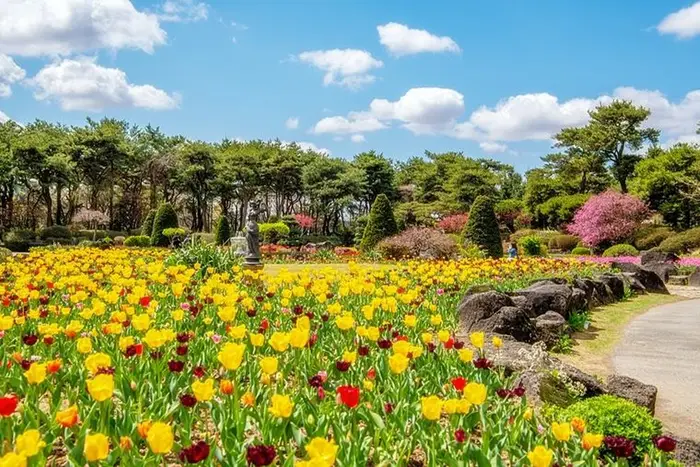
An Unenviable Course to Enjoy in Any Season with Anyone
7 stops · Approx. 3 hours 30 minutes
A travel route spanning Paju-si, Yeoncheon-gun, and Cheorwon-gun, offering everything from botanical gardens brimming with diverse flora to vast fields of kochia turning vibrant red in autumn! Splendid, colorful landscapes unfold no matter which season you visit.
- Duration
- Approx. 3 hours 30 minutes
- Distance
- Approx. 160 km
Along the way
- 1Byukchoji Gardens
벽초지수목원
Byukchoji Gardens is a botanical garden that harmoniously brings together 27 Eastern and Western gardens like a single painting, themed around excitement, myth, adventure, freedom, contemplation, and emotion. Centered on the Space of Excitement in the middle of the arboretum, Eastern-style gardens are situated around Byukchoji Pond on the left, while Western-style gardens begin past the Malis Castle Gate on the right. With approximately 1,000 plant species, the gardens' seasonal transformations are captured in dozens of movies, commercials, music videos, and dramas each year, including ''The Handmaiden'', ''Devilish Charm'', ''Hotel Del Luna'', and ''The Return of Superman''. In addition, most of the walking trails and gardens are built on flat ground, making it easy and comfortable for visitors of all ages to explore.MoreLess
- 2Majanghosu Suspension Bridge
마장호수 출렁다리
This romantic destination is perfect for weekend outings for families and couples, featuring well-maintained parks, fountains, benches scattered throughout for resting, a Sky Staircase full of wild flowers, water leisure sports (canoeing, kayaking) for added fun, and a scenic lake trail. Flanked by mountains and the lake, the beautiful harmony of shimmering waters, stunning sunsets, surrounding tree groves, and lush green mountains makes it a representative natural attraction of Paju where visitors can escape daily stress and enjoy a relaxing break in nature's embrace.MoreLess
- 3
Paju Jangdankong Village
파주 장단콩마을
Jangdankong Village is a slow food experience village formed as an agricultural corporation by local residents dedicated to preserving and sharing native Korean soybeans and agricultural products. The village holds the Jangdan Soybean Festival annually, and the cultivated land in the Jangdan area reaches about 200,000 pyeong per year. It yields approximately 1,500 sacks (70 kg each), of which 1,000 are processed into soybean paste (doenjang) and rich fermented soybean paste (cheonggukjang) for sale, while 500 sacks are sold directly online and during the Jangdan Soybean Festival. Various hands-on activity programs are available at Jangdankong Village.MoreLess
- 4Jeongok Prehistory Musuem
전곡선사박물관
Jeongok Prehistory Musuem is a specialized museum built on the Paleolithic site in Jeongok-ri, the historic location where the first Acheulean-type hand axe in East Asia was discovered, rewriting the global history of Paleolithic research. Centered on Paleolithic artifacts such as Acheulean hand axes excavated from the Jeongok-ri site, the exhibition space is organized across diverse themes to offer a systematic understanding of human evolution and Paleolithic culture.MoreLess

- 5
Imjingang Kochia Park
임진강댑싸리공원
Imjingang Kochia Park is a landscaped park spanning about 30,000 ㎡ in front of the Samgot-ri Stone-mound Tomb in Yeoncheon, where approximately 20,000 kochia plants have been planted. Along with kochia, visitors can admire various other flowers such as yellow cosmos, chrysanthemums, zinnia, globe amaranth, marigolds, Madagascar periwinkle, and canna. Carrying the floral meaning of 'humility and pure beauty,' the kochia begins to turn reddish in late August and transforms into pink, red, and orange in early September, creating an exotic atmosphere. Located near Seoul, Imjingang Kochia Park is ideal for a day trip where families and couples can quietly enjoy nature and snap unforgettable photos. Nearby attractions such as Taepung Observatory and Gunnam Flood Control Reservoir Crane Theme Park can also be visited. ※ Pets allowed (Only permitted for visitors who keep their dogs on a leash and carry plastic bags for pet waste cleanup)MoreLess
- 6
Soisan Mountain
소이산
Soisan Mountain is a 362-meter-high small mountain rising above the plains, boasting magnificent summit views overlooking untouched nature and expansive fields. As home to the No. 1 Beacon Station that signaled foreign invasions since the Goryeo Dynasty, it stands at the heart of Cheorwon's history, preserving the memory of the vibrant old Cheorwon before the Korean War. In addition, the Soisan Ecological Forest Green Trail has been created. For decades, Soisan Mountain had been inaccessible to the public, enclosed by minefields and civilian control zones. However, through extensive consultations and active cooperation with the Army's 3007th Unit (6th Infantry Division), the military, government, and private sector united to open the current trail. Fences installed in consideration of mine safety and regional characteristics blend with the dense natural forest, and the pristine natural ecosystem offers profound peace of mind to visitors. (Source: Cheorwon Culture & Tourism)MoreLess
- 7Goseokjeong Flower Field
고석정 꽃밭
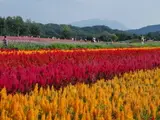
This flower field is located near Goseokjeong Pavilion, Cheorwon's representative tourist attraction. Colorful flowers in shades of red, yellow, and purple—including cockscomb, sunflowers, kochia (bassia scoparia), Gujeolcho (Siberian chrysanthemum), buckwheat flowers, zinnia, and globe amaranth—showcase their unique beauty. Wherever you take a photo, you are guaranteed clear and gorgeous pictures.MoreLess
Source: Korea Tourism Organization (TourAPI) · Machine-translated