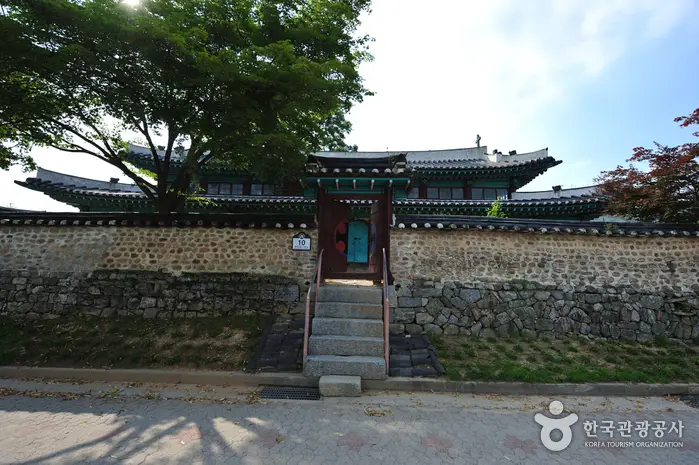
Day Trip Travel Course to Ganghwa near Seoul
5 stops
Here is a day trip course for those who wish to travel around peaceful Ganghwado Island near Seoul. This Ganghwado itinerary allows you to enjoy Geumpung Brewery for a makgeolli experience, the Historic Site-designated Anglican Church of Korea Ganghwa Cathedral, and the historic Jeondeungsa Temple.
Along the way
- 1
Geumpung Brewery
금풍양조장
Geumpung Brewery carries a living tradition passed down through three generations. Spanning three generations from Yang Hwan-tak to Yang Jae-hyeong and Yang Tae-seok, it represents the history of traditional Ganghwado liquor. Its 100-year-old makgeolli is crafted using Ganghwado Island's finest eco-friendly rice as the raw ingredient, striving toward premium quality and scientific brewing. In 2021, Geumpung Brewery obtained Ganghwado's first regional specialty liquor (takju, yakju) license, moving forward toward the goals of consuming local ingredients and globalizing liquor production. Distinctively, it is drawing fresh attention by producing packaging upcycled from rice sacks.MoreLess
- 2
Anglican Church of Korea Ganghwa Cathedral
대한성공회 강화성당
Ganghwa Anglican Church was consecrated in 1900 by the first bishop, Charles John Corfe, and was named the Church of Saints Peter and Paul. The construction at the time was led by a royal master carpenter, and although several renovations have taken place since, its original appearance is well preserved. The site of the church was shaped like a ship to clearly convey the meaning of an ark saving the world. The church building features a rectangular (4 bays wide, 10 bays long) multi-story structure. While the overall architectural style follows traditional Korean architecture, the layout and interior design apply Western basilica architectural styles to reveal the beauty of harmony and the indigenous spirit. First designated as a Local Tangible Cultural Heritage of Gyeonggi-do in 1981, it was reclassified as an Incheon Tangible Cultural Heritage when Ganghwa-gun was incorporated into Incheon Metropolitan City, and was subsequently designated as a National Historic Site in January 2001.MoreLess
- 3
Ganghwa Jeondeungsa Temple
강화 전등사
As the oldest temple in Korea, it is also the largest temple on Ganghwado Island. Blending harmoniously with the mountain, it offers distinct charms in every season, and it is especially pleasant for a light hike while taking in the yellow-dyed ginkgo trees and autumn foliage. In the basement, there is a modern-style Dharma hall called Museoljeon and the Seoun Gallery, where Buddhist art exhibitions are held regularly. It has recently gained attention after being selected as a Korea Unique Venue and a wellness tourist destination, making it a highly recommended place to explore while taking in the autumn atmosphere.MoreLess
- 4
Gyodongdo Daeryong Market
교동도 대룡시장
Daeryong Market is an alley market created by residents who briefly evacuated to Gyodongdo Island from Yeonbaek-gun, Hwanghae-do during the Korean War. When the mouth of the Hangang River became the division line and prevented them from returning home, they recreated the Yeonbaek Market from their hometown to make a living. It served as the center of Gyodongdo Island's economic development for some 50 years. Today, most of the displaced elders who founded the market have passed away, and as the population has sharply declined, the scale of the market has significantly decreased as well. However, with the opening of Gyodongdaegyo Bridge in July 2014, Daeryong Market, which resembles a 1960s movie set, became a must-visit destination for tourists looking to capture its vintage scenes on camera. Since late March, the Gyodong GiGA Island (also known as "Gyodong Swallow's Nest") has been in operation, providing tourists with IT-based tourist information, bicycle and smartwatch rentals, and various experiential programs such as 'VR video experience' and 'Gyodong Newspaper making'.MoreLess
- 5Ganghwado Jejeokbong Peace Observatory
강화도제적봉 평화전망대
The Ganghwa Peace Observatory opened on September 5, 2008, featuring one basement floor and four aboveground floors in the woodland north of the Civilian Control Line in Cheolsan-ri, Yangsa-myeon, where public access had been strictly restricted since late 2006. It was built so visitors could closely observe and compare North Korea's unique culture and ecology, which are difficult to view from other regions. The basement and 4th floor are facilities exclusively for military personnel. The 1st floor includes a souvenir shop selling local specialties of Ganghwa and North Korea, a restaurant, an administrative office, a unification prayer room, and a lounge. The 2nd floor houses high-powered binoculars and an exhibition hall showcasing the tragedy and remnants of war. The 3rd floor features an observation facility overlooking North Korean land, providing a panoramic view of the mountains and rivers of the North up close, along with a screen facility that presents scenic videos of North Korea even on cloudy days. The exhibition hall on the 2nd floor offers facilities where visitors can learn about Ganghwa's national defense experience, North Korean provocations, and military comparisons between South and North Korea in "The Unfinished War and We Are One Nation"; experience a journey to North Korea in "The Road to Unification"; and watch video presentations detailing the background of the Korean War, the domestic and international outbreak process, and the unforgettable hardships suffered ever since. From the North Korean land viewing room, visitors can look across the coast about 2.3 km ahead to see the Yeseonggang River, Gaeseong Industrial Complex, the confluence of the Imjingang and Hangang Rivers, Gimpo Aegibong Observatory, Paju Odusan Unification Observatory, Ilsan New Town, the planned site of the neutral Nadeulseom Island, everyday scenes of North Korean residents, propaganda model villages, the Gaeseong Industrial Complex tower, Mt. Songaksan, and various defense obstacles.MoreLess
Source: Korea Tourism Organization (TourAPI) · Machine-translated