Haeparang Trail (Goseong and Sokcho Section)
9 stops · 3+ nights
The Haeparang Trail is South Korea's longest walking trail, covering a total of 750 km starting from Oryukdo Island in Busan. Let's walk the northernmost section of the Haeparang Trail in Goseong and Sokcho. Courses 48 and 49 of the Haeparang Trail include the Castle at Hwajinpo and the Baekseom Marine Observatory, where you can watch a beautiful sunrise. Featuring villas where Kim Il-sung and Rhee Syngman once stayed, this course vividly illustrates the divided history of Korea. Course 47 leads through Seonangbawi Rock, which resembles a human profile, toward Wanggok Village, home to traditional houses with a unique "yangtongjip" structure found only in northern Gangwon-do. On Course 46, you can sit and contemplate at Neungpadae, where surging waves crash against the rocks, and take a stroll to Jangsahang Port. Course 45 is a single course within Sokcho. It includes Yeongnangho Lake, where the Silla Hwarang warrior Yeongrang was captivated by the crouched Beombawi Rock and stayed, Yeonggeumjeong, where you can face the sea after crossing a roughly 50-meter footbridge, and Cheongchoho Lake, known for its sparkling night views.
- Duration
- 3+ nights
- Distance
- 36.1km
Along the way
- 1Castle at Hwajinpo
김일성 별장
From 1948 to 1950, Kim Il-sung visited Hwajinpo as a summer vacation spot with his family, including his wife Kim Jong-suk, his son Kim Jong-il, and his daughter Kim Kyong-hui. A photograph taken in August 1948 showing six-year-old Kim Jong-il with his arm around the shoulder of the son of Soviet Major General Lebedev at the villa entrance proves this. The Castle at Hwajinpo was originally built in 1938 by Weber, an exiled German architect, for the missionary Sherwood Hall and his wife. Built as a stone building with one basement floor and two above-ground floors, it displayed considerable luxury for the architecture of the time. The Castle at Hwajinpo displays replica exhibits of various relics, including a parlor set used by Kim Il-sung's family, as well as photographic materials depicting the villa's past. Located at the foot of a coastal mountain, the villa was built just after the liberation and was frequently used by Kim Il-sung, his son Kim Jong-il, and his daughter Kim Kyong-hui until the Korean War. Originally a stone structure with one basement level and two above-ground levels, it was heavily damaged during the war. In 1964, the army demolished the original structure and rebuilt it into the single-story building seen today. An essential highlight of the scenery at the Castle at Hwajinpo is Geumgudo, a rocky islet facing the villa. Located about 300 meters from Hwajinpo Beach, Geumgudo resembles a turtle, and in autumn, the bamboo forest growing on the island turns yellow, coloring the entire island in gold. While the Castle at Hwajinpo is located on a coastal hill overlooking the East Sea, the Rhee Syngman Villa is situated in a spot overlooking only Hwajinpo Lake without a view of the sea, located about 1 km away from each other.MoreLess
- 2
Baekseom Marine Observatory
백섬해상전망대
Built from March 2019 to October 2020 as part of the Geojinhang Fishing Village Tourism Experience Village project, it opened to tourists on October 30, 2020. With a total length of 137 m and a height of 4 to 25 m, it connects the coastal road with Baekseom Island (Baegamdo Island). Walking over the beautiful East Sea, visitors can take in views of Haegeumgang and Geumgudo to the north, and a magnificent panorama of Geojin Port and Geojin 11-ri Beach to the south. A portion of the 25-meter-high observatory features a transparent tempered-glass floor. It is an ocean deck connecting Baekseom Island (Baegamdo Island), located at Geojin Dwijjang, to the coastal road, measuring 137 m long, 2.5 m wide, and 4 to 25 m high. Ascending the marine observatory offers beautiful views of the East Sea, Haegeumgang, Geumgudo, and Geojin Port.MoreLess
- 3Goseong Wanggok Village
고성 왕곡마을
Located north of Songjiho Lake, Wanggok Traditional Village is a must-visit destination when traveling for summer vacation to the northern coast of Gangwon-do. Although it is only 1.5 km from the beach, curiously, the sound of waves cannot be heard in the village because five mountain peaks surround its perimeter. Thanks to being encircled by these mountains, most of the houses were able to avoid bombing during the Korean War. As a result, the old houses have been preserved intact to this day, retaining the atmosphere of a traditional village. While it is neither as large as Andong Hahoe Village or Suncheon Naganeupseong Walled Town nor filled with grand houses, stepping into the village gives the feeling of embarking on a journey back in time. At the entrance of the village, around ten large old pine trees over 150 years old stand beside a large information board, welcoming travelers with their pine scent. The village is home to 50 households, with 32 tile-roofed houses and 9 thatched-roof houses. Ham Seung-bon, who runs a pure buckwheat noodle restaurant in Wanggok Village, explains, "This neighborhood was not particularly wealthy, but there were quite a few tile-roofed houses because there was a tile kiln in the further inland village of Guseong-ri." The tile-roofed houses here feature the unique architectural layout of northern Gangwon-do, where rooms, wooden verandas, kitchens, and barns are all connected under one roof. This layout is typical of regions with long, cold winters. The Yanggeun Ham clan resides in the upper part of the village, while the Gangneung Choe clan resides in the lower part, with slightly more Ham households than Choe households. Additionally, there are two Jeon households, two Kim households, and one Park household. It is also a filial village featuring two filial piety pavilions (hyojagak). Retaining its antique atmosphere, the village has frequently served as a filming location for TV dramas and movies. Many anti-communist films and literary TV programs, including 'TV Literature - Skate', were filmed here. Villagers even boast about their past experiences as extras. The main occupation of the Wanggok Village residents is rice farming, cultivating paddies ranging from about 3,300 m² to 33,000 m². Up until four years ago, they grew a lot of potatoes, but due to a lack of sales channels, they now cultivate only enough for family consumption. Due to coastal winds and significant daily temperature fluctuations, dry-field grains do not grow well, so they even cultivate upland rice in their fields. Nearby beaches to visit after touring Wanggok Village include Songjiho, Sampo, and Baekdo beaches. In particular, Jajakdo Beach, located between Baekdo and Sampo beaches, is a summer resort that has only recently gained renown. Although its beach length is relatively short for an East Coast beach at around 400 m, it curves deeply inland like a bow and has shallow waters, with guesthouse owners proudly noting there has never been a drowning accident. Even walking 100 meters out into the sea, the water reaches only an adult's chest. Since being recognized as a family-friendly summer getaway, several condo-style guesthouses have recently opened along the beach. Since 2004, the "Goseong Wanggok Village Folk Experience Festival" has been held in mid-October, allowing families to enjoy a journey into the past together.MoreLess
- 4
Seonangbawi Rock on Songjiho Coast (Gangwon Peace Geopark)
송지호 해안 서낭바위 (강원평화지역 국가지질공원)
Seonangbawi Rock is a rocky coast developed in the granite area south of Songjiho Beach, forming a very unique landscape through the interplay of granite micro-weathering landforms and wave erosion. In particular, thick felsic dike rocks intrude through the granite layers, creating a distinctive landscape. The name Seonangbawi originates from the presence of a seonangdang (shrine to the village tutelary deity) in Oho-ri Village. A seonangdang is a sacred space of traditional Korean folk belief where a seonangshin (village guardian deity) is enshrined, and the area around it has long been a place where taboos against careless digging or demolition were strictly observed.MoreLess
- 5
Neungpadae (Gangwon Peace Geopark)
능파대 (강원평화지역 국가지질공원)
Neungpadae is a large-scale colony of tafoni developed on a rocky coast that forms a land-tied island (tombolo). The name Neungpadae, meaning "a stone island that surmounts the waves," was given in comparison to the sight of surging waves striking the rocks. A land-tied island refers to an island connected to the mainland by accumulated sand, while tafoni refers to honeycomb-like clusters of cavities hollowed out on the rock faces. Neungpadae originally existed as an island (reef) where bedrock (granite) was exposed off the coast of Munam Beach, but sand supplied by Munamcheon Stream accumulated behind the island, where wave action was diminished, connecting it to the mainland. However, a port in Munam 2-ri has now been built along the southern boundary of Neungpadae, and a settlement has been established on the tombolo spit connecting the island to Munam Beach, making the original form of the land-tied island virtually unobservable.MoreLess
- 6Jangsahang Port
장사항
Jangsahang Port is a small fishing port located in Jangsa-dong, Sokcho-si, featuring a 90-meter breakwater, a 144-meter sand-arresting groin, a 130-meter landing pier, and around 30 fishing boats, making it a typical fishing village. With around 50 raw fish restaurants and live fish markets in the surrounding area, it is ideal for enjoying fresh sliced raw fish. It is also an optimal spot to enjoy sea fishing, as boat-fishing grounds are located nearby. A festival where visitors catch squid with their bare hands is held here every year during the summer vacation season, adding refreshing fun.MoreLess
- 7Yeongnangho Lake
영랑호
Yeongnangho Lake is a natural lagoon formed by the development of coastal sand dunes. It is wide and deep, with a circumference of 7.8 km, an area of about 1.2 km², and a water depth well exceeding 8 meters. Water flowing from Jangcheoncheon Stream connects to the East Sea through a waterway beneath Yeongranggyo Bridge. Surrounded by Jangsa-dong, Yeongnang-dong, Dongmyeong-dong, and Geumho-dong in Sokcho-si, it has well-maintained walking paths along the lakeside. Following the walking path reveals a lyrical and beautiful landscape where a clear, calm lake blends with cherry blossoms, royal azaleas, and reeds. According to the Samguk Yusa (Memorabilia of the Three Kingdoms), Yeongnangho Lake is said to take its name from the Silla Hwarang warrior Yeongrang. On his way to a martial arts competition after completing his training at Geumgangsan Mountain, Yeongrang passed this lake and was so captivated by its magnificent scenery that he forgot about the competition and stayed here for a long time. Yeongnangho Lake boasts such outstanding scenery that it is recorded in ancient records. In particular, Beombawi Rock, one of the Eight Scenic Views of Sokcho, elicits admiration from all who see it. It emanates a mystical aura as if a tiger were quietly crouching. Gwaneumam Rock, where various strangely shaped rocks are clustered, and Bogwangsa Temple are also must-see sights. The wetland ecological park on the western side of the lake is also worth a visit. [Main Facilities & Amenities] Yeongnang Lake Park [Experience Programs] SightseeingMoreLess
- 8Yeonggeumjeong
영금정
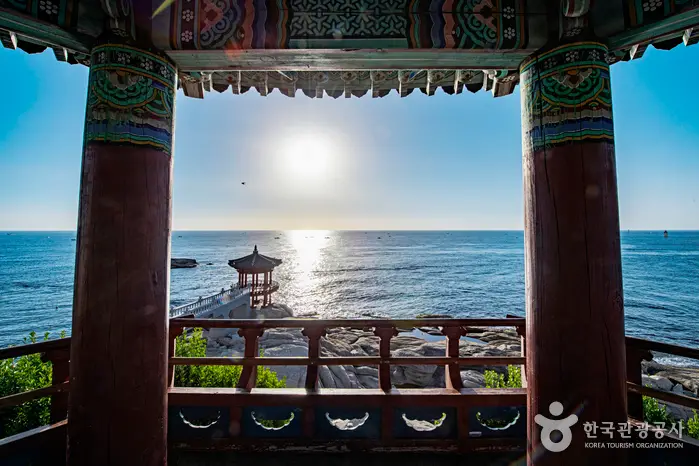
Yeonggeumjeong is a place where large, wide flat rocks spread across the seashore beneath the Sokcho Lighthouse in Dongmyeong-dong, Sokcho-si. The name comes from the fact that the sound of waves hitting the rocks produces a mysterious melody, which was said to resemble the mystical sound of a geomungo (traditional Korean zither). Located close to downtown with outstanding scenery, it is a place where Sokcho residents enjoy summer retreats and fishing throughout all four seasons. Sokcho-si has developed the Yeonggeumjeong area into a tourist destination and constructed an actual pavilion near the southern breakwater. This marine pavilion is built atop the rocks of Yeonggeumjeong and can be reached by crossing a footbridge of about 50 meters. Looking out at the ocean from the marine pavilion offers a refreshing feeling distinct from the breakwater, though the pavilion itself is a somewhat plain concrete structure. It is commonly called the Sunrise Pavilion (Haedodijeong), but the signboard of the pavilion bears the inscription Yeonggeumjeong (靈琴亭).MoreLess
- 9Cheongchoho Lake
청초호
Stretching across the center of Sokcho-si, Cheongchoho Lake is a large natural lagoon with a circumference of 5 km and an area of 1.3 km². The Cheongchocheon Stream, originating near Misiryeong in the Taebaek Mountains, reaches the East Coast to form a beautiful lake before flowing into the adjacent sea. It looks like an intermediate staging area linking the river to the ocean. Cheongchojeong Pavilion is built over the lake, allowing visitors to enjoy views of Seoraksan Mountain and the East Sea. Located at the end of a marine pedestrian bridge measuring approximately 75 meters, it gives the feeling of being right in the middle of the lake. Standing here, the entire panorama of the lake can be taken in at a glance. Cheongchojeong shines even more at night, ranking as one of the top night-view spots in Sokcho. Sculptures of the Blue Dragon and Yellow Dragon, reflecting the dragon legend passed down at Cheongchoho Lake, also catch the eye. The walking trail around the lake is equipped with night illumination, attracting many visitors even after dark. Benches placed throughout offer great spots to rest while taking in the lake. The area surrounding Cheongchoho Lake is also home to many places to visit, including the Seokbong Ceramic Museum and a migratory bird habitat. Cheongchoho Lake Park, developed along the lakeside, is where the 1999 Gangwon International Travel Expo was held, and features the 73.4-meter-high Expo Tower observatory. [Main Facilities & Amenities] Cheongchoho Lake Park, Expo Tower, Citizens' Tree Planting Park [Experience Programs] WalkingMoreLess
Source: Korea Tourism Organization (TourAPI) · Machine-translated