Jeju Olle Trail
8 stops · 3 nights or more
The Jeju Olle Trail is a comprehensive walking trail network across Jeju Island that connects various alleyways into extensive routes. Spanning a total of 27 courses and 437 km, the Olle Trail reveals the vibrant and hidden inner beauty of Jeju. Walking along the trail brings visitors past the orange tangerine peel drying grounds of Sincheon Seaside Ranch and the Soesokkak Estuary, a famous spot where freshwater meets the ocean. Just as Jeju reveals diverse facets throughout the seasons, walking slowly allows travelers to discover even more along the way.
- Duration
- 3 nights or more
- Distance
- 96.7 km
Along the way
- 1
Seoubong Dulle-gil Trail
서우봉둘레길
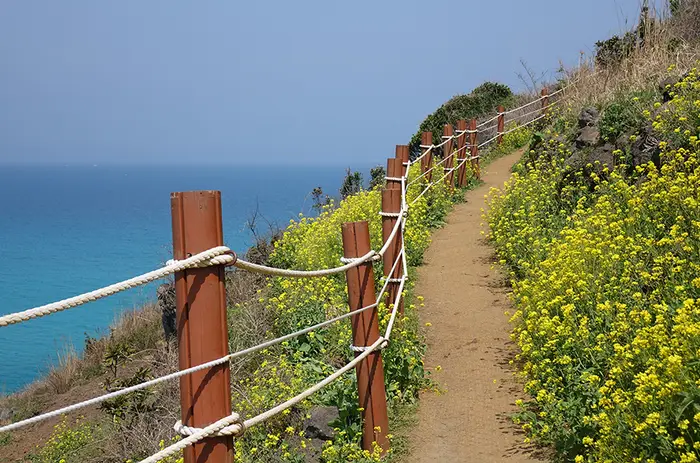
The Seoubong Dulle-gil Trail is part of Jeju Olle Course 19, bordering the sea east of Hamdeok Beach in Jocheon-eup, Jeju. In spring, yellow canola flowers harmonize with the emerald waters of Hamdeok Beach, making it one of the most celebrated walking courses. Seoubong Peak is a conical volcanic cone with two gentle peaks that offer panoramic views, hosting a sunrise festival every New Year. It also holds historical significance as the site where the Sambyeolcho army made their final stand after fleeing from Jindo to Geoje, engaging in battle against General Kim Bang-gyeong's forces. A beacon station built during the Joseon Dynasty once stood at the summit, and there are 20 caves constructed by the Japanese military during the Japanese colonial period. Reaching the summit offers a relaxing view of Hamdeok's waters and Hallasan Mountain in the distance, and the area has also become popular for paragliding.MoreLess
- 2
Jeju April 3 Peace Park
제주4·3평화공원
While human history long commemorated only heroes, it was not until the 20th century that the history of everyday people began to be commemorated. Jeju 4·3 Peace Park is a memorial park dedicated to peace and human rights, honoring the memory and tragic lives of the civilian victims of the Jeju April 3 Incident while striving toward a future of reconciliation and coexistence. The park's development was carried out as part of community reparations for the April 3 Incident, starting with the promulgation of the Special Act on the Jeju April 3 Incident in 2000, followed by land acquisition, research studies, a design competition, construction, and the production and installation of exhibits, culminating in its opening on March 28, 2008.MoreLess
- 3Sinpung Sincheon Seaside Ranch
신풍 신천 바다목장
Jeju Olle Course 3 features a peaceful mid-mountain trail stretching across 14 km, flanked on both sides by old stone walls and lush native vegetation of Jeju. Beyond this section lies a seaside ranch path opened to the public, offering a scenic coastal Olle experience unique to Jeju where blue seas meet vibrant green pastures.MoreLess
- 4Soesokkak Estuary
쇠소깍
Located in Hahyo-dong, Seogwipo-si, Jeju, Soesokkak Estuary was originally called 'Soedun' because it resembles the shape of a lying cow. It later came to be called 'Soesokkak' as the freshwater of Hyodoncheon Stream meets seawater to form a deep pool. In the local dialect, 'soe' means cow, 'so' means a deep water pool, and 'kkak' means the end. Soeso is a valley formed by hardened lava flows, creating unique and fascinating terrain true to its name. Considered one of the hidden gems of Seogwipo's scenic spots, Soesokkak offers breathtaking landscapes where deep waters, strangely shaped volcanic rocks, and pine forests harmonize. Hahyo-dong, where Soesokkak is located, sits at the southern foot of Hallasan Mountain and is renowned as a prime producer of tangerines, filling the village with sweet citrus fragrance. There are also many famous tourist destinations nearby, such as the Jusangjeolli Cliff, Jungmun Saekdal Beach, and Cheonjeyeon Falls, making it convenient to visit together.MoreLess
- 5
Jeongbangpokpo Falls
정방폭포
Along with Cheonjiyeon and Cheonjeyeon, Jeongbangpokpo Falls is one of the three major waterfalls in Jeju, located about 1.5 km southeast of downtown Seogwipo. It is the only coastal waterfall in East Asia that falls directly into the sea, measuring 23 m in height, 8 m in width, and 5 m in pool depth. When sunlight reflects off the roaring cascade of water, a seven-colored rainbow blends with the blue sea to create a mesmerizing spectacle. Historically, this scene was called Jeongbanghapok (Jeongbang Summer Waterfall) and counted as one of the Ten Scenic Views of Yeongju (Jeju). Legend has it that Emperor Qin Shi Huang sent Seobul (Xu Fu) to Hallasan Mountain, one of the three sacred mountains of the East, to find the elixir of life; unable to find it, Seobul carved the words "Seobulgwaji (Seobul passed by here)" on the cliff of Jeongbangpokpo Falls before heading west. High cliffs along the coast are lined with old pine trees leaning toward the sea, surrounded by dense foliage.MoreLess
- 6Sagyehaebyeon Beach
사계해변
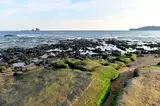
Located right beneath Sanbangsan Mountain, Sagyehaebyeon Beach is characterized by its tranquil and peaceful ambiance. From here, visitors can enjoy views of Hyeongjeseom Island, Sanbangsan Mountain, Hallasan Mountain, and Yongmeori Coast. Clean sand and the blue sea blend together in harmony. Sagye Port, located near the beach, is a popular fishing spot frequently visited by anglers. Surrounded by naturally formed volcanic rocks, the Sagye coast belongs to Jeju Olle Course 10, attracting an increasing number of hikers. Near Sagyehaebyeon Beach, visitors can also see the Sagye Footprint Fossil Site, designated as a Natural Monument.MoreLess
- 7
Songaksan Mountain Observatory
송악산전망대
Songaksan Mountain, also known as Gugubong because it is said to consist of 99 small peaks, features three observatories offering spectacular surrounding views. In particular, it is a favored destination among tourists for its panoramas of Marado Island, Gapado Island, Hyeongjeseom Island, Hallasan Mountain, and the scenic coastline. Walking up toward the observatories reveals artificial caves built by the Japanese military as bases during the colonial period. The combination of open plains and stairways makes it a pleasant route for a stroll while looking down over the coastal scenery.MoreLess
- 8
Altteureu Airfield and Japanese Military Aircraft Hangar
알뜨르비행장 및 일본군 비행기 격납고
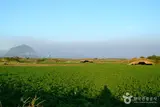
These fighter aircraft hangars were built during World War II by mobilizing Jeju residents for forced labor under the Japanese military. Facilities such as the airfield, control tower, anti-aircraft gun positions, and hangars are preserved and open for viewing. Along with nearby April 3 historical sites and the coastal cliff cave fortifications at Songaksan Mountain, it provides an opportunity to explore wartime remnants of the Japanese military and reflect on Korea's tragic modern history.MoreLess
Source: Korea Tourism Organization (TourAPI) · Machine-translated