Haeparang Trail (Busan, Ulsan Section)
8 stops · 3 nights or more
The Haeparang Trail begins at Oryukdo Islets in Busan and spans a total of 750 km, making it the longest walking trail in South Korea. Walking along the trail, which connects coastal paths, forest trails, and village roads, fills your view with scenic coastal landscapes. Following the path imbued with the wishes of seafarers leads to Haedong Yonggungsa Temple, a temple where the sun rises first. The trail also features Dongbaekseom Island, which is dyed red with camellia blossoms in midwinter, and Ganjeolgot Cape, where you can greet the earliest sunrise.
- Duration
- 3 nights or more
- Distance
- 76.1km
Along the way
- 1
Oryukdo Islets (Busan National Geopark)
오륙도 (부산 국가지질공원)
Oryukdo Islets offer a refreshing view of the endlessly unfolding ocean that clears both the eyes and the mind. The name Oryukdo (meaning five or six islands) originated from the fact that this cluster of islands appears as either five or six islands depending on the ebb and flow of the tide. Each islet presents a spectacular landscape created by sheer coastal cliffs, wave-cut platforms formed by wave erosion, various sea caves, flora and fauna that have thrived for ages without human interference, and deep blue seas. Oryukdo Islets consist of volcanic rocks similar to those found at Igidae geological site, and it is estimated that what was once a small peninsula connected to the mainland until 120,000 years ago became separated through long-term erosion by fierce waves. A coastal geological trail connecting Oryukdo Islets to Igidae Park has been established. This 4.7 km coastal trail runs from "Oryukdo Skywalk" to "Dongsaengmal Observatory" and serves as a trekking course through Igidae Park, an outstanding National Geopark home to Oryukdo Islets, Oryukdo Sunrise Park, Oryukdo Skywalk, and Dongsaengmal Observatory. From Dongsaengmal Observatory, visitors can enjoy the splendid night view of Busan's landmarks, including the Gwangan Bridge and the skyscrapers of Haeundae, making it a hidden night view hotspot in Busan.MoreLess
- 2Haeundae Dongbaekseom Island
해운대 동백섬
Looking out at the open sea from Haeundae Beach and turning your gaze to the right, you will see the Chosun Hotel where the sandy beach ends, with the cozy Dongbaekseom Island nestled behind it. Originally an island, it became connected to the mainland over a long period through sedimentation, but it is still called Dongbaekseom Island, reminiscent of its past topography. Early on, scholar Choe Chi-won and many poets and calligraphers visited to revel in the superb scenery where the sea and forest harmonize, composing verses to pass their inspiration down to future generations. A walking path has been developed around Dongbaekseom Island, attracting continuous footsteps of citizens. Traces of both past and present are found throughout the island, including Choe Chi-won's Haeundae rock carving, statue, and poetry monument, as well as the mermaid statue based on the legend of Princess Hwangok and the Nurimaru APEC House. In addition, the panoramic view of Busan seen from Dongbaekseom Island is impressive; the coastline toward Mipo across the way, Dalmaji Hill, Gwangan Bridge spanning across the sea and sky, and Oryukdo Islets—the symbol of Busan's sea—can all be taken in at a glance. True to its name, camellia blossoms used to bloom so profusely in the past that they brushed against horses' hooves, and even today, flower buds form unfailingly between winter and spring, with whole red flowers falling to add atmospheric charm.MoreLess
- 3Haeundae Beach
해운대해수욕장
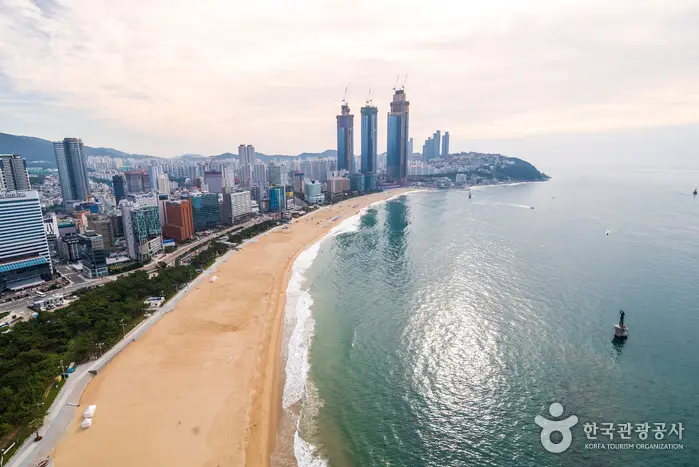
* Busan's Representative Beach, Haeundae Beach Haeundae Beach is Busan's flagship beach. Boasting a sandy beach 1.5 km long, 30–50 m wide, an average water depth of 1 m, and an area of 58,400 m², it features a vast sandy shore and a beautiful coastline, offering optimal conditions for swimming with its shallow waters and gentle waves. It is Busan's most iconic destination—so much so that Haeundae Beach is the first place people think of when mentioning "Busan"—and attracts the largest crowds in the country, often serving as a barometer for counting summer vacationers each year. In particular, it is famous for its modern and sophisticated beach atmosphere with small and large buildings and luxury hotels rising along the coastline, drawing energetic crowds not only during the summer holiday season but throughout all four seasons, and is widely popular among international visitors. * Diverse Festivals and Entertainment at Haeundae Beach Haeundae Beach hosts the annual Dalmaji (Moon Watching) Festival on Jeongwol Daeboreum (the first full moon of the lunar year). In addition, the Polar Bear Swimming Contest held every winter has become an iconic winter festival. Various events large and small are also held, including sand sculpture exhibitions and the Busan Sea Festival. Furthermore, there are plenty of sights to see around the beach, such as Dongbaekseom Island, Oryukdo Islets, an aquarium, yacht marina, BEXCO, Dalmaji Hill, and scenic drive courses. Befitting a first-class national beach, the surrounding area is well-equipped with first-rate hotels, accommodations, recreational facilities, and entertainment spots for a comfortable and relaxing visit.MoreLess
- 4Cheongsapo Port
청사포
Heading toward Songjeong along Haeundae Dalmaji Hill, you will see Cheongsapo Port below to your right. Between Busan's Haeundae and Songjeong, three small fishing ports lie side by side along the coast. Along with Gudeokpo and Mipo, Cheongsapo is one of those small ports. Cheongsapo is famous for producing high-quality brown seaweed (miyeok), and its sunrise has long been renowned for its beauty. The coastal rocks around Cheongsapo are always bustling with anglers gathered for fishing, attracting even more people in autumn when mackerel is in season. In addition, the Donghae Nambu Line railway stretches along the coast, with trains occasionally sounding their horns as they run, enhancing the idyllic scenery of this quiet rural village. This railroad is one of only two seaside railways in the country, and has gained further popularity as a filming location for the movie 'My Girl and I.' Tasting fresh seafood caught on the spot at the rows of restaurants and raw fish eateries flanking one side of the port against the tranquil harbor backdrop is also a true highlight. Cheongsapo's original name was Cheongsa, meaning 'blue snake.' The legend behind the name tells of a devoted couple who lived in this village; when the husband drowned at sea while fishing, his wife climbed the coastal rocks every day waiting for him. Moved by pity, the Dragon King sent a blue snake to bring the wife to the underwater palace of the East Sea to reunite with her deceased husband. However, because having the word 'snake' in the village name was deemed unfavorable, it was later changed to mean 'port of blue sand.'MoreLess
- 5Haedong Yonggungsa Temple (Busan)
해동 용궁사(부산)
* A Sacred Place Where Wishes Come True, Haedong Yonggungsa Temple (Busan) * Founded in 1376 by Great Monk Naong, who was the royal preceptor of King Gongmin, Haedong Yonggungsa Temple is one of Korea's three major Avalokitesvara sacred grounds. Harmonizing the sea, dragon, and the Great Avalokitesvara Bodhisattva, it embodies profound spiritual significance and is famous as a sacred place where sincere prayers are answered in dreams, granting at least one wish. Destroyed by fire during the Imjin War, it was rebuilt in the early 1930s by Ungang of Tongdosa Temple. In 1974, Monk Jeongam became the head priest, resolved to restore it as a place of Avalokitesvara practice, and performed a 100-day prayer. It was renamed Haedong Yonggungsa Temple after he dreamt of Avalokitesvara Bodhisattva in a white robe ascending to heaven riding a dragon. Existing buildings include the Daeungjeon Hall, Gulbeopdang (Cave Dharma Hall), Yongwangdang (Dragon King Hall), Bell Pavilion, and Yosachae (monks' quarters). Daeungjeon Hall was rebuilt in the 1970s by head priest Jeongam. The Cave Dharma Hall beside Daeungjeon, known as Mireukjeon, has enshrined a seated stone Buddha of Maitreya since its founding; it is called Deuknambul because it is said that childless people who pray here will be granted a son. In front of Daeungjeon stands a Four-Lion Three-Story Stone Pagoda. Originally, a 3-meter-high rock (Maitreya Rock) stood here, but after the temple fell into ruins during the Imjin War and was destroyed while building a coastal security network during the Korean War, Jeongam collected broken stones and reinforced the damaged cliff in 1990 to erect this pagoda, enshrining seven Buddha sarira brought from Sri Lanka. Other notable statues include the approximately 10-meter-tall Sea-Dwelling Great Avalokitesvara Bodhisattva—Korea's largest single-stone statue—and the Bhaisajyaguru (Medicine) Buddha, also known as the East Sea Gatbawi Buddha. At the temple entrance are the Traffic Safety Prayer Pagoda and 108 stone stairs, at the start of which stands a Bodhidharma statue said to grant a son to those who touch its nose and belly. * Sights around Haedong Yonggungsa Temple * Walking just two minutes from the parking lot brings you to statues of the twelve Chinese zodiac signs representing Oriental philosophy, and a Traffic Safety Prayer Pagoda wishing safe driving for everyone. A poetry stone by Chunwon Lee Gwang-su praising the scenery, along with the famous verse by Great Monk Naong singing, "The green mountain bids me to live without words, and the blue sky bids me to live without blemish," invites visitors to briefly reflect upon themselves. Passing through Yongmun Stone Cave and descending the 108 stone steps one by one past aligned stone lanterns to reach the vast, deep blue sea offers an exhilarating sensation like entering the Dragon Palace itself. To the left, a stone Bhaisajyaguru Buddha is enshrined on Baekhobawi Rock, and a short walk further leads to Ilchuram Rock, where the sunrise can be observed first.MoreLess
- 6Ganjeolgot Lighthouse
간절곶 등대
Located in Daesong-ri, Seosaeng-myeon, Ulju-gun, where the first sunrise of the new millennium rose earliest on the Korean Peninsula, Ganjeolgot Cape is where you can greet the earliest sunrise on the East Coast. Since it first shone its light on March 26, 1920, Ganjeolgot Lighthouse has steadily guided ships along the sea routes to Ulsan Port for over 100 years, gaining fame as the lighthouse at Ganjeolgot where the new millennium sun rose earliest at "7:31:26 a.m. on January 1, 2000." Sunrise begins one minute earlier here than at Homigot in Yeongil Bay and five minutes earlier than at Jeongdongjin in Gangneung, creating a spectacular sight. It is drawing attention as a new attraction alongside Jinha Beach and Seosaengpo Japanese Fortress in the Ulsan region. Ganjeolgot Lighthouse is about 20 minutes from the entrance of Ulsan Nambu Ring Road. When acacia flowers bloom and you drive along the coastline from Ulsan toward Haeundae in Busan, the sweet fragrance of acacia fills the air more deeply than the scent of the sea. Running along mountain roads lined with drooping acacia branches heavy with white blossoms and suddenly opening up to the sea, this road serves as a wonderful driving course anytime. Gentle hills stretch out before an open expanse of sea. It is a great family outing destination anytime and is spotlighted as a new attraction together with Jinha Beach and Seosaengpo Japanese Fortress. Although it is just 20 minutes from the Ulsan Nambu Ring Road entrance, its refreshing scenery feels exotic, as if having traveled far away. Gazing at the white lighthouse standing tall toward the sea evokes images of a captain on a long sea voyage, inspiring quiet solitude and boundless imagination. In front of the lighthouse lies a pine grove. Though not as dense as the one in Ulgi Park, its winding shapes are charming. The building housing the lighthouse is also entirely white. Even with an industrial complex close by, it feels like a remote rural village where all movement slows down, with only the waves steadily lapping against the shore. Lit in March 1920, it continues its operation today with only changes in managing authorities. Anyone can climb up the lighthouse; inquiring with the administrator and leaving a visitor log allows entry. Inside the cylindrical lighthouse is a spiral staircase, and the sea viewed through the windows offers a fresh perspective. A path with the lighthouse on your right leads closer to the ocean, lined neatly with tented raw fish restaurants where you can savor various fresh raw fish dishes while taking in sea views and listening to breaking waves. * Observatory-type Light Tower * Exhibition Room - 1 model of Ulsan Port, 1 information retrieval terminal, 13 promotional panels * Recreational Facility - Ilyeongjeong Pavilion, 79.34 m² (approx. 24 pyeong)MoreLess
- 7Jangsaengpo Whale Culture Village
장생포 고래문화마을
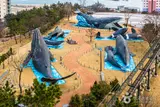
Established in 2015, the Whale Culture Village faithfully recreates the old whaling village of Jangsaengpo. Visitors can explore the park featuring various themes and stories, including Whale Square, Old Jangsaengpo Village, Prehistoric Whale Plaza, Whale Sculpture Garden, and Aquatic Botanical Garden. * Major Facilities of Jangsaengpo Whale Culture Village * - Old Jangsaengpo Village: A space recreating Jangsaengpo during the 1960s and 1970s when whaling was flourishing, serving as both a nostalgic space evoking old memories and an educational venue. - Whale Sculpture Garden: An exotic hands-on experience space where visitors can learn about and experience various whales modeled in life-size scales. - Whale Story Road & Whale Encounter Road: Storytelling photo zones featuring various themes such as bonding and coexistence with whales. - Prehistoric Whale Plaza: An outdoor learning space to experience prehistoric whale history and culture, including the Bangudae Petroglyphs and whaling murals.MoreLess
- 8Bangudae Petroglyphs in Daegok-ri, Ulju
울주 대곡리 반구대 암각화
In Daegok-ri, Eonyang-eup, lies the scenic Bangudae Terrace. A ridge of Yeongosan Mountain extends and comes to an abrupt halt here, culminating in fantastic rocks and bizarre stone formations shaped like a crouching turtle, giving it the name Bangudae (Turtle Terrace). Crystal-clear waters flowing down from Cheonjeon Valley in Dudeong-myeon gather here to form a lake, earning it renown for its superb beauty. Hence, poets and scholars from all over have visited since ancient times to enjoy the scenery through poetry. Petroglyphs are drawings carved onto rocks by prehistoric people depicting various aspects of their daily life. They were mostly carved in sacred communal places such as large rocks, where people are believed to have gathered to perform various rituals. The Bangudae Petroglyphs in Daegok-ri, Ulju, are carved on what is called 'Geonneo Gakdan' along Daegokcheon Stream, a tributary of the Taehwagang River. The main rock surface where drawings are concentrated measures 10 m wide and 3 m high. However, numerous figures are also identified on both sides, bringing the total number of carved rocks to about ten. These petroglyphs are believed to have been produced across multiple periods starting from the Neolithic Age, revealing stylistic differences by era; techniques include the surface-pecking method (pecking the entire interior of the subject) and the line-pecking method (pecking only the outline). The carved subjects can be broadly divided into marine animals, land animals, humans, and tools. Marine animals feature whales, seals, and turtles, while land animals include deer, tigers, wild boars, and dogs. Humans are depicted showing only faces, standing upright, standing in profile, or boarding boats. Tools include boats, fences, nets, harpoons, and objects resembling crossbows. These depictions are believed to have been carved onto the rock with prayers for successful hunting activities and abundant game. Expressing animals and hunting scenes vividly while realistically portraying the characteristics of objects, it is considered a masterpiece of both hunting art and religious art that provides insight into the life and customs of prehistoric people. As humanity's earliest record of whaling and the Korean Peninsula's first artwork, the Bangudae Petroglyphs, along with the Petroglyphs of Cheonjeon-ri (the first petroglyphs discovered in Korea, celebrating its 50th excavation anniversary), stand as representative historical tourism resources of South Korea.MoreLess
Source: Korea Tourism Organization (TourAPI) · Machine-translated