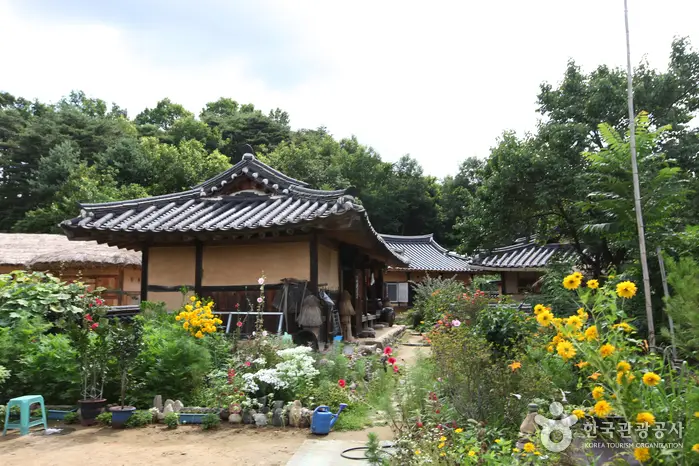
A Trip to Yeongju: Traveling Back in Time for a Restful Pause
8 stops · Approx. 3 hours
This travel course takes you to Yeongju, a renowned wellness destination. Preserving the charm of days gone by, its historical attractions offer a welcoming pause to set aside the rush of daily life and catch your breath. Enjoy an atmospheric stroll through the restored Husaeng Market, explore the cozy and charming Museom Village and Yongmaru Park, and immerse yourself in the restful tranquility of nature at Seonbichon Village, Buseoksa Temple, and Sosuseowon Confucian Academy!
- Duration
- Approx. 3 hours
- Distance
- 145.1 km
Along the way
- 1
Husaeng Market
후생시장
Through a modern landscape restoration project by Yeongju City, the buildings of Husaeng Market have been restored to their former appearance, offering a wide array of sights for visitors to Yeongju.MoreLess
- 2
Museom Village
무섬마을
Located in Sudo-ri, Munsu-myeon, Yeongju-si, Gyeongsangbuk-do, Museom Village is a prime water-winding (muldori) village surrounded by water on three sides, much like Hahoe Village in Andong, Hoeryongpo in Yecheon, and Seonam Village and Cheongnyeongpo in Yeongwol. Formed where the Naeseongcheon and Yeongjucheon streams—tributaries of the Nakdonggang River—converge and wrap around three sides of the village along the Taebaeksan and Sobaeksan mountain ridges, it stands as an inland island village that still fully preserves its traditional heritage.MoreLess
- 3
Yeongjuho Yongmaru Park
영주호용마루공원
Yeongjuho Yongmaru Park is situated in Pyeongeun-myeon, Yeongju-si, Gyeongbuk. The park is divided into Yongmaru Park 1 and Yongmaru Park 2. Yongmaru Park 1 features a visitor center, an observatory, and a cafeteria. Walking along the path and crossing the suspension bridges—Yongdugyo and Yongmigyo—leads to Yongmaru Park 2, where you can explore the former Pyeongeun Station building. The Yeongju Dam Water Cultural Center is also nearby.MoreLess
- 4
Seonbichon Village
선비촌
Located adjacent to Sosuseowon Confucian Academy in Sunheung, Yeongju, Gyeongbuk—the cradle of Korean Confucian culture—Yeongju Seonbichon Village was established to recreate the study halls and traditional living quarters of past scholars, serving as an experiential learning ground for Korea's unique philosophy and historical lifestyle.MoreLess
- 5Sosuseowon Confucian Academy
소수서원
Nestled below Yeonggwibong Peak at the foot of the Sobaeksan Mountain, imbued with the spirit of the Baekdudaegan Mountain Range, Sosuseowon Confucian Academy originated as Baegundongseowon Confucian Academy, founded by Ju Se-bung as Korea's first royally chartered private academy (saek seowon). Deeply admiring An Hyang, a prominent late-Goryeo scholar, Ju Se-bung established a shrine to enshrine An's spirit tablet in An's hometown in 1542 (the 37th year of King Jungjong's reign), the year after taking office as magistrate of Punggi. In 1543, he constructed a lecture hall, completing the institutional structure of an academy that marked the beginning of Baegundongseowon.MoreLess
- 6
Buseoksa Temple
부석사
Buseoksa Temple is the head temple of the Hwaeom Sect of Korean Buddhism, founded in 676 (the 16th year of King Munmu of Silla) by Great Master Uisang, the patriarch of the Haedong Hwaeom Sect, by royal decree. While studying in Tang China, Master Uisang heard of Emperor Gaozong's planned invasion of Silla and returned home to alert the king. He founded this temple to unite public sentiment through the principles of Hwaeom and overcome internal and external trials, making it the birthplace of Korean Hwaeom thought.MoreLess
- 7
Jeontong Mukjip
전통묵집
Taepyeongcho is a distinctive local delicacy unique to the Yeongju region, made by combining buckwheat jelly (memilmuk), pork, aged kimchi, and seaweed. This restaurant is an unmissable destination for taepyeongcho in Yeongju, attracting countless visitors, with mukbap (cold or warm buckwheat jelly soup with rice) and sundubu (soft tofu) serving as signature dishes alongside it. Using domestic buckwheat and soybeans to freshly make buckwheat jelly and soft tofu in-house, the restaurant consistently maintains top-notch flavor. The soft tofu boasts a smooth, nutty taste, while the mukbap tossed in seasoned soy sauce delivers another distinct flavor you can only taste in Yeongju.MoreLess
- 8Buyongdae Cliff
부용대
Buyongdae Cliff is a 64-meter-high cliff situated at the very end of the Taebaeksan Mountain Range, offering a panoramic view of Andong Hahoe Village from its summit. The name 'Buyongdae' is derived from a Chinese classic, with 'buyong' meaning lotus flower. It originates from how Hahoe Village resembles a blooming lotus flower, and as the prime spot to gaze upon the village, it was named Buyongdae. It was initially called 'Buk-ae,' meaning 'the cliff north of Hahoe.' At the bottom where the Nakdonggang River winds around, Ogyeonjeongsa House, Gyeomamjeongsa House, and Hwacheonseowon Confucian Academy are located.MoreLess
Source: Korea Tourism Organization (TourAPI) · Machine-translated