Encountering Green Mountains and Lakes
4 stops
Jecheon has long been called Cheongpung Myeongwol (a land of clear breeze and bright moon) as a place blessed with refreshing winds and a bright moon. Everywhere you go, the blue waters of Cheongpungho Lake and the surrounding mountain ridges generously reveal the scenic splendor of Cheongpung Myeongwol.
- Distance
- 41.4km
Along the way
- 1Uirimji Reservoir, Jecheon
제천 의림지
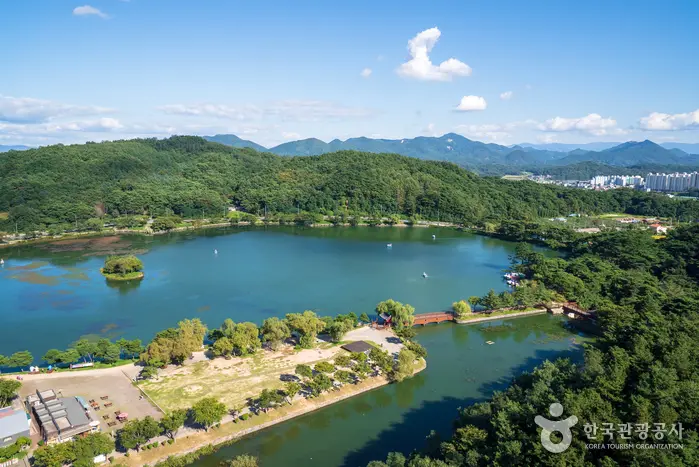
Chungcheong-do is also called the Hoseo region, meaning "west of the lake," and the lake referred to here is none other than Uirimji. This reflects just how ancient and famous Uirimji Reservoir is. Designated as Chungcheongbuk-do Monument No. 11, Uirimji is an irrigation reservoir built during the Samhan period and was originally called Imji. With a circumference of 1.8 km, a full water surface area of 151,470㎡, a water storage capacity of 6,611,891㎡, and a water depth of 8–13 m, it serves as a major reservoir irrigating 289.4 jeongbo of farmland. Alongside Byeokgolje Reservoir in Gimje and Susanje Reservoir in Miryang, it is one of the hydraulic structures from the Samhan period, and its water drainage gates built using earthenware serve as valuable resources for researching agricultural technology of that era.\nToday, it is a renowned scenic spot in Jecheon. Around the lake, Yeonghojeong Pavilion built in 1807 (the 7th year of King Sunjo), Gyeonghoru Pavilion built in 1948, centuries-old pine trees, weeping willows, and a 30-meter natural waterfall come together to enhance the scenic beauty. In particular, a local specialty called gong-eo (pond smelt), which can only be seen during the spawning and thawing season, is highly favored by tourists for its delicacy as raw fish. The area also features Solbat Park, a traditional archery range, and Parkland, making it a great place of rest for citizens and tourists alike.MoreLess
- 2Cheongpung Cultural Heritage Complex
청풍문화재단지
Cheongpung was a place of beautiful natural landscapes and flourishing culture with numerous cultural relics. However, due to the construction of Chungju Dam, villages in Husan-ri and Hwangseok-ri in Cheongpung-myeon and Jigok-ri in Susan-myeon faced the risk of being submerged along with their cultural heritage. Over a three-year period starting in 1983, the Chungcheongbuk-do Provincial Government relocated and restored the cultural properties from the flooded areas in their original forms to the current site, creating this complex.MoreLess
- 3Cheongpung Cable Car
청풍호반케이블카
Located just an hour and a half from the Seoul Metropolitan Area and within three hours from anywhere in the country, this inland sea in Cheongpung, Jecheon, Chungbuk—the true home of Cheongpung Myeongwol that promotes natural blessings, healing, and recovery—invites you to soar on the wings of a phoenix to explore the hidden scenic wonders of Cheongpung Myeongwol. Cheongpung Cable Car is a 2.3-km round-trip ropeway system operating between Multae-ri, Cheongpung-myeon and the summit of Bibongsan Mountain, utilizing the latest D-Line model from Doppelmayr based in Austria. It operates 43 ten-passenger cabins, 10 of which are Crystal Cabins with transparent floors that offer a thrilling view right beneath your feet.MoreLess
- 4Jeongbangsa Temple
정방사
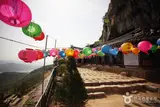
Jeongbangsa is a Buddhist temple situated on a ridge stretching down toward Dohwa-ri in Cheongpung from Sinseonbong Peak (845 m), a foot of Geumsusan Mountain (1,016 m). Founded by Great Monk Uisang in 662 (the 2nd year of King Munmu of Silla), it is currently a branch temple of Beopjusa Temple on Songnisan Mountain and is famous as a place of prayer. In Donggukyeojiseungnam (Augmented Survey of the Geography of the Eastern Kingdom), it is introduced as Sanbangsa Temple. Legend has it that after achieving enlightenment, Uisang threw his walking staff to find a place to build a temple, and it flew and stuck here, leading to the construction of the temple. Temple records also note that the main prayer hall was repaired in 1825. The surrounding scenery is outstanding, and the view of Cheongpungho Lake seen from the front of the prayer hall is so breathtaking that it makes one forget all worldly matters. In addition, a colossal cliff covering one-third of the temple roof adds a majestic and intriguing presence, evoking the grandeur of nature.MoreLess
Source: Korea Tourism Organization (TourAPI) · Machine-translated