A Refreshing Trip to Sokcho
4 stops · 2 Days, 1 Night
Looking out at the clear, vast sea seems to wash away all the complicated and suffocating feelings in your heart. If you need a place where you can enjoy the cool ocean breeze while looking at the scenic sea view, set off for Sokcho, home to Oeongchi Bada Hyanggi-ro—which opened to the public after 65 years of restricted access—and Yeonggeumjeong, a pavilion built over the sea.
- Duration
- 2 Days, 1 Night
Along the way
- 1
Sokcho Tourist & Fishery Market
속초관광수산시장
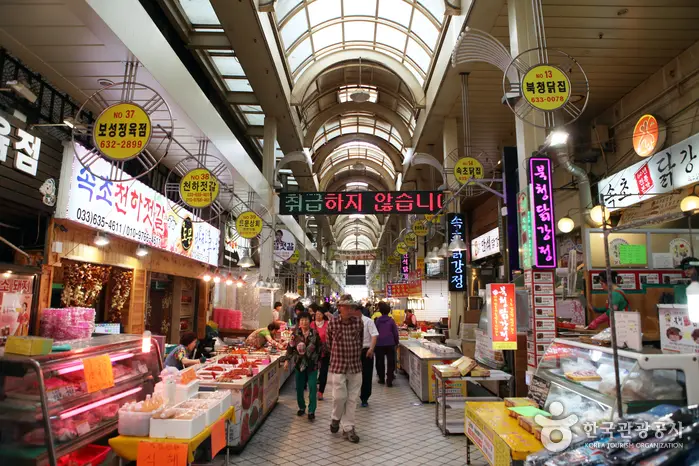
Originally established as a temporary wooden structure under the 1954 market housing site development, it became the current mixed-use Jungang Market under the 1982 Jungang Market Modernization Project. The facility consists of one basement level and two above-ground floors (total floor area: 15,436 m²) housing 449 stores. The basement floor features seafood sales and raw fish restaurants, while the first and second floors consist of general wholesale and retail stores (food, clothing, etc.). The market's name was changed to Sokcho Tourist & Fishery Market.\nSokcho Tourist & Fishery Market provides convenience for visitors by offering shopping carts, a customer lounge, a nursing room, an unmanned civil service certificate issuance machine, a rest area, and a large parking lot capable of accommodating 350 vehicles simultaneously.MoreLess

- 2Oeongchi Bada Hyanggi-ro
외옹치 바다향기로
The Oeongchi coastal area was completely closed to the public with the installation of coastal security barbed wire fences in 1970, and was reopened in April 2018. It is the second coastal trail on the East Coast following the Jeongdong-Simgok Badabuchae-gil Trail in Gangneung. Named 'Bada Hyanggi-ro' (Ocean Scent Trail) because it is a path to walk along the sea, this premium coastal trail was built along the Oeongchi Beach and Sokcho Beach areas, which were opened 65 years after entry was restricted. As you walk along, you can feel that it is the East Coast's finest emotional trekking road. 'Sokcho Bada Hyanggi-ro' runs from Sokcho Beach to Oeong Port and is the only place in the Sokcho area where you can see jangseung (traditional wooden totem poles). You can closely listen to the sound of waves crashing against uniquely shaped rocks, and because tourist and commercial zones are developed near Bada Hyanggi-ro, it is lined with raw fish restaurants where you can taste fresh sashimi. Beach bleachers, a scenic pedestrian bridge, and a deck road offering views of Oeongchi Beach are also available.MoreLess
- 3Yeonggeumjeong
영금정
Yeonggeumjeong is a place where large and wide rocks are laid out along the beach below the Sokcho Lighthouse in Dongmyeong-dong, Sokcho-si. The name originates from the idea that when waves hit the rocks, a mystical melody is heard, sounding like the divine playing of a geomungo (traditional Korean zither). Located close to the city center and boasting exquisite scenery, it is a place where Sokcho citizens enjoy summer retreats and fishing throughout the year. Currently, Sokcho-si has developed the Yeonggeumjeong area into a tourist attraction and built an actual pavilion near the south breakwater. This marine pavilion is built on top of the Yeonggeumjeong rocks and can be accessed by crossing a 50-meter bridge. Looking at the sea from the marine pavilion offers another refreshing feeling different from the breakwater, but the pavilion itself leaves something to be desired as it is a rather rustic concrete pavilion. It is commonly called the Sunrise Pavilion, and the sign on the pavilion reads Yeonggeumjeong (靈琴亭).MoreLess
- 4
Korean Peninsula Cliffs
한반도지형
Named for its striking resemblance to the shape of the Korean Peninsula, it was formed by the erosive action of the incised meandering river that wraps around the Korean Peninsula-shaped landform. Here, you can see the limestone observed in this area, the meandering Seogang River, the formation process of the Korean Peninsula terrain, dolines, and the various uses of limestone.MoreLess
Source: Korea Tourism Organization (TourAPI) · Machine-translated