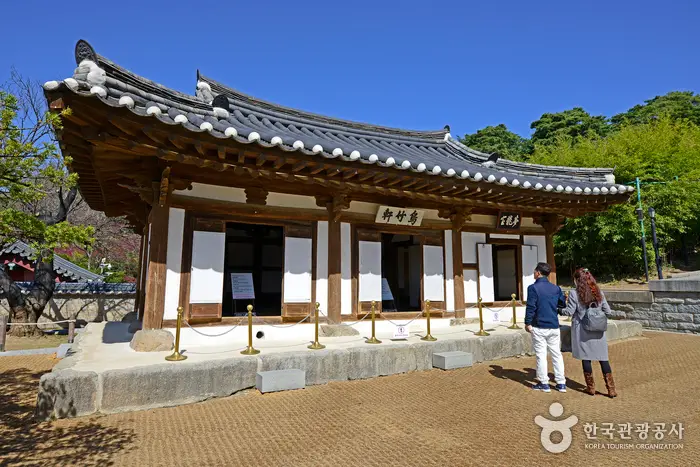
Walking Around Gyeongpoho Lake Amid Fluttering Cherry Blossoms
5 stops
The trail around Gyeongpoho Lake is filled with fluttering cherry blossom petals. It is a perfect spring travel destination where you can enjoy a stroll in the gentle spring breeze and explore nearby attractions. Stroll through Ojukheon House and Seongyojang House to encounter the culture and history of ancestors, listen to spring greetings at Charmsori Gramophone Museum, and head toward the Gyeongpodae Cherry Blossom Trail. Looking out at Gyeongpoho Lake from Gyeongpodae Pavilion offers yet another wonderful view.
- Distance
- 4.1km
Along the way
- 1Ojukheon House
오죽헌
'Ojukheon House' is a representative historic site in Gangneung, renowned for its connection to Yulgok Yi I, a great scholar of the Joseon Dynasty. As an early Joseon architectural structure, its architectural significance was recognized when it was designated Treasure No. 165 in 1963. It is said that Yulgok Yi I was born here in the Mongnyongsil room. Within the grounds are Ojukheon, Munseongsa Shrine, the Sarangchae (men's quarters), Eojegak Pavilion, the Yulgok Memorial Hall, and the Gangneung City Museum.MoreLess
- 2Seongyojang House
강릉 선교장
Seongyojang House is the best-preserved, elegant noble residence (sadaebu house) in Gangwon-do. Located about 4 km toward Gyeongpo from Gangneung-si, Seongyojang represents upper-class residences of the Joseon Dynasty and has been designated Important Folklore Cultural Heritage No. 5. When Gyeongpoho Lake was wider than it is today, people used to cross by boat, leading this neighborhood to be called Baedari Village (Seongyori). The name Seongyojang originates from this.MoreLess
- 3
Gyeongpoho Lake
경포호
Gyeongpoho Lake is a scenic spot beloved and yearned for not only by Gangneung locals but by people across the nation. Along with its beautiful surrounding scenery, it holds prehistoric cultural ruins, legends of Hwarang (youth warriors), and the traces and breath of famous historical figures. In addition, the reflection of the moon on Gyeongpoho Lake viewed from Gyeongpodae Pavilion is exceptionally beautiful. Gyeongpoho is a natural lagoon connected to the sea with an area of 1,256,204 m² (approx. 380,000 pyeong), featuring a road adjacent to the sea. It is also famous as a winter habitat for migratory birds (such as mallards and mandarin ducks), making it an ideal retreat where nature and traditional culture coexist. Furthermore, Gyeongpoho Lake is inhabited by crucian carp, common carp, mullet, snakehead, and eels; as a nature conservation area, fishing is prohibited.MoreLess
- 4
Charmsori Gramophone & Edison Science Museum
참소리축음기&에디슨과학박물관
Charmsori Museum consists of two specialized museums: the Charmsori Gramophone Museum, a music-focused museum centered on sound, and the Edison Science Museum, a science museum highlighting Edison's inventions. Founded in 1982 in Songjeong-dong, Gangneung-si, by Director Son Seong-mok as "Charmsori Bang," it boasts a history and tradition spanning about 30 years. The main collection includes around 5,000 items such as music boxes, gramophones, radios, televisions, automobiles, and Edison inventions, making it the world's largest private museum in terms of collection size.MoreLess
- 5Gyeongpodae Pavilion
강릉 경포대
Gyeongpodae Pavilion is one of the Eight Scenic Views of Gwandong, situated on a northern hill overlooking Gyeongpoho Lake. It was originally built in 1326 (the 13th year of King Chungsuk of Goryeo) by Park Suk-jeong, an official of Gangwon-do, on the former site of Inwolsa Temple behind Banghaejeong Pavilion. In 1508 (the 3rd year of King Jungjong of Joseon), Gangneung Magistrate Han Geup relocated it to its current location, and it took its present form after several renovations. It measures 5 bays across the front and 5 bays on the sides, featuring a paljak (hipped-and-gabled) roof with side profiles shaped like the Chinese character "八". Built with 48 pillars, it has a multi-level floor structure. The seal script plaque reading 'Gyeongpodae' was written by Yu Han-ji, while the regular script plaque was written by Yi Ik-hoe. Inside Gyeongpodae, writings by numerous famous figures, poets, and calligraphers are displayed, including an 'Imperial Poem' composed directly by King Sukjong, the 'Gyeongpodaebu' composed by Yulgok Yi I at age 10, and a Sangnyangmun (building dedication text) by Jo Ha-mang. Surrounding the pavilion, pine trees and oak trees are gracefully clustered, creating a tasteful scenic atmosphere. Gyeongpodae and the surrounding lake were designated a Gangwon Provincial Park in 1981, and along the coast lies the famous Gyeongpo Beach (6 km long).MoreLess
Source: Korea Tourism Organization (TourAPI) · Machine-translated