Essential History & Nature Tour of Seosan!
6 stops · 2 Days, 1 Night
A collection of Seosan's essential historical sites and scenic natural attractions! Spend your first day visiting the Seosan Rock-carved Buddha Triad from the late Baekje period, the Gyeongju Kim Clan Historic House where the Gyeongju Kim clan lived for over 600 years, the Birth Home of Queen Jeongsun, and Haemieupseong Walled Town, a representative walled town of the Joseon Dynasty. On the next day, conclude your trip with Ungdo Island, which becomes an island or part of the mainland depending on the tide, and Samgilpohang Port, a popular spot among photographers for its picturesque scenery.
- Duration
- 2 Days, 1 Night
- Distance
- 86.3km
Along the way
- 1
Rock-Carved Buddha Triad
마애여래삼존상
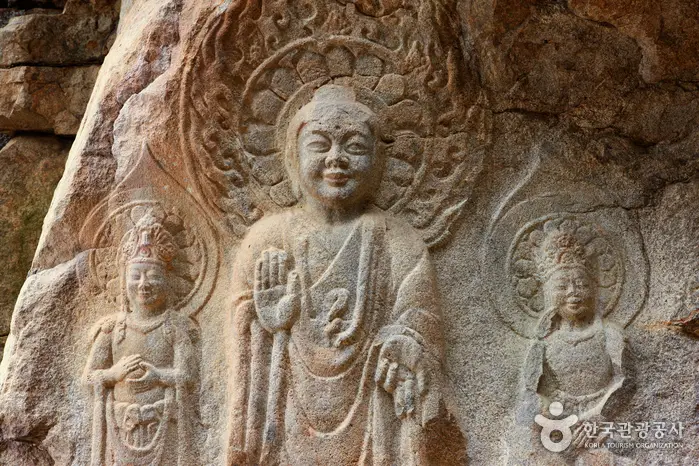
The Rock-carved Buddha Triad of Seosan (National Treasure No. 84) is a late Baekje piece that allows visitors to experience the famous 'Smile of Baekje.' The faces appear at times solemn and at times gentle, shifting with the angle of sunlight throughout the day to create an even more mystical presence. Crossing the pristine Yonghyeon Valley and climbing the stairs up the rocky mountain, one encounters the triad carved onto a precarious cliff face. Centered around the standing Shakyamuni Buddha as the main statue, a cross-legged Maitreya in Pensive Pose sits to the right, while a standing Dvekarapala Bodhisattva stands to the left. Even the nimbuses of the statues are vividly preserved, particularly the main Buddha's lotus-and-flame patterned nimbus, which looks alive as if blooming.MoreLess
- 2
Gyeongju Kim Clan Historic House
경주김씨 고택
This traditional wooden tiled-roof house faces east against the backdrop of a low hill in Handari, a flat village in Yugye-ri, Eumam-myeon. Judging by the architectural techniques, condition of the wooden members, and house layout, it is estimated to have been built in the mid-19th century. According to oral tradition, it was built by a Mr. Yi who lived in Taean, but based on pungsu (feng shui) principles suggesting the site was suited for a Kim rather than an Yi, an ancestor of Kim Gi-hyeon of the Gyeongju Kim clan bought and moved into the house. The house forms an overall square-shaped (ㅁ-shaped) layout through the combination of a U-shaped (ㄷ-shaped) main building (anchae) and an L-shaped (ㄱ-shaped) detached men's quarters (sarangchae).MoreLess
- 3Birth Home of Queen Jeongsun
정순왕후생가
This is the birthplace of Queen Jeongsun (1745–1805), the second wife of King Yeongjo of the Joseon Dynasty, where she lived before becoming queen. Following the passing of Queen Jeongseong of the Seo clan, the first wife of King Yeongjo, Queen Jeongsun was invested as queen in 1759 (the 35th year of King Yeongjo's reign). This house is presumed to have been built between 1649 and 1659 during the reign of King Hyojong. Kim Hong-uk (pen name Hakju), who served as a royal secretary (Seungji) and vice minister of the Ministry of Rites (Yejochami) during the reign of King Hyojong, had a close friendship with the king; upon learning that he was caring for his elderly father, the king bestowed this house upon his father, Kim Jeok. The main house has a square-shaped (ㅁ-shaped) floor plan, featuring a 5-bay front and 2-bay side structure with 3 bays attached on both sides, forming a U-shaped (ㄷ-shaped) structure. To the south sits an outbuilding measuring 5 bays wide and 1 bay deep, forming a square-shaped layout. The walls surrounding the rear garden and main building are built of natural stones, and the main gate is a plain gate (pyeongmun).MoreLess
- 4Haemieupseong Walled Town
서산 해미읍성
A representative walled town (eupseong) of the Joseon Dynasty. An eupseong is a flatland fortress built to enclose a town; alongside Haemieupseong, Gochangeupseong and Naganeupseong are also well-known. Haemieupseong is a stone fortress completed in 1491, the 22nd year of King Seongjong's reign. It is a massive fortress with a circumference of approximately 1.8 km, a height of 5 m, and a total area of 196,381 m² (approx. 60,000 pyeong), featuring three gate pavilions in the east, south, and west. Having undergone recent restoration and cleanup projects to regain its historic appearance, it has been developed into a historic park and is also famous as a Catholic martyrdom site from the late Joseon period. During the Catholic persecutions, numerous believers from across the Chungcheong-do region were captured, brought to the government office inside Haemieupseong, and tortured to death; in particular, during the 1866 persecution, over 1,000 people were executed here.MoreLess
- 5
Ungdo Island
웅도
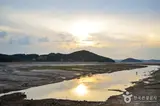
Ungdo Island was originally under the jurisdiction of Jigok-myeon, Seosan-gun, but during the 1914 administrative district reorganization, it was established as an independent administrative village (ri) named Udo-ri and incorporated into Daesan-myeon, Seosan-gun. Later, in 1991, Daesan-myeon was elevated to an eup (town). Ungdo Island was named Ungdo or Gomseom ('Bear Island') because the shape of the island resembles a crouching bear. Situated right in the center of the inner waters of Garorimman Bay, it is the only inhabited island among the seven islands of Daesan-eup.MoreLess
- 6
Samgilpohang Port
삼길포항
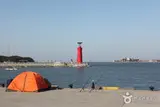
Samgilpohang Port, located in Hwagok-ri, Daesan-eup, Chungcheongnam-do, is situated at the end of the Daeho Embankment connecting Gyoro-ri, Seongmun-myeon, Dangjin-si, and Samgilpo, Hwagok-ri, Daesan-eup, where the Daeho floodgate is located. Completed on November 16, 1984, the Daeho Embankment is a 7.8 km-long seawall that serves as a scenic coastal driving route, offering beautiful views of various islands dotting the sea and enjoying great popularity as a sea fishing spot. Dobido Island, located at the center of the embankment, has been developed into a rural resort with a direct agricultural sales market, accommodations, and sports/leisure facilities, drawing attention as a tourist attraction.MoreLess
Source: Korea Tourism Organization (TourAPI) · Machine-translated