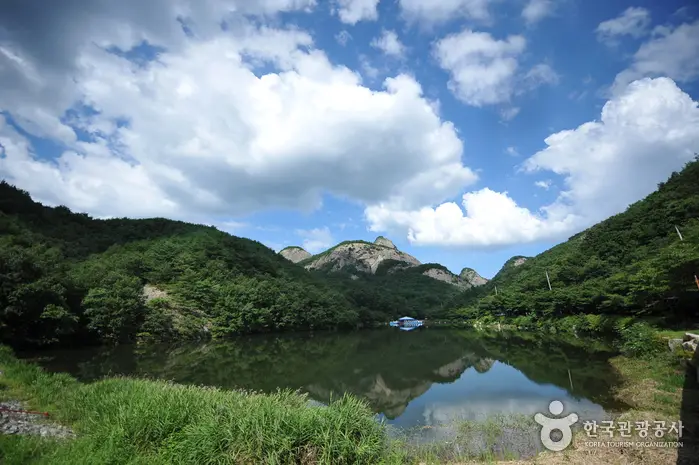
Wonchon Village, Made Famous by Its Storefront Signs
8 stops · 5 hours
Wonchon Village in Jinan is a travel destination where you can rekindle warm emotions in a space that is rustic yet natural, rough-hewn yet sophisticated. Though it appears to be an ordinary rural village with nothing particularly notable at first glance, it was transformed into a wonderfully charming place by replacing standardized, mass-produced shop signs with lovely handwritten ones. The analog scenery along the streets and the warm lettering on the signs hidden like treasures bring back forgotten memories of one's hometown. And that is why I am now strolling through Wonchon Village.
- Duration
- 5 hours
- Distance
- 16.37km
Along the way
- 1Maisan Mountain
마이산
Maisan Mountain, which is noticeable from anywhere in Jinan-eup, has four different names depending on the season. In spring, the two peaks piercing through the mist resemble twin-masted boats, earning it the name Dotdaebong (Mast Peak); in summer, when the foliage turns lush, it is called Yonggakbong (Dragon Horn Peak) because it looks like a dragon's horns; in autumn, its foliage-draped appearance resembles a horse's ears, giving it the name Maibong (Horse Ear Peak); and in winter, since snow does not accumulate, it looks like a brush tip dipped in ink, earning the name Munpilbong (Writing Brush Peak). Although Maisan Mountain is composed entirely of rock, shrubs, conifers, and broad-leaved trees grow in various spots, and it is home to Hwaamgul Cave, a pagoda cluster, and Geumdangsa Temple. MoreLess

- 2
Wonchon Village
원촌마을
Wonchon Village was created under the 2007 project name "Art in City - Jinan Baegun-myeon Public Art Project," hosted by the Ministry of Culture and Tourism and sponsored by the Arts Council Korea, planned collaboratively by residents of Baegun-myeon, Jinan and design experts to promote open and boundaryless communication between urban and rural areas.MoreLess

- 3
Geumdangsa Temple
금당사
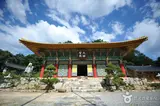
If you climb Maisan Mountain from the southern access road, Geumdangsa Temple is located on the left just past the ticket office. Going up 1.4 kilometers from Geumdangsa Temple leads to Maisan Tapsa Temple. It is said to have been founded by Great Monk Hyegam in the 2nd year of King Heongang of Silla (876). Geungnakjeon Hall houses the Wooden Seated Buddha Statue of Geumdangsa Temple (Tangible Cultural Heritage No. 18), carved from a ginkgo tree over a thousand years old, and a Gwaebultenghwa hanging scroll painting (Treasure No. 1266) measuring 5 meters wide and 9 meters high.MoreLess
- 4
Tapsa Temple
탑사
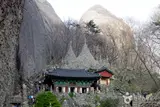
Maisan Tapsa Temple is famous for around 80 stone pagodas built by the lay devotee Yi Gap-yong. Most of the stone pagodas are either cylindrical or conical in shape, and they vary in size. The pair of Cheonjitap Pagodas behind the main hall (Daeungjeon) is the largest, standing about three times the height of an adult. How such tall pagodas were built remains a mystery to this day, sparking curiosity among visitors. These stone pagodas are known to have been built single-handedly by Yi Gap-yong in the late 1800s. It is said that Yi Gap-yong gathered stones by day and erected the pagodas by night.MoreLess
- 5
Tapsa Temple
탑사
Maisan Tapsa Temple is famous for around 80 stone pagodas built by the lay devotee Yi Gap-yong. Most of the stone pagodas are either cylindrical or conical in shape, and they vary in size. The pair of Cheonjitap Pagodas behind the main hall (Daeungjeon) is the largest, standing about three times the height of an adult. How such tall pagodas were built remains a mystery to this day, sparking curiosity among visitors. These stone pagodas are known to have been built single-handedly by Yi Gap-yong in the late 1800s. It is said that Yi Gap-yong gathered stones by day and erected the pagodas by night.MoreLess
- 6
Wonchon Village
원촌마을
Wonchon Village was created under the 2007 project name "Art in City - Jinan Baegun-myeon Public Art Project," hosted by the Ministry of Culture and Tourism and sponsored by the Arts Council Korea, planned collaboratively by residents of Baegun-myeon, Jinan and design experts to promote open and boundaryless communication between urban and rural areas.MoreLess
- 7Maisan Mountain
마이산
진안읍내 어느 방면에서나 눈에 띄는 마이산은 이름이 철에 따라서 네 가지이다. 봄에는 안개를 뚫고 나온 두 봉우리가 쌍돛배 같다하여 돛대봉, 여름에 수목이 울창해지면 용의 뿔처럼 보인다고 용각봉, 가을에는 단풍 든 모습이 말의 귀 같다 해서 마이봉, 겨울에는 눈이 쌓이지 않아 먹물을 찍은 붓끝처럼 보여 문필봉이다. 마이산은 전체가 바위로 되어 있으나 관목과 침엽수, 활엽수 등이 군데군데 자라고 있으며, 화암굴, 탑군, 금당사 등이 있다.MoreLess
- 8
Geumdangsa Temple
금당사
If you climb Maisan Mountain from the southern access road, Geumdangsa Temple is located on the left just past the ticket office. Going up 1.4 kilometers from Geumdangsa Temple leads to Maisan Tapsa Temple. It is said to have been founded by Great Monk Hyegam in the 2nd year of King Heongang of Silla (876). Geungnakjeon Hall houses the Wooden Seated Buddha Statue of Geumdangsa Temple (Tangible Cultural Heritage No. 18), carved from a ginkgo tree over a thousand years old, and a Gwaebultenghwa hanging scroll painting (Treasure No. 1266) measuring 5 meters wide and 9 meters high.MoreLess
Source: Korea Tourism Organization (TourAPI) · Machine-translated