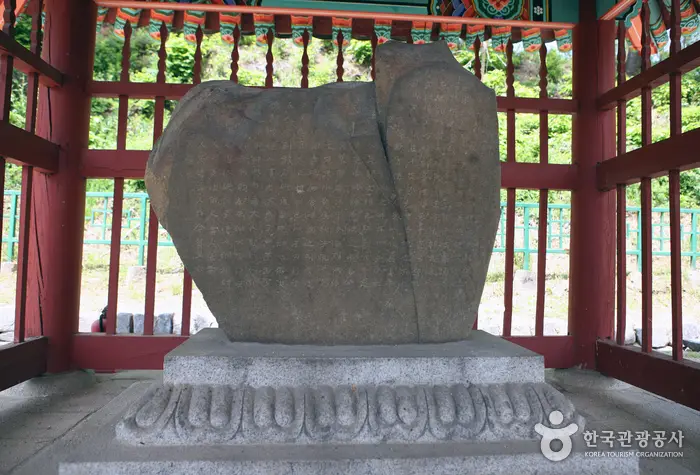
Silla Advances into the Han River Basin, Builds a Fortress, and Erects a Monument
5 stops · 5 hours
Embark on a historical journey along the Namhangang River in Danyang. Silla crossed Jungnyeong Pass to occupy Jeokseong, then a Goguryeo territory, built a fortress, and erected the Jeokseongbi Monument to pacify the local populace. This marked the beginning of Silla's expansion into the Han River basin. The nearby Suyanggae Prehistory Museum exhibits Late Paleolithic relics excavated from an area submerged by the construction of Chungju Dam, offering a glimpse into the lives of Paleolithic people.
- Duration
- 5 hours
- Distance
- 16.7km
Along the way
- 1
Danyang Silla Jeokseongbi Monument
단양 신라 적성비
Designated as National Treasure No. 198, this monument was discovered at Jeokseongsanseong Fortress in 1978. It was erected by King Jinheung, the 24th king of Silla, to instruct and pacify local residents after conquering Goguryeo territory. The discovery of this stele serves as an important academic resource, shedding light on Silla's territorial expansion, key figures of Silla, policies for pacifying conquered lands, official posts, government ranks, and the promulgation of statutory codes at the time. Overlooking the Namhangang River from atop Jeokseong, it is clear that this site served as a strategic fortress during the Three Kingdoms Period.MoreLess
- 2
Danyang Jeokseong Fortress
단양 적성
This is a stone fortress located on Seongjaesan Mountain in Danyang. Although it has a circumference of about 900 meters, most of it has collapsed, leaving only part of the inner wall in the northeastern section where inner and outer stones were stacked. Jeokseongsanseong Fortress is a ridge-type mountain fortress built around the peak and southern slope of Seongjaesan Mountain. It was designated as Historic Site No. 265 on August 1, 1979, and according to historical records such as Sinjeung Dongguk Yeoji Seungnam and Hoseo Eupji Danyang-gunji, it was recorded to have had a circumference of 1,768 cheok.MoreLess
- 3
Suyanggae Prehistory Museum
수양개선사유물전시관
Discovered by the Chungbuk National University Museum during an investigation of the area submerged by the construction of Chungju Dam, this site boasts the largest area among Paleolithic sites discovered in Korea to date. In addition to the vast scope of the site, a large quantity of typical Late Paleolithic stone tools was excavated here, making it recognized as a world-class Paleolithic site. At Suyanggae Prehistory Museum, visitors can view maps and detailed explanations of the Danyang area marking Paleolithic sites, offering a look into the lifestyles and wisdom of Paleolithic people.MoreLess
- 4
Danuri Aquarium
다누리아쿠아리움
The freshwater ecological museum Danuri Aquarium houses approximately 20,000 fish across 63 domestic species and about 1,600 fish across 87 overseas species. It is a place where you can see diverse fish from around the world alongside native species of the Namhangang River, such as golden mandarin fish, sweetfish, and Korean striped bitterlings, all in one place. In addition, the aquariums at Danuri Aquarium are decorated with the theme of the Eight Scenic Views of Danyang, offering an extra spectacle.MoreLess
- 5Dodamsambong Peaks
도담삼봉
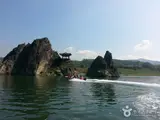
Dodamsambong Peaks stand in the middle of the leisurely flowing, clear blue waters of the Namhangang River. Rising above the water are three peaks: the stately Janggunbong Peak (Husband Peak) in the center, flanked by the coquettish Cheopbong Peak (Concubine Peak/Daughter Peak) on the left and the modestly turned-away Cheobong Peak (Wife Peak/Son Peak) on the right. It is said that Jeong Do-jeon, a founding contributor to the Joseon Dynasty, spent his youth enjoying this scenic spot so much that he took Sambong as his pen name.MoreLess
Source: Korea Tourism Organization (TourAPI) · Machine-translated