In Search of Hidden Wildflower Spots [Welchon]
9 stops · 2 Days, 1 Night
Stroll through tunnels of blooming cherry blossoms, unwind in a phytoncide-rich hinoki cypress forest, and discover hidden gems off the beaten path by exploring Seongdangpogu Ecological Wetland Park—home to lotus flowers in summer, cosmos in autumn, and silver grass fields serving as a winter haven for migratory birds—along with native habitats of the rare Gorancho fern.
- Duration
- 2 Days, 1 Night
- Distance
- 11.66km
Along the way
- 1
Sungnimsa Temple (Iksan)
숭림사(익산)
Sungnimsa Temple is said to have been founded by Master Jinpyo alongside Geumsansa Temple during the reign of King Gyeongdeok of Silla (r. 742–764). However, according to Iksanji (Records of Iksan), written records and inscribed roof tiles currently preserved show that Master Haengyeo rebuilt it in 1345, the first year of King Chungmok of Goryeo, establishing it as a representative temple of the Iksan region. During the Imjin War in the Joseon Dynasty, all structures except Bogwangjeon Hall were destroyed by fire. Ten years later, in 1613 (the 5th year of Gwanghaegun's reign), Uhwaru Pavilion and Yeongwonjeon Hall were newly constructed, followed by Nahanjeon Hall. In 1987, Venerable Jikwang was appointed chief monk and newly built the Bell Pavilion (Beomjonggak), Mountain Spirit Pavilion (Sansingak), One Pillar Gate (Iljumun), Ansimdang dormitories, Haetalgyo Bridge, and Sesimgyo Bridge, leading to its present appearance. The name "Sungnimsa" is said to have taken "Sung" from Mount Song (Sungshan) and "Lim" from Shaolin Temple (Sorimsa) to honor the story of Bodhidharma from South India meditating facing a wall for nine years at Shaolin Temple on Mount Song in China, designating it as a Seon (Zen) Buddhist temple.MoreLess
- 2
Iksan Seongdangpogu Village
익산 성당포구마을
Located to the west of the Geumgang River, Iksan Seongdangpogu Village was home to Seongdangchang, a granary that managed tax grain from the Goryeo Dynasty to the late Joseon Dynasty, and was thus called Seongdangpo or Seongpo. Visitors can relax while learning about the ecosystem of the Geumgang River, viewing traditional yellow-sailed wooden boats (Hwangpodotbae), and admiring murals that depict the history of this traditional port village.MoreLess
- 3
Sungnimsa Temple (Iksan)
숭림사(익산)
Sungnimsa Temple is said to have been founded by Master Jinpyo alongside Geumsansa Temple during the reign of King Gyeongdeok of Silla (r. 742–764). However, according to Iksanji (Records of Iksan), written records and inscribed roof tiles currently preserved show that Master Haengyeo rebuilt it in 1345, the first year of King Chungmok of Goryeo, establishing it as a representative temple of the Iksan region. During the Imjin War in the Joseon Dynasty, all structures except Bogwangjeon Hall were destroyed by fire. Ten years later, in 1613 (the 5th year of Gwanghaegun's reign), Uhwaru Pavilion and Yeongwonjeon Hall were newly constructed, followed by Nahanjeon Hall. In 1987, Venerable Jikwang was appointed chief monk and newly built the Bell Pavilion (Beomjonggak), Mountain Spirit Pavilion (Sansingak), One Pillar Gate (Iljumun), Ansimdang dormitories, Haetalgyo Bridge, and Sesimgyo Bridge, leading to its present appearance. The name "Sungnimsa" is said to have taken "Sung" from Mount Song (Sungshan) and "Lim" from Shaolin Temple (Sorimsa) to honor the story of Bodhidharma from South India meditating facing a wall for nine years at Shaolin Temple on Mount Song in China, designating it as a Seon (Zen) Buddhist temple.MoreLess
- 4
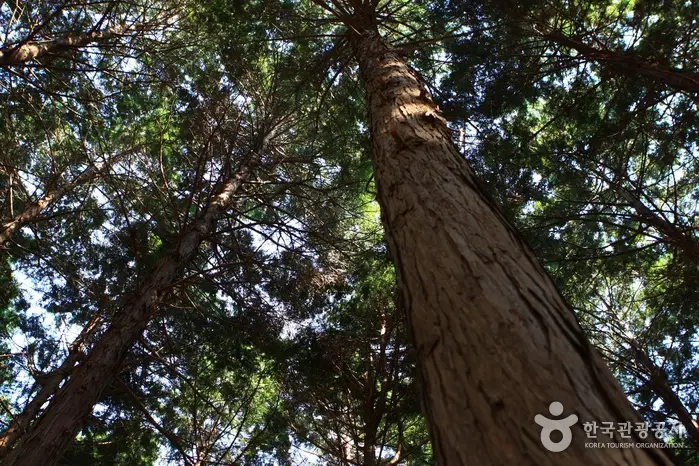
Dudong Hinoki Cypress Forest
두동편백나무숲
Dudong Hinoki Cypress Forest is a place where you can enjoy forest bathing in the rich wood aroma emitted by dense hinoki cypress trees, rest, chat, and set aside life's fatigue for a while. It is a space to shake off daily tension and stress while walking, rejuvenating your mind and body with fresh air.MoreLess
- 5
Former Main Sanctuary of Dudong Church
두동교회 구본당
Named "Dudong Church" because it was built by combining two wings, this church is the only L-shaped ("ㄱ"-shaped) church in Korea alongside Geumsan Church in Gimje, Jeonbuk. The seating areas for men and women were positioned at right angles so they could not see each other, with the pulpit placed at the center where the two axes meet. This design separated movement paths in accordance with the Confucian tradition of gender segregation. Founded over 80 years ago, Dudong Church is still used for worship services on special occasions and remains well preserved after two rounds of restoration.MoreLess
- 6
Dudong Hinoki Cypress Forest
두동편백나무숲
Dudong Hinoki Cypress Forest is a place where you can enjoy forest bathing in the rich wood aroma emitted by dense hinoki cypress trees, rest, chat, and set aside life's fatigue for a while. It is a space to shake off daily tension and stress while walking, rejuvenating your mind and body with fresh air.MoreLess
- 7
Iksan Seongdangpogu Village
익산 성당포구마을
Located to the west of the Geumgang River, Iksan Seongdangpogu Village was home to Seongdangchang, a granary that managed tax grain from the Goryeo Dynasty to the late Joseon Dynasty, and was thus called Seongdangpo or Seongpo. Visitors can relax while learning about the ecosystem of the Geumgang River, viewing traditional yellow-sailed wooden boats (Hwangpodotbae), and admiring murals that depict the history of this traditional port village.MoreLess
- 8
Former Main Sanctuary of Dudong Church
두동교회 구본당
Named "Dudong Church" because it was built by combining two wings, this church is the only L-shaped ("ㄱ"-shaped) church in Korea alongside Geumsan Church in Gimje, Jeonbuk. The seating areas for men and women were positioned at right angles so they could not see each other, with the pulpit placed at the center where the two axes meet. This design separated movement paths in accordance with the Confucian tradition of gender segregation. Founded over 80 years ago, Dudong Church is still used for worship services on special occasions and remains well preserved after two rounds of restoration.MoreLess
- 9
Yongan Ecological Wetland Park / Habitat of Gorancho
용안생태습지공원/고란초 서식지
Yongan Ecological Wetland Park is a large-scale 670,000㎡ ecological wetland park created along the Geumgang River in the Nanpo-ri area of Yongan-myeon as part of the Four Major Rivers Project. The Geumgang ecological wetland serves as a haven for lotus flowers in summer, cosmos and silver grass in autumn, and migratory birds in winter. Adjacent to Yongan Ecological Park is the nation's largest model silver grass field spanning 550,000 pyeong, where the Geumgang Silver Grass Festival is held every autumn.MoreLess
Source: Korea Tourism Organization (TourAPI) · Machine-translated