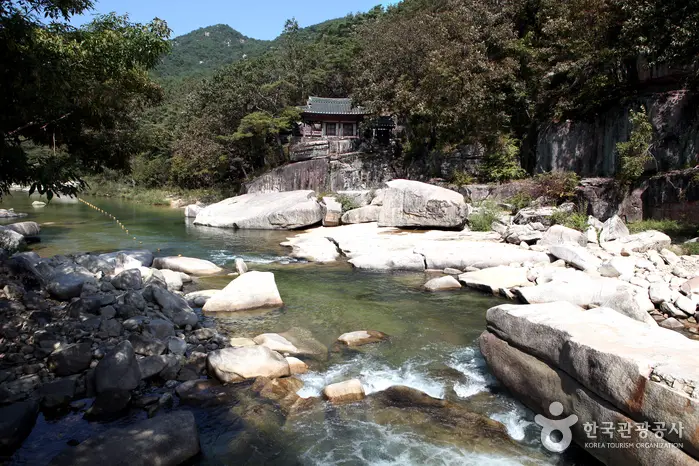
Reciting a Poem by the Clear Waters of Hwayang Gugok and Enjoying the Lush Greenery [Welchon]
6 stops · 1 Night 2 Days
This forest trekking course allows visitors to encounter Goesan's outstanding natural landscapes, including Hwayang Gugok, where clear water flowing over wide bedrock meets dense forests to create a magnificent spectacle, and Sanmagi Old Trail, a beautifully landscaped walking path restored from an old trail that once connected to a mountain village.
- Duration
- 1 Night 2 Days
- Distance
- 43.48km
Along the way
- 1
Hwayang Gugok (Hwayangdong Valley)
화양구곡(화양동계곡)
It was designated as part of Songnisan National Park in 1975 and is located 32 km east of Cheongju. In the mid-Joseon period, the scholar Uam Song Si-yeol lived here in seclusion and named the nine scenic spots (Gyeongcheonbyeok, Un-yeongdam, Eupgung-am, Geumsadam, Cheomseongdae, Neung-undae, Waryong-am, Haksodae, and Pacheon) in Hwayangdong, modeling them after China's Wuyi Gugok. Hwayangdong Valley is located 7 km from Goesan Seonyudong Valley and is a tourist destination where you can enjoy both lush green mountains and clear waters.MoreLess
- 2
Hwayangseowon Confucian Academy
화양서원
Hwayangseowon was established in 1696 (the 22nd year of King Sukjong's reign) to enshrine the spirit tablet of and hold memorial rites for Uam Song Si-yeol, who served as Left State Councillor and was posthumously titled Munjeonggong. It received a royal charter in the year of its founding, and a hanging board inscribed with royal calligraphy was hung in 1716 (the 42nd year of King Sukjong's reign). After the Historic Site of Uam Song Si-yeol was designated as a National Historic Site (Historic Site No. 417) in 1999, two buildings—Songjasa and Seung-sammun—were restored in 2004. The myojeongbi (academy monument), which had been erected in 1716 and later buried underground when the seowon was demolished, was unearthed and re-erected after national liberation. MoreLess
- 3
Mandongmyojeongbi Monument
만동묘정비
A myojeongbi is a monument erected at a shrine or academy that records the reasons for establishing the shrine and praises the venerated figures. This monument is located at Mandongmyo, a shrine where ancestral rites were performed for Emperors Shenzong and Yizong of China's Ming Dynasty, who aided Korea during the Imjin War. Following the teachings of Uam Song Si-yeol, Mandongmyo was built in 1704 (the 30th year of King Sukjong's reign) by his disciple Suam Gwon Sang-ha, 60 years after the death of Emperor Yizong of Ming.MoreLess
- 4
Bihakbong Experience and Recreation Village
비학봉체험휴양마을
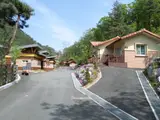
Bihakbong Village, where the Sanmagi Old Trail is located, is a village that offers pristine natural scenery and various hands-on programs for people fatigued and stressed by urban life. Diverse experiential activities are prepared for each season—spring, summer, autumn, and winter—along with well-maintained accommodations.MoreLess
- 5Sanmagi Old Trail
산막이옛길
Sanmagi Old Trail, a scenic mountain bend path, is a 10-ri (approx. 4 km) old road restored as a walking trail that once connected Saorang Village in Oesa-ri, Chilseong-myeon, Goesan-gun, Chungcheongbuk-do, to the remote mountain village of Sanmagi. The harmony of mountains, water, and forests stretching along the old path makes it one of the highlights of Goesan.MoreLess
- 6
Seongbulsan Forest Recreation Complex
성불산 산림휴양단지
Seongbulsan Forest Recreation Complex is a natural recreational forest where visitors can enjoy healing throughout all four seasons. Since 2009, Goesan-gun has invested 25.5 billion KRW to develop the Seongbulsan Forest Recreation Complex in the area of Geomseung-ri, Goesan-eup, and is preparing various facilities across an 81-hectare area, including a natural recreation forest, ecological park, forest tourism megacity, miseonnamu theme park, ecological forest learning center, forest culture recreation hall, and hanok experience hall.MoreLess
Source: Korea Tourism Organization (TourAPI) · Machine-translated