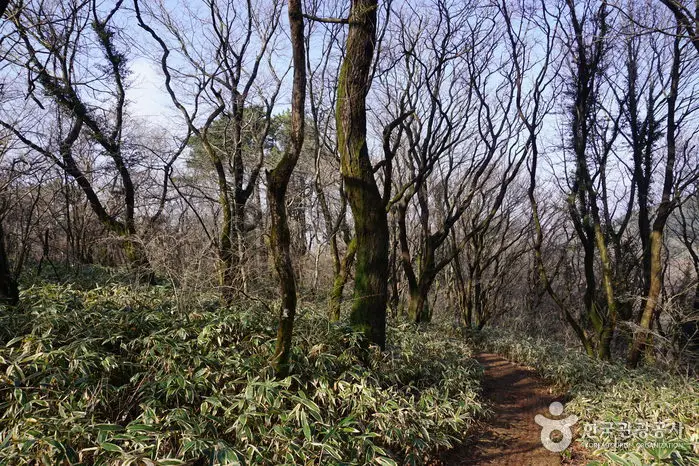
A Course to Stroll Through the Pristine Nature of Jeju
4 stops · 1 day
The beauty of Jeju Island can be described as spanning 'from the sky to the sea.' This course is especially ideal for experiencing the pristine, untouched primeval forests and clean environment of Jeju. It will be a wonderful opportunity to visit a forest preserving the intact ecosystem of Hallasan Mountain, a roe deer park, and unique museums characteristic of Jeju.
- Duration
- 1 day
- Distance
- 30.13km
Along the way
- 1
Halla Eco-Forest
한라생태숲
Halla Eco-Forest covers 196 hectares of state-owned land managed by the Korea Forest Service, located along the 5.16 Road at an elevation of 600 meters. From the early 1970s until 1995, this land was leased to private individuals and used as pasture for horses and cattle. Befitting a repository of Jeju's flora, the forest was ecologically restored by planting 288,000 trees across 333 species, harmoniously incorporating diverse flora ranging from warm-temperate, temperate, to subalpine plants. The Gotjawal terrain and natural forest areas are planned to be managed as genetic resource conservation zones. The site features infrastructure such as ecological trails, an observatory, nursery greenhouses, themed walking paths, and a tissue culture lab for genetic conservation, as well as 13 themed forests—including maple, cherry, Korean fir, and Rhododendron weyrichii forests—along with a central rock garden that serves as a miniature version of the entire eco-forest, presenting the true essence of a thriving forest.MoreLess
- 2
Jeju Roe Deer Observation Center
제주 노루생태관찰원
Jeju Roe Deer Observation Center opened on August 3, 2007. Across a 52-hectare area where various flora and fauna are naturally preserved, the center features forest trails where visitors can observe roe deer roaming freely on the oreum (volcanic cone), as well as a regular observation area where visitors can see the deer up close, touch them, and participate in feeding experiences. The exhibition hall includes the Animal Stories Pavilion showcasing Jeju's diverse wildlife and the vegetation distribution of Hallasan Mountain, the Roe Deer Ecology Pavilion providing knowledge on the characteristics of roe deer and historical records concerning them, and the Roe Deer Story Video Hall presenting their ecology and lifestyle through video. Set against a blessed natural environment, the Roe Deer Observation Center is a space where visitors can directly observe roe deer—a symbol of Jeju—relax, and gain knowledge about them, offering both nature study and ecological experiences at the same time.MoreLess
- 3Jeju Stone Park
제주돌문화공원
Jeju Stone Park is a museum and ecological park that comprehensively and systematically showcases the stone culture of Jeju, the land of stones. With the entire park slated for full completion by 2020, its first phase—including the Jeju Stone Museum, Jeju Stone Culture Exhibition Hall, and traditional Jeju thatched-roof houses—was completed and opened on June 3, 2006, seven years after construction began. Allowing visitors to explore Jeju's stone culture in one place, the park is vast, so it is best to tour it at a leisurely pace. Jeju Stone Park is situated in front of an oreum, a unique natural heritage of Jeju. Following a gentle uphill path built along stone fortress-style walls brings visitors to the entrance of the park, offering refreshing open views of the surroundings.MoreLess
- 4
Jeju National Museum
국립제주박물관
Opened on June 15, 2001, Jeju National Museum is an archaeological and historical museum that systematically exhibits, preserves, and researches the history and cultural heritage of Jeju. Centered on historical relics and artifacts excavated from various archaeological sites across Jeju, the museum presents the historical and cultural significance of each site and artifact from prehistoric times to the Joseon Dynasty. It systematically introduces the unique and indigenous culture of Tamna through specialized Tamna culture exhibition spaces, while hosting special exhibitions with diverse themes every year. In addition, the museum strives to serve as a cultural space that systematically presents the development of Jeju's indigenous culture to both domestic and international visitors through a variety of educational and community programs.MoreLess
Source: Korea Tourism Organization (TourAPI) · Machine-translated