Head to Seocheon for the Best of Ecotourism!
4 stops · 2 Days 1 Night
Set against the backdrop of the West Sea sunset, vast reed beds spanning over 198,000 square meters stretch out endlessly, where rare migratory birds perform spectacular group dances. What's more, it is a hub of ecotourism home to the National Institute of Ecology and the National Institute of Marine Biodiversity of Korea. If you want to take in all these sights and treasure them in your heart, take a trip to Seocheon.
- Duration
- 2 Days 1 Night
- Distance
- 67.25km
Along the way
- 1Munheonseowon Confucian Academy
문헌서원
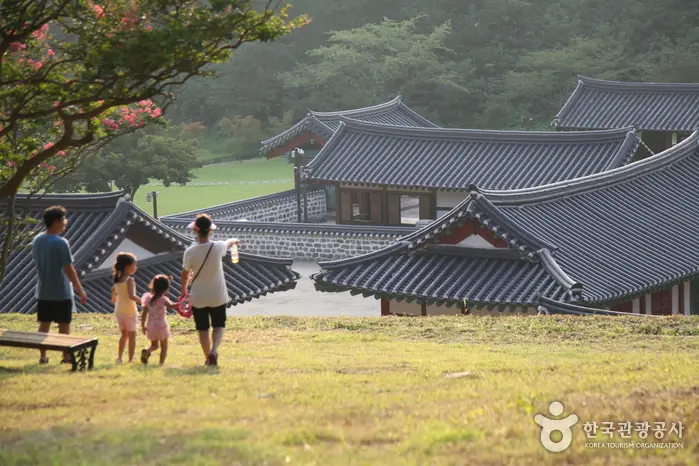
In 1594 (the 27th year of King Seonjo's reign), it was established by a consensus of local Confucian scholars to commemorate the scholarship and virtue of Yi Gok and Yi Saek, and housed their spirit tablets. After being destroyed during the Japanese invasions of Korea (Imjin War), it was relocated to Gochon, Hansan, and restored in 1610 (the 2nd year of King Gwanghaegun's reign). In 1611, it received a royal charter named 'Munheon', and Yi Jong-hak, Yi Gae, and Yi Ja were additionally enshrined. While playing a part in venerating past sages and educating local youth, it was demolished in 1871 (the 8th year of King Gojong's reign) due to the Regent Heungseon Daewongun's seowon abolition decree, after which an altar was set up in its place to burn incense. Later, in 1969, local Confucian scholars restored it and additionally enshrined Yi Jong-deok. The buildings within the grounds include a 3-kan shrine (sau), a 6-kan 2-story lecture hall pavilion, a 4-kan Jinsudang, a 3-kan Mokeun Yeongdang (portrait hall), a 5-kan jaesil (ritual house), a 3-kan jeonsacheong (ritual preparation hall), a 3-kan suhosa (guardian house), naesammun (inner three-panel gate), oesammun (outer three-panel gate), Yi Saek's Stele, and Yi Jong-deok's Filial Piety Monument Pavilion. MoreLess
- 2
National Institute of Marine Biodiversity of Korea
국립해양생물자원관
The National Institute of Marine Biodiversity of Korea carries out diverse research to systematically preserve and utilize marine bioresources, and promotes the value of marine bioresources through multifaceted exhibitions and educational programs. It offers various marine life exhibits, 4D screenings, and exhibition commentaries. The Seed Bank in the first-floor lobby, with 5,000 marine life specimens stacked like a tower, is the symbol of this place. The interactive media wall—where a shark appears over your head or your hands turn into crayfish claws when standing before the wall—and the sophisticated robotic fish also stimulate visitors' curiosity.MoreLess

- 3
National Institute of Ecology (Seocheon)
국립생태원(서천)
The National Institute of Ecology is a national institution established to pursue a sustainable balance between the conservation of the natural environment and the public's right to pursue happiness. At the Ecorium, visitors can experience various ecosystems including tropical, temperate, Mediterranean, and polar biomes. Diverse ecological experiences and education programs also take place in outdoor ecological spaces such as wetland ecosystems.MoreLess
- 4Seocheon Maryang-ri Camellia Forest
서천 마량리 동백나무 숲
One of the Eight Scenic Views of Seocheon, the Maryang-ri Camellia Forest in Seo-myeon is designated as Natural Monument No. 169. Here, 85 camellia trees, around 500 years old, form a dense forest across 8,265㎡. If you visit the camellia forest from late March to early May, you can fully enjoy the shy red camellia blossoms blooming among the green leaves. Climbing up to Dongbaekjeong Pavilion at the summit allows you to take in the blue sea of the West Sea and the beauty of the sunset all at once. In particular, the view of the sea combined with the scenery of Oryeokdo Island right in front offers the delight of admiring an oriental painting.MoreLess
Source: Korea Tourism Organization (TourAPI) · Machine-translated