A Place Steeped in the True Scent of Baekje Culture
4 stops · 1 day
When people think of 'Baekje,' Buyeo and Gongju often come to mind. However, Iksan is also a prime city where you can witness the traces of the brilliantly flourished Baekje culture. This journey takes you to encounter the blossom of culture in Iksan, where the somewhat rustic yet heartwarming, tranquil countryside still retains its old charm.
- Duration
- 1 day
- Distance
- 59.27km
Along the way
- 1
Iksan Cultural Center
익산문화원
The Iksan Cultural Center was established on January 17, 1991, to foster community development and promote local culture. Since then, it has taken the lead in hosting local cultural events, collecting, preserving, and distributing cultural materials, conducting domestic exchanges of regional traditional culture, running social education programs on local culture, and pursuing other projects that contribute to regional development. In particular, the Iksan Cultural Center is characterized by activities such as the Youth Summer Culture School, city and county nongak (farmers' music) competitions, participation in Jeonbuk folk games, and the publication of Iksan cultural heritage and cultural magazines, while offering opportunities to directly participate in and learn from various exciting activities. In particular, the Iksan Cultural Center is characterized by activities such as the Youth Summer Culture School, city and county nongak (farmers' music) competitions, participation in Jeonbuk folk games, and the publication of Iksan cultural heritage and cultural magazines, while offering opportunities to directly participate in and learn from various exciting activities.MoreLess
- 2
Hwasan Catholic Church (Nabawi Shrine)
화산천주교회(나바위 성당)
As a sacred site of Korean Catholicism, Nabawi Shrine boasts several attractions. The first highlight is the Monument to the Martyrdom of Father Kim Dae-geon. This monument was erected on the 100th anniversary of Father Kim Dae-geon's martyrdom. The second highlight is Manggeumjeong Pavilion. Meaning 'wishing for beauty,' Manggeumjeong is a pavilion built in 1915 by Father Vermorel to assist Bishop Demange, the first bishop of the Daegu Diocese, with his retreats. This pavilion is located on Nabawi, a wide rock at the edge of Hwasan Mountain, boasting its beauty in harmony with the surrounding landscape.MoreLess
- 3
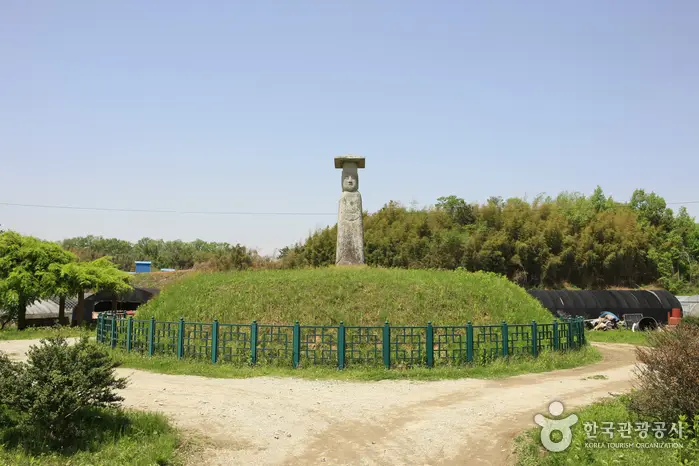
Standing Stone Buddha Statues in Godo-ri, Iksan
익산 고도리 석조여래입상
The Standing Stone Buddhas in Godo-ri, Iksan, are a pair of stone statues facing each other across a distance of about 200 meters, designated as Treasure No. 46 on January 21, 1963. Faces, hands, and pedestals are depicted on trapezoidal stone pillars. These stone Buddhas are male and female statues standing face to face about 200 meters apart. The bodies are flat, trapezoidal stone pillars without curvature, and the arms are not expressed, with the hands barely shown on the abdomen. On the head, a square hat is placed over a tall square crown. On the square face, slender eyes, a short nose, and a small mouth are barely expressed, presenting the expression of a folk guardian deity. MoreLess
- 4
Wanggung-ri Historic Site, Iksan [UNESCO World Heritage]
익산 왕궁리유적[유네스코 세계유산]
Designated as Historic Site No. 408 on September 17, 1998, this site covers an area of 216,862㎡. Also known as 'Wanggung-ri Fortress Site,' it is associated with theories of being the capital of Mahan, the capital or secondary capital relocated by King Mu of Baekje, the Bodeokguk of Anseung, or the capital of Gyeon Hwon of Later Baekje. Archaeological excavations suggest that this site was formed over at least three periods (from late Baekje to late Unified Silla). Two tile kilns believed to date from the Unified Silla period were discovered 30 meters east of the stone pagoda. In particular, fortress relics believed to be a rectangular flatland fortress centered around the hills surrounding the pagoda were found.MoreLess

Source: Korea Tourism Organization (TourAPI) · Machine-translated