Gunsan History and Culture Exploration Time Travel
8 stops · 7 hours
Gunsan is a city where the past, present, and future coexist. While traveling in Gunsan, the traces of the Japanese colonial period are so vividly present in its streets, buildings, and railroads that one might feel as if they took a time machine back in time. The present life of Gunsan's residents, who persevered and maintained their home through such difficult times, is all the more touching.
- Duration
- 7 hours
- Distance
- 17.45km
Along the way
- 1
Chae Man-sik Literary Museum
채만식 문학관
Built near the Geumgang River Estuary Bank to honor the literary achievements of Chae Man-sik and promote local literary arts, the Chae Man-sik Literary Museum opened after completing its internal facilities and complex construction. It also produced the opera "Takryu" (Muddy Stream), which was successfully performed six times at the Gunsan Civic Cultural Center.MoreLess
- 2
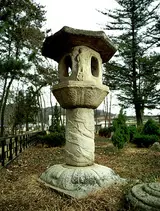
Stone Lantern in Balsan-ri, Gunsan
군산 발산리 석등
The Stone Lantern in Balsan-ri is a work from the Goryeo Dynasty, and was taken out by Shimatani from the Bongrimsa Temple site in Samgi-ri, Gosan-myeon, Wanju-gun during the Japanese colonial period. Eight downward-facing double lotus petals are carved on the lower base stone, and a dragon grinning with exposed teeth is humorously carved on the pillar stone. This makes it the only stone lantern in Korea with a dragon carved on its pillar. In addition, the base foundation stone is currently kept in the Jeonbuk National University Museum. As a work from the early Goryeo Dynasty, it stands 2.5 meters tall, and its dragon pattern carving on the pillar is characteristic; it was relocated from the Bongrimsa Temple site in Samgi-ri, Wanju-gun by a Japanese landowner. It is currently located inside Balsan Elementary School. The current site of Balsan Elementary School was where the Japanese plantation owner Shimatani's house and farm were located in the 1900s, and a large number of cultural relics collected by the Japanese plantation owner at that time are preserved here.MoreLess
- 3
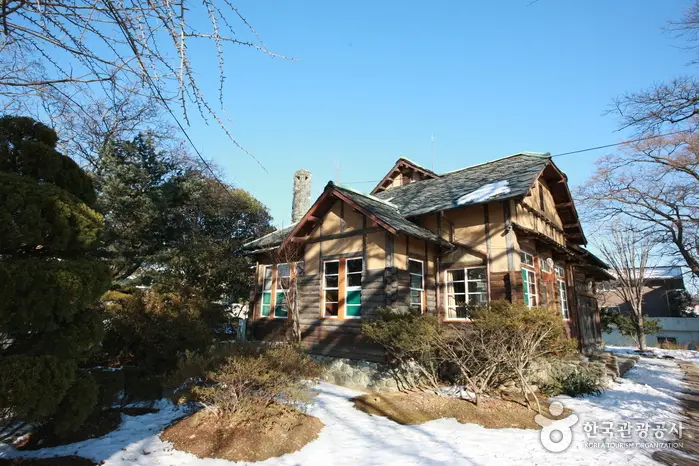
Lee Yeong-chun House
이영춘 가옥
This villa residence was built by Kumamoto Rihei, a wealthy Japanese landowner who operated a large-scale plantation in Gunsan during the Japanese colonial period. Used as a temporary residence when visiting the plantation during the spring and harvest seasons, this villa-like building displays a variety of eclectic architectural features blending Western, Korean, and Japanese styles. After liberation, it came to be called the Lee Yeong-chun House as Dr. Ssangcheon Lee Yeong-chun, a pioneer of rural healthcare and hygiene in Korea, resided here. Thanks to its beautiful exterior, it has served as a filming location for numerous movies and dramas, such as "Freezing Point," "Sandglass," and "The Age of Success."MoreLess
- 4Jinpo Maritime Theme Park
진포해양테마공원
Jinpo Maritime Theme Park is a maritime park opened in 2008 to commemorate the Battle of Jinpo, where General Choe Mu-seon built shipboard cannons and defeated around 500 Japanese pirate ships during the late Goryeo Dynasty. Against the backdrop of the vast sea bordering the port, visitors can see 16 pieces across 13 types of retired military equipment. Retired army, navy, and air force equipment that served on the front lines to defend the nation—including naval vessels such as the LST-676 Weibong which was deployed to the Vietnam War, armored vehicles, self-propelled artillery, and fighter jets—are on display. Visitors can go inside the military equipment and experience boarding them firsthand. Inside the Weibong ship, an exhibition hall showcases a diorama of the Battle of Jinpo, weapons used at the time, stories of the firearms made by General Choe Mu-seon, and an experiential display of naval barracks life.MoreLess

- 5
Chae Man-sik Literary Museum
채만식 문학관
Built near the Geumgang River Estuary Bank to honor the literary achievements of Chae Man-sik and promote local literary arts, the Chae Man-sik Literary Museum opened after completing its internal facilities and complex construction. It also produced the opera "Takryu" (Muddy Stream), which was successfully performed six times at the Gunsan Civic Cultural Center.MoreLess
- 6
Stone Lantern in Balsan-ri, Gunsan
군산 발산리 석등
The Stone Lantern in Balsan-ri is a work from the Goryeo Dynasty, and was taken out by Shimatani from the Bongrimsa Temple site in Samgi-ri, Gosan-myeon, Wanju-gun during the Japanese colonial period. Eight downward-facing double lotus petals are carved on the lower base stone, and a dragon grinning with exposed teeth is humorously carved on the pillar stone. This makes it the only stone lantern in Korea with a dragon carved on its pillar. In addition, the base foundation stone is currently kept in the Jeonbuk National University Museum. As a work from the early Goryeo Dynasty, it stands 2.5 meters tall, and its dragon pattern carving on the pillar is characteristic; it was relocated from the Bongrimsa Temple site in Samgi-ri, Wanju-gun by a Japanese landowner. It is currently located inside Balsan Elementary School. The current site of Balsan Elementary School was where the Japanese plantation owner Shimatani's house and farm were located in the 1900s, and a large number of cultural relics collected by the Japanese plantation owner at that time are preserved here. MoreLess
- 7
Lee Yeong-chun House
이영춘 가옥
This villa residence was built by Kumamoto Rihei, a wealthy Japanese landowner who operated a large-scale plantation in Gunsan during the Japanese colonial period. Used as a temporary residence when visiting the plantation during the spring and harvest seasons, this villa-like building displays a variety of eclectic architectural features blending Western, Korean, and Japanese styles. After liberation, it came to be called the Lee Yeong-chun House as Dr. Ssangcheon Lee Yeong-chun, a pioneer of rural healthcare and hygiene in Korea, resided here. Thanks to its beautiful exterior, it has served as a filming location for numerous movies and dramas, such as "Freezing Point," "Sandglass," and "The Age of Success."MoreLess
- 8Jinpo Maritime Theme Park
진포해양테마공원
Jinpo Maritime Theme Park is a maritime park opened in 2008 to commemorate the Battle of Jinpo, where General Choe Mu-seon built shipboard cannons and defeated around 500 Japanese pirate ships during the late Goryeo Dynasty. Against the backdrop of the vast sea bordering the port, visitors can see 16 pieces across 13 types of retired military equipment. Retired army, navy, and air force equipment that served on the front lines to defend the nation—including naval vessels such as the LST-676 Weibong which was deployed to the Vietnam War, armored vehicles, self-propelled artillery, and fighter jets—are on display. Visitors can go inside the military equipment and experience boarding them firsthand. Inside the Weibong ship, an exhibition hall showcases a diorama of the Battle of Jinpo, weapons used at the time, stories of the firearms made by General Choe Mu-seon, and an experiential display of naval barracks life.MoreLess
Source: Korea Tourism Organization (TourAPI) · Machine-translated