An Exciting Journey into the Tales of Gimcheon
4 stops · 1 day
Gimcheon is known as the land of Samsan-isu (three mountains and two waters), shaped by the convergence of three mountains and two waterways. Honest and bold attractions, much like the rough and rustic local dialect, are situated throughout the region. Explore Gimcheon, a place boasting fascinating stories and refreshing scenery, with spirited strides on foot...
- Duration
- 1 day
- Distance
- 39.20km
Along the way
- 1
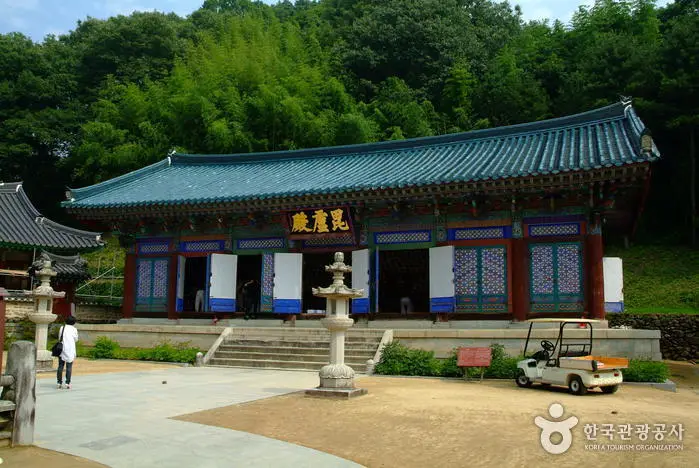
Jikjisa Temple
직지사
Located at the foot of Hwangaksan Mountain, 12 km west of Gimcheon Station, Jikjisa Temple was founded in 418 (the 2nd year of King Nulji of Silla) by the Buddhist monk Ado. The lush ancient pine trees surrounding the temple grounds, the crystal-clear waters of the deep valley, and the autumn foliage offer spectacular views that harmonize beautifully with the surrounding landscape. Within the temple grounds is Birojeon Hall (also known as Cheonbuljeon Hall), where 1,000 small Buddha statues are enshrined side by side. Other notable features include the Iljumun Gate made from 1,000-year-old arrowroot vines and bush clover pillars, Daeungjeon Hall, a representative building of the Joseon dynasty, and the Seated Stone Bhaisajyaguru Buddha (Treasure No. 319), a 1.63-meter-tall work from the Unified Silla period. Additionally, an International Buddhist Training Center capable of accommodating 5,000 people was completed in May 1994. MoreLess
- 2
Jikji Cultural Park
직지문화공원
Located in Gimcheon-si, Gyeongsangbuk-do, this park was created to prevent reckless development in the surrounding area, preserve traditional temples, develop tourism resources, and provide a relaxation space for citizens. Centered around a musical sculpture fountain in the middle, the park is equipped with various amenities and facilities, including three plazas, a large two-tiered waterfall measuring 25 meters wide and 17 meters high, a 330-meter stream facility that channels clear water from the grounds of Jikjisa Temple directly into the park, 10 types of comprehensive children's play facilities, 3,600 meters of walking trails made of acupressure paths, decomposed granite, and clay blocks, uniquely shaped pavilions and pergolas, and benches for resting.MoreLess
- 3
Gimcheon World Porcelain Museum
김천 세계도자기박물관
The Gimcheon World Porcelain Museum is located at the entrance to Jikjisa Temple in Gimcheon. The museum was established when Yeongja Bokjeon (Eiko Fukuda), a second-generation Korean resident in Japan, donated 1,019 pieces of Western porcelain, crystal, and other items to Gimcheon-si. The opening of the museum has enhanced the city's reputation as a high-caliber city of culture and the arts. Experiencing the splendid and elegant beauty of rare, masterpiece ceramics at the Gimcheon World Porcelain Museum will make for a meaningful time.MoreLess

- 4
Cheongamsa Temple (Gimcheon)
청암사(김천)
Cultural heritage items at Cheongamsa Temple include the Cheongamsa Daeungjeon Hall, the Cheongamsa Multi-story Stone Pagoda, and the Cheongamsa Bogwangjeon Hall. Its buildings include Daeungjeon Hall, Yukhwajeon Hall, Jin-yeonggak Hall, Jeongbeomnu Pavilion, Iljumun Gate, Sacheonwangmun Gate, a stele pavilion, and a guest hall. Among them, Daeungjeon Hall has been designated as Gyeongsangbuk-do Cultural Heritage Material No. 120, and Yukhwajeon Hall is a building that was formerly used as a lecture hall (Gangwon). In addition, Jeongbeomnu Pavilion currently functions as a bell pavilion. Preserved artifacts include a stone pagoda designated as Gyeongsangbuk-do Cultural Heritage Material No. 121, a group of stupas, and various stone steles.MoreLess
Source: Korea Tourism Organization (TourAPI) · Machine-translated