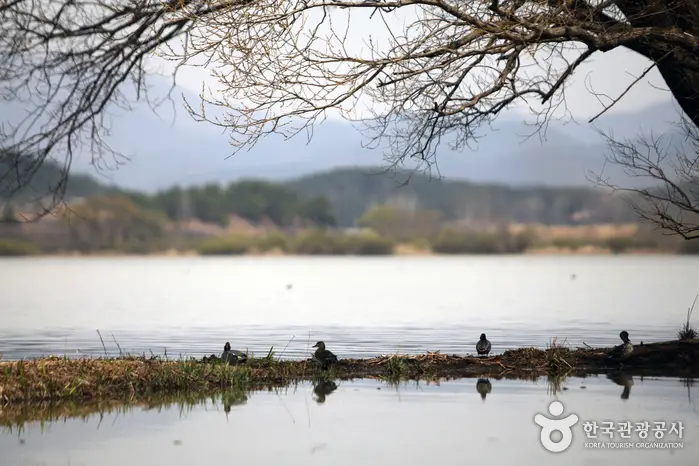
Encountering the Pristine Nature and Cultural Heritage that Graces Changnyeong
3 stops · 6 hours
When thinking of Changnyeong, Upo Wetland, a "living natural history museum," is often the first thing that comes to mind. However, it is also a "roofless history museum" where you can encounter precious cultural heritage spanning from the Gaya era to the Joseon dynasty throughout the region. After exploring Upo Wetland and its beautiful cultural heritage, finishing your trip by unwinding at Bugok Onsen (Hot Springs) completes the perfect Changnyeong tour!
- Duration
- 6 hours
- Distance
- 10.93km
Along the way
- 1Changnyeong Upo Wetland
창녕 우포늪
Upo Wetland is the largest natural inland wetland in Korea. Spanning across three townships in Changnyeong-gun, Gyeongsangnam-do—Yueo-myeon, Ibang-myeon, and Daehap-myeon—it has a perimeter of 7.5 km and covers a total area of 2,314,060 m². The wetland is believed to have first begun forming approximately 140 million years ago. During the Cretaceous Period of the Mesozoic Era, the age of dinosaurs, the sea level rose rapidly, and the ground along the Nakdonggang River basin subsided. Consequently, water flowing into the Nakdonggang River from this area gathered to form wetlands and natural lakes, which became a playground for the dinosaurs that ruled the Earth at the time. Today, dinosaur footprint fossils presumed to date back to that era remain in Sejin-ri, Yueo-myeon, near Upo Wetland.MoreLess
- 2
Changnyeong Seokbinggo Ice Storage
창녕 석빙고
A seokbinggo is a stone ice storage facility that highlights the wisdom of ancestors who harvested ice during the cold winter and stored it for use in the hot summer. This ice storage is believed to have been renovated during the Joseon dynasty. This is inferred from its structural style and the fact that the custom of storing ice was institutionalized and widely practiced during that period. The earthen mound of this ice storage remains almost completely intact; its exterior resembles a giant ancient tomb, and it was constructed lengthwise from north to south at a right angle to the stream flowing behind it. MoreLess
- 3
Changnyeong Suljeong-ri Ha Family Thatched House (Ha Byeong-su House)
창녕술정리하씨초가(하병수 가옥)
A Joseon-era house, it is said to have been built by Baekyeon, the 17th-generation ancestor of Ha Byeong-su. In addition, an ink inscription on the sangdori (upper purlin) mentioning the 25th year of Qianlong suggests it was built in 1760 (the 36th year of King Yeongjo's reign). This south-facing thatched-roof house, which offers insight into Joseon-era house structures and folk architectural techniques, is an ancestral site where the Ha clan lived for generations.MoreLess
Source: Korea Tourism Organization (TourAPI) · Machine-translated