Stepping into Prehistoric Sites and the Frontlines of Division
5 stops · 1 day
Yeoncheon, the northernmost frontline border region of Gyeonggi-do, embraces both pristine nature within the Civilian Control Zone (CCZ) and the ancient living sites of prehistoric people. Discover stories of hope in Yeoncheon, a land of pure and clear nature.
- Duration
- 1 day
- Distance
- 65.93km
Along the way
- 1
Jaein Falls
재인폭포
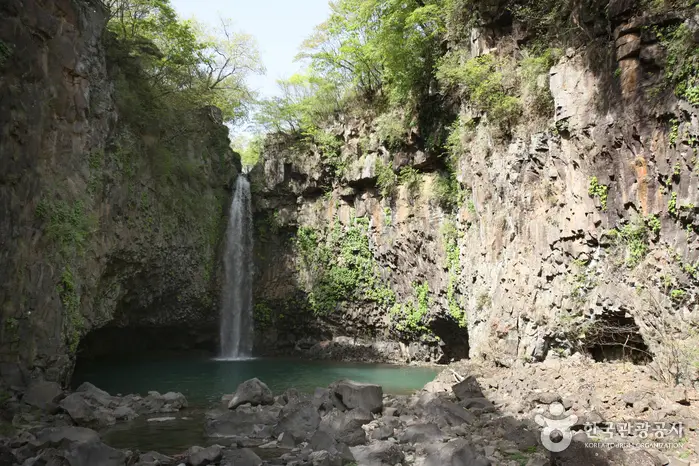
Originating from Jijangbong Peak (877m), this waterfall is nestled deep in the western part of the Hantangang River. The clear and cool stream formed by the approximately 18-meter-high waterfall, along with the surrounding lush forest, creates a scenic view. It is especially popular with visitors in summer and autumn. According to legend, a local magistrate fell in love with the extraordinary beauty of an acrobat's (jaein) wife, and forced the acrobat to walk a tightrope over this waterfall to cause his death and claim his wife, whereupon she took her own life. Ever since, people have called this waterfall Jaein Falls after the lingering sorrow of the acrobat.MoreLess
- 2Jeongok Prehistory Musuem
전곡선사박물관
Jeongok Prehistory Musuem is a site museum built at the Jeongok-ri Paleolithic Site, a historic location that rewrote the history of global Paleolithic research with the discovery of East Asia's first Acheulean hand axe. Centered around Paleolithic artifacts such as Acheulean hand axes excavated from the Jeongok-ri Paleolithic Site, the exhibition spaces are organized with artifacts covering diverse themes to provide a systematic understanding of human evolution and Paleolithic culture.MoreLess
- 3
Pureunae Village [Rural Experience]
푸르내마을 [농촌체험]
With an active rural experience program that draws bustling crowds of visiting families on weekends, this village offers hands-on harvesting experiences for various crops such as potatoes, cucumbers, and tomatoes. It runs diverse programs for experiencing rural culture, including cooking with harvested produce, catching catfish, crafting with common rush, and making gochujang (chili paste).MoreLess
- 4Typhoon Observatory
태풍전망대
Typhoon Observatory was built on December 3, 1991, by the Invincible Typhoon Division. It is located on Suribong, the highest peak of Bikkisan Mountain in Jung-myeon, about 65 km from Seoul and about 140 km from Pyongyang. Initially, the Southern Limit Line and Northern Limit Line were set 2 km from the Military Demarcation Line, but as North Korea erected wire fences close to the Armistice Line in 1968, South Korea also partially installed wire fences in 1978. Located 800 m from the Armistice Line and 1,600 m from a North Korean guard post, Typhoon Observatory is renowned as the closest observatory to North Korea along the 155-mile Armistice Line. MoreLess
- 5
Yeoncheon Station Water Tower
연천역 급수탑
The Yeoncheon Station Water Tower, along with the water towers at Dogye Station in Gangwon-do, Chupungnyeong Station, Yeonsan Station in Chungnam, Andong Station in Gyeongbuk, Yeongcheon Station, and Samnangjin Station in Gyeongnam, was recognized as a major heritage for understanding railway history and researching modern transportation history, and was designated as a Registered Cultural Heritage in January 2003.MoreLess

Source: Korea Tourism Organization (TourAPI) · Machine-translated