A Walk Through UNESCO World Heritage Sites in Namyangju
4 stops · 1 day
Namyangju is a blessed city endowed with outstanding scenery, centered around Cheonmasan Mountain, surrounded by Chukryeongsan, Buramsan, and Ungilsan Mountains, and bordered by the Namhangang and Bukhangang Rivers. Visiting this city allows you to appreciate just how precious the leisurely pace of a slow-living lifestyle can be.
- Duration
- 1 day
- Distance
- 63.48km
Along the way
- 1
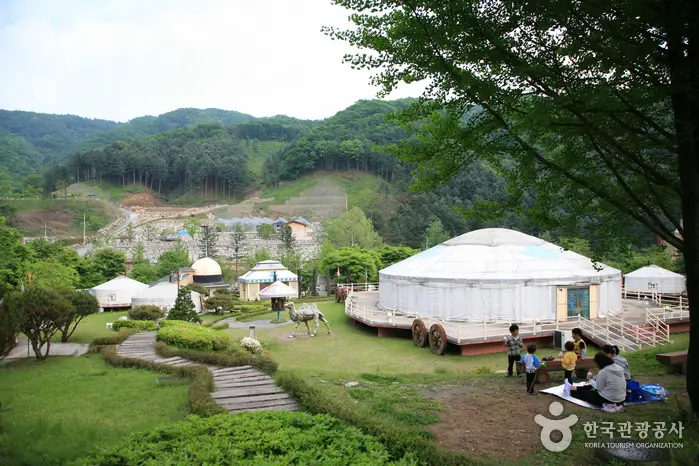
Mongolian Culture Town
몽골문화촌
Nestled at the foot of Cheonmasan Mountain in Namyangju-si, Gyeonggi-do, Mongolian Culture Town was established following a friendship and cooperation agreement signed between Namyangju-si and Ulaanbaatar, Mongolia, in 1998, offering visitors an opportunity to experience traditional Mongolian culture and arts. Nestled at the foot of Cheonmasan Mountain in Namyangju-si, Gyeonggi-do, Mongolian Culture Town was established following a friendship and cooperation agreement signed between Namyangju-si and Ulaanbaatar, Mongolia, in 1998, offering visitors an opportunity to experience traditional Mongolian culture and arts.MoreLess
- 2
Bongseonsa Temple (Gyeonggi)
봉선사(경기)
The history of Bongseonsa Temple dates back to the Goryeo dynasty. Originally, a temple named Unaksa, founded by National Preceptor Beobin in 969 (the 20th year of King Gwangjong of Goryeo), stood on this site. After it fell into ruins through several wars and turmoils, Queen Jeonghui of the Papyeong Yun clan (queen consort of King Sejo, the 7th monarch) rebuilt it in 1469 (the 1st year of King Yejong, the 8th monarch of the Joseon dynasty) to enshrine the spirit of King Sejo, and renamed it Bongseonsa Temple. Since then, Bongseonsa Temple has been destroyed and rebuilt seven times through events such as the Japanese Invasions of Korea (Imjin War), the Manchu Invasions (Byeongja Horan), and the Korean War.MoreLess
- 3
Sareung Royal Tomb, Namyangju [UNESCO World Heritage]
남양주 사릉[유네스코 세계문화유산]
Sareung is the tomb of Queen Jeongsun (1440–1521) of the Song clan, the consort of King Danjong and one of the most tragic women of the Joseon dynasty. As the tomb of a queen, Sareung is modest and simple compared to other royal tombs. The scale of the tomb is very small, without byeongpungseok (wide rectangular stones erected around the upper perimeter of a mound like a folding screen to protect it), and features only munseokin (stone civil officials erected in front of the tomb) and seongma (stone horses placed in front of the tomb). MoreLess
- 4
Hongneung and Yureung Royal Tombs, Namyangju [UNESCO World Heritage]
남양주 홍릉과 유릉[유네스코 세계문화유산]
Designated as Historic Site No. 207, this site houses the tombs of the last two emperors of the Joseon dynasty and their empresses. Hongneung is the tomb of Emperor Gojong, the 26th monarch of Joseon, and Empress Myeongseong of the Min clan, while Yureung is the tomb of Emperor Sunjong, the 27th monarch, his first consort Empress Sunmyeong of the Min clan, and his second consort Empress Sunjeong of the Yun clan. Unlike conventional Joseon royal tombs, Hongneung and Yureung were constructed in the style of the Xiaoling Tomb of Emperor Taizu of Ming, reflecting their status as emperors since the Gwangmu era. Instead of the traditional T-shaped wooden shrine (jeongjagak), an imperial resting pavilion (chimjeon) measuring five bays wide and four bays deep was built. In front of it stand stone civil and military officials, followed by rows of stone animals in the order of giraffes (qilin), elephants, haetae, lions, camels, and horses leading to the hongsalmun (red spiked gate). While the stone statues at Hongneung were crafted using traditional techniques, those at Yureung are realistic, distinctive, and richly three-dimensional.MoreLess
Source: Korea Tourism Organization (TourAPI) · Machine-translated