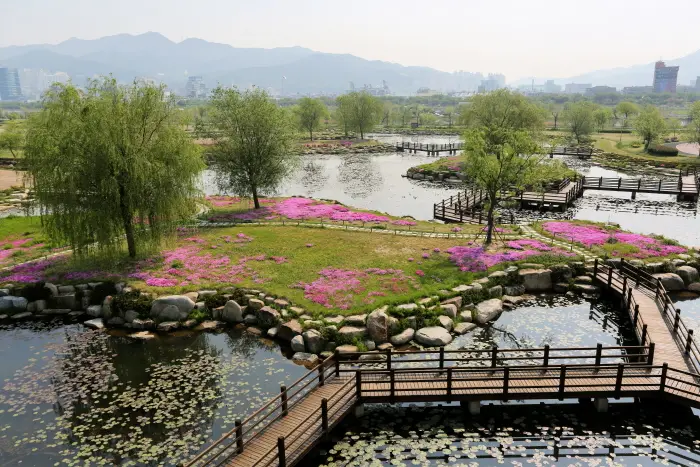
Natural Ecology Experience Course in Busan
4 stops · 1 day
Busan is a large coastal city offering endless courses, hands-on activities, and entertainment. Among them, this course allows visitors to thoroughly explore both the land and marine environments, as well as the diverse living creatures surrounding Busan. Do not forget to taste various Busan delicacies along the way.
- Duration
- 1 day
- Distance
- 28.68km
Along the way
- 1
Samnak Eco Park
삼락생태공원
Samnak Eco Park is a riverside wetland area spanning from Eomgung-dong, Sasang-gu on the left bank of the Nakdonggang River to the Gangseo Nakdongdaegyo Bridge in Samnak-dong, making it the largest among the four riverside areas in the Nakdonggang River estuary. Located within the Habitat of Migratory Birds on the Lower Nakdonggang River (Natural Monument No. 179), it is equipped with various amenities such as wetlands, migratory bird feeding grounds, a grass plaza, wildflower gardens, bicycle paths, walking courses, an auto camping site, and a water sports town. Various sports facilities for citizens (59 courts/fields across 13 sports) are developed in the central and uppermost parts of Samnak Eco Park, and walking trails run through wetlands formed of reed and willow colonies in the upper area. The lower Eomgung area features well-formed waterways and reed wetlands, attracting many migratory birds in winter.MoreLess
- 2
Amnam Park
부산 암남공원
It covers an area of 562,500㎡. As a nature park, it is adjacent to South Port to the east, Gamcheon Port to the west, and the Animal Quarantine Station in front. To the south, it connects to Hallyeohaesang National Park. Located in Amnam-dong, Seo-gu, Busan, Amnam Park is only 4 km away from Nampo-dong, a bustling downtown area of Busan. This path, formerly called the entrance to the serum center, boasts superb coastal scenery and panoramic views of the Songdo coast and Busan South Port at a glance.MoreLess
- 3
Yeongdo Lighthouse
영도 등대
Established in December 1906, Yeongdo Lighthouse was initially named Mokdo Lighthouse, meaning 'pasture island', before being renamed Jeolyeongdo Lighthouse on January 4, 1948. The name Jeolyeongdo originated because many military training horses were raised in Yeongdo, and these horses were so fast like lightning that even their shadows could not be seen in an instant. In 1881, Jeolyeongdojin was established, and on September 1, 1951, the Yeongdo Branch Office was established, where the character 'Jeol (絶)' was omitted for administrative convenience and named Yeongdo.MoreLess
- 4National Maritime Museum
국립해양박물관
Under the theme of 'My Ocean, Our Future', the National Maritime Museum is a comprehensive maritime museum encompassing all fields of the sea, including maritime culture, maritime history and figures, navigation and ships, marine life, marine experience, maritime industry, maritime territory, and marine science. Its beautiful exterior resembling a water drop makes it an outstanding landmark of maritime Korea, boasting the third-largest scale among museums in Korea. It houses over 14,000 domestic and international artifacts that offer a glimpse into the future through maritime history, displayed across permanent exhibition halls (8 halls), special exhibition halls, and a children's museum. In addition, it functions as a complex cultural space equipped with a maritime library, aquarium, auditorium, outdoor performance stage, and a 4D theater.MoreLess
Source: Korea Tourism Organization (TourAPI) · Machine-translated