A Night Experiencing 300 Years of History Through All Five Senses
4 stops · 2 Days, 1 Night
Handari Village in Seosan-si, Chungcheongnam-do, is a clan village of the Gyeongju Kim clan. It was established around 500 years ago when Kim Yeon, who served as the Magistrate of Anju, was granted royal land (sapaeji) for suppressing the rebel Im Kkeok-jeong while serving as the Magistrate of Seoheung. Don't miss the chance to experience its antique charm and neat traditional food.
- Duration
- 2 Days, 1 Night
- Distance
- 28.24km
Along the way
- 1
Rock-carved Buddha Triad in Yonghyeon-ri, Seosan
서산 용현리 마애여래삼존상
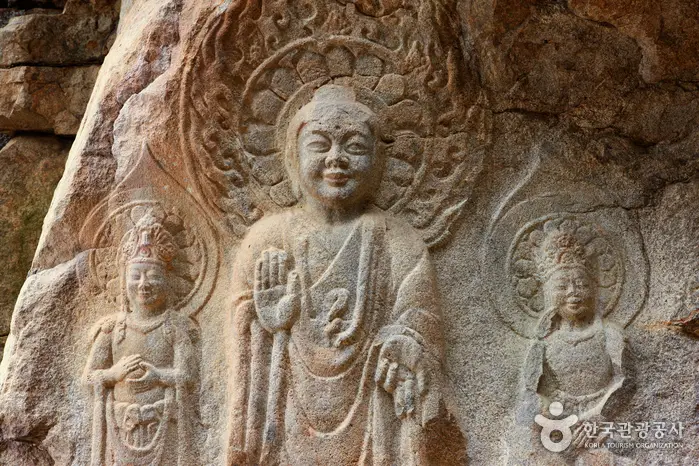
The Rock-carved Buddha Triad in Seosan (National Treasure No. 84) is a late Baekje masterpiece where you can appreciate the famed "Smile of Baekje." The facial expressions, appearing solemn at times and gentle at others, change depending on the angle of sunlight, creating an even more mystical aura. Crossing the clear Yonghyeon Valley and ascending the stone stairs on the rocky hill leads you to the triad carved onto a sheer rock face. Standing at the center is the standing Shakyamuni Buddha, flanked by a pensive Maitreya Bodhisattva seated cross-legged on the right and a standing Dīpankara Bodhisattva on the left. The halos (nimbus) of the statues are also vividly preserved, with the lotus and flame patterns of the central Buddha appearing as if they are in full bloom.MoreLess
- 2
Bowonsa Temple Site, Seosan
서산 보원사지
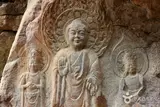
Located at 119-1 Yonghyeon-ri, Unsan-myeon, Seosan-si, Chungcheongnam-do, Bowonsa Temple Site is where Buddhist relics spanning from Unified Silla to the Goryeo Dynasty were discovered. Although founded during the Unified Silla period, it showcases Baekje-style elements, spanning over a thousand years of history. The site holds immense value, with its 4-meter-tall flagpole supports (Dangganjiju) hinting at the temple's former scale, a five-story stone pagoda, a stone basin, and the Stupa and Stele of State Preceptor Beopin all designated as Treasures. It is said that up to 1,000 monks once resided here, and even by today's standards, the temple site situated deep in the mountains is so vast that it cannot be taken in at a single glance. Although the Gilt-bronze Standing Buddha, the Iron Seated Tathagata, and the Iron Seated Buddha excavated from the site were moved to the National Museum of Korea, traces revealing the grandeur of this thousand-year-old temple can still be found throughout the grounds.MoreLess
- 3Seosan Gaesimsa Temple
개심사(서산)
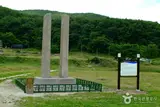
Located deep in the lush forest of Sangwangsan Mountain (307 m), about 6 km from Haemi-myeon, Gaesimsa Temple is one of the four major temples in Chungcheongnam-do. The winding mountain path leading from the parking lot to the temple courtyard is quiet and beautiful, with cherry blossoms blooming brightly in spring.\n Daeungjeon Hall of Gaesimsa Temple is a single-story gabled building measuring 3 bays by 3 bays, constructed in an eclectic architectural style combining the multi-cluster (dapo) and column-head (jusimpo) bracket systems.\n Built in 1484 (the 15th year of King Seongjong's reign), it is designated as Treasure No. 143.\n The temple buildings constructed using naturally curved tree trunks as pillars are particularly eye-catching.\nMoreLess
- 4Haemieupseong Fortress
해미읍성
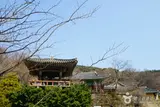
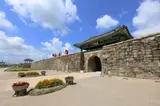
This is a representative eupseong (walled town) from the Joseon Dynasty. \n An eupseong is a flatland fortress built to surround a town center; besides Haemieupseong Fortress, Gochangeupseong and Naganeupseong are also well-known. \n Haemieupseong Fortress is a stone fortress completed in 1491, the 22nd year of King Seongjong's reign during the Joseon Dynasty. \n It is a massive fortress with a circumference of approximately 1.8 km, a height of 5 m, and a total area of 198,348 m² (approx. 60,000 pyeong), featuring three gate pavilions in the east, south, and west.\n Following recent restoration and purification projects, it was restored to its former glory and developed into a historic site park, and it is also renowned as a holy site of martyrdom for Joseon-era Catholics.MoreLess
Source: Korea Tourism Organization (TourAPI) · Machine-translated