Secret Valley on the Way to Geumgangsan Mountain
6 stops · 1 day
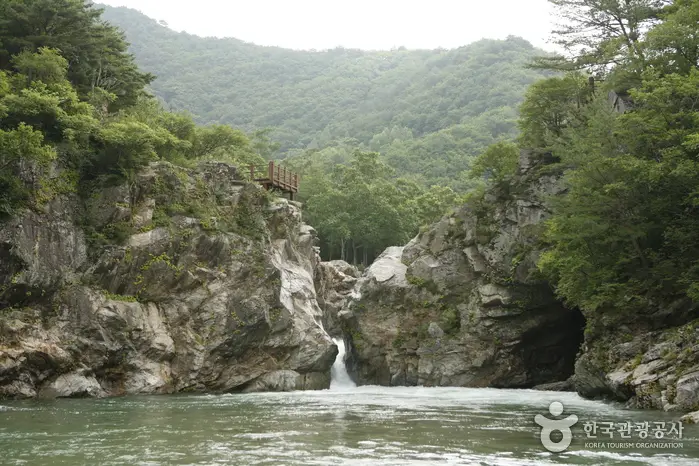
A section of Dutayeon, located north of the Civilian Control Line, was opened to the public in 2004. Left untouched by humans for about 50 years, it is renowned as an ecotourism destination where pristine nature is preserved intact. Dutayeon refers to a wide pool beneath a waterfall formed when a stream originating from Geumgangsan Mountain flowed through the deep valleys of Yanggu, Gangwon-do, and cut through a curved section.
- Duration
- 1 day
- Distance
- 70.33km
Along the way
- 1
Dutayeon
두타연
Dutayeon is located on a tributary of Suipcheon Stream in Geonsol-ri, Bangsan-myeon, north of the Civilian Control Line, and also sits downstream from Bia-ri and Satae-ri in Dong-myeon. While the water volume is not large, the surrounding mountain scenery is magnificent, and its unpolluted waters make it known as Korea's largest habitat for the natural monument lenok (Manchurian trout). Dutapokpo Falls, where valley waters gather and plunge from a height of 10 meters and a width of about 60 meters, shakes the surroundings with a thunderous roar and creates a thick mist that obscures visibility even at midday. Right below this waterfall lies Dutayeon, encircled by 20-meter-high rocks like a folding screen. On the eastern rock wall is a cave of about 10 square meters, where impressions resembling a comb and a horse's trough are stamped into the flat bedrock. The name originates from a temple named Dutasa that existed here a thousand years ago.MoreLess
- 2Park Soo Keun Museum
박수근미술관
Painter Park Soo Keun sought to express the goodness and truthfulness of human nature in his paintings. Looking into life with a sincere and benevolent gaze like Millet rather than the madness of Van Gogh or the revolutionary nature of Picasso, he stands as an unrivaled figure in contemporary Korean art. Built on an area of about 660 square meters at the site of the artist's birthplace in Yanggu-gun, Gangwon-do, the Yanggu County Park Soo Keun Museum was established to honor the artist's artistic and life philosophies while serving as a leading cultural space for the region. The works on display at the Park Soo Keun Museum include three oil paintings such as 'Two Seated Men', prints including 'A Tree and Two Women' and 'Pagoda Walk', the watercolor 'Paints', and dozens of drawings.MoreLess
- 3
Gwangchi Natural Recreation Forest
광치자연휴양림
Gwangchiryeong Pass, at an elevation of 800 meters, forms various waterfalls and valleys. Alongside lush primeval forests, it serves as a passageway to the East Coast via Gwangchi Tunnel connecting Yanggu, Inje, and Wontong. The natural recreation forest was opened here—a place boasting beautiful scenery throughout the four seasons—with recreation facilities to attract tourists from the Seoul Metropolitan Area, provide a restful space for local residents and provincial visitors, and revitalize the local economy.MoreLess
- 4
Yanggu Eco-Botanical Garden
양구생태식물원
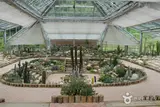
Opened in June 2004 with a total budget of 3.1 billion KRW across a 189,141-square-meter site to serve as an ecological restoration center for South and North Korea, this botanical garden is located in the northernmost part of South Korea. It is planted with about 400 species of rare plants, including Korean endemic and Ministry of Environment protected species such as Geumgangsan bellflower (Hanabusaya asiatica), twinleaf, and Sophora koreensis, as well as speedwell, swallow cuckoo flower, Korean edelweiss, golden patrinia, yellow-striped iris, Siberian columbine, pincushion flower, and bush clematis. It is broadly divided into six distinct zones with different characteristics, including the Botanical Garden Zone, Natural Forest Zone, and Intensive Facility Zone. In particular, the Botanical Garden Zone allows visitors to see rare alpine and northern plants native to the DMZ and Yanggu area all in one place. Additionally, there are walking trails, a medicinal plant exhibition garden, a nursery, and an exhibition greenhouse, along with a mountain stream zone and wetland zone utilizing mountain streams so that visitors can hear the sound of water to complement the typically static nature of a botanical garden.MoreLess
- 5Yanggu War Memorial Hall
양구전쟁기념관
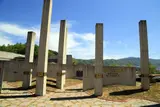
The Yanggu War Memorial Hall was established to shed new light on the combat history by comprehensively covering nine fierce battles fought in the Yanggu area during the Korean War—including the Battles of Dosolsan, Daewoosan, Bloody Ridge, Baekseoksan, Punchbowl, Gachilbong, Heartbreak Ridge, Hill 949, and Christmas Hill—as well as to honor the spirit of sacrifice and achievements of patriotic ancestors and inspire patriotism and national defense spirit in post-war generations. It opened on June 20, 2000. The interior exhibition consists of the Hall of Non-thought, Hall of Welcome, Hall of Encounter, Hall of Understanding, Hall of Experience, Hall of Confirmation, Hall of Commemoration, Rooftop, and Hall of Meditation. The exhibition facilities include a Miracle Video System and a 3-way multi-video room harmonizing battle scene dioramas, videos, and slide presentations.MoreLess
- 6Yanggu War Memorial Hall
양구전쟁기념관
The Yanggu War Memorial Hall was established to shed new light on the combat history by comprehensively covering nine fierce battles fought in the Yanggu area during the Korean War—including the Battles of Dosolsan, Daewoosan, Bloody Ridge, Baekseoksan, Punchbowl, Gachilbong, Heartbreak Ridge, Hill 949, and Christmas Hill—as well as to honor the spirit of sacrifice and achievements of patriotic ancestors and inspire patriotism and national defense spirit in post-war generations. It opened on June 20, 2000. The interior exhibition consists of the Hall of Non-thought, Hall of Welcome, Hall of Encounter, Hall of Understanding, Hall of Experience, Hall of Confirmation, Hall of Commemoration, Rooftop, and Hall of Meditation. The exhibition facilities include a Miracle Video System and a 3-way multi-video room harmonizing battle scene dioramas, videos, and slide presentations.MoreLess
Source: Korea Tourism Organization (TourAPI) · Machine-translated