Gaze upon the Beautiful Night of Seoul
4 stops
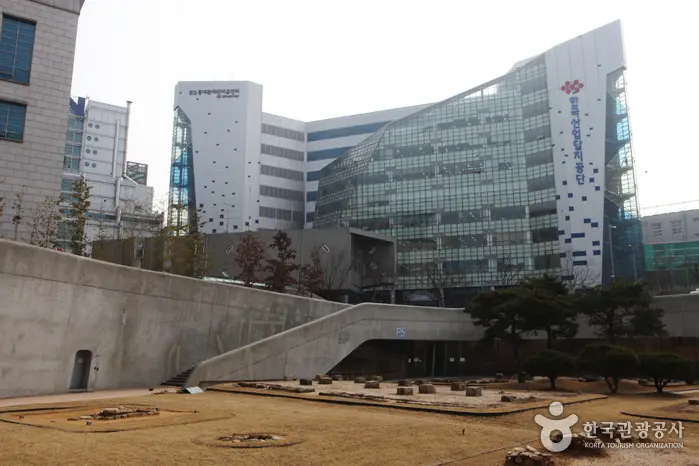
The Hanyangdoseong (Seoul City Wall) was built along with the founding of the Joseon Dynasty and is inscribed on the UNESCO World Heritage Tentative List. Stretching a total length of 18 km, its most picturesque section is the Naksan Mountain Trail, running from Heunginjimun Gate to Hyehwamun Gate. Before climbing the fortress wall from Heunginjimun Gate, stop by the Seoul City Wall Museum at the Seoul Design Support Center to look into Seoul's past. As the sun begins to set, head to Naksanjeong Pavilion located in Naksan Park. A sweeping panoramic view of central Seoul will unfold before your eyes.
Along the way
- 1Dongdaemun History & Culture Park
동대문역사문화공원
The Hanyangdoseong (Seoul City Wall) was built along with the founding of the Joseon Dynasty and is inscribed on the UNESCO World Heritage Tentative List. Stretching a total length of 18 km, its most picturesque section is the Naksan Mountain Trail, running from Heunginjimun Gate to Hyehwamun Gate. Before climbing the fortress wall from Heunginjimun Gate, stop by the Seoul City Wall Museum at the Seoul Design Support Center to look into Seoul's past. As the sun begins to set, head to Naksanjeong Pavilion located in Naksan Park. A sweeping panoramic view of central Seoul will unfold before your eyes.MoreLess

- 2Seoul City Wall Museum
한양도성박물관
Seoul Hanyangdoseong was built to mark the boundaries of Hanseongbu, the capital of Joseon, and to defend against foreign invasions. Spanning a total length of 18.627 km, it functioned as a capital city wall for the longest period among all existing capital walls in the world. Located at the starting point of the Naksan Mountain Trail, the Seoul City Wall Museum is a cultural space featuring permanent and special exhibition halls, a city wall information center, and a learning room, conveying the history and future value of the Seoul City Wall as a proud cultural heritage.MoreLess
- 3Naksan Park
낙산공원
Naksan Mountain is one of the four inner guardian mountains (Namsan, Inwangsan, Bugaksan, and Naksan) that formed the topographical landscape of Seoul, corresponding to the Azure Dragon (left guardian) of the main mountain, Bugaksan, according to feng shui principles. Despite holding such precious natural environments and cultural heritage, a significant portion of Naksan was destroyed and lost through the Japanese colonial period up to the present. In particular, reckless urban planning during the modernization process since the 1960s led to apartments and houses encroaching upon Naksan, leaving it neglected for a long time and causing it to lose its proper function as a historical relic. Accordingly, as part of the 5-Year Plan for Expanding Parks and Green Spaces, the Seoul Metropolitan Government designated Naksan as a neighborhood park and promoted a project to restore its appearance and historical character while establishing connections with surrounding green corridors.MoreLess
- 4
Dongdaemun Design Plaza (DDP)
동대문디자인플라자(DDP)
Dongdaemun Design Plaza (DDP), where traditional historic architecture, relics, and artifacts harmonize with state-of-the-art modern multi-cultural facilities. Inside the park, along with the Seoul City Wall and Igansumun Floodgate (265 m, 8,030 ㎡), there are facilities such as the Dongdaemun History Museum (1,313 ㎡), Dongdaemun Relic Exhibition Hall (4,460 ㎡), Dongdaemun Stadium Memorial (339 ㎡), Event Hall (2,058 ㎡), and Design Gallery (400 ㎡).MoreLess

Source: Korea Tourism Organization (TourAPI) · Machine-translated