Heartwarming Scenery Beyond the Golden Waves
5 stops · 1-day course
Okcheon is the birthplace of poet Jeong Jiyong, known as a pioneer of modern Korean poetry. The traces of poet Jeong Jiyong stretch for 100 ri, starting from his birthplace and memorial hall. The Hyangsu 100-ri Road, created by combining the former Hyangsu 30-ri Road and the Geumgang River Road, is a warm and nostalgic hometown route that follows the beautiful scenery depicted in his works.
- Duration
- 1-day course
- Distance
- 29.89km
Along the way
- 1
Jeong Jiyong's Birthplace
정지용 생가
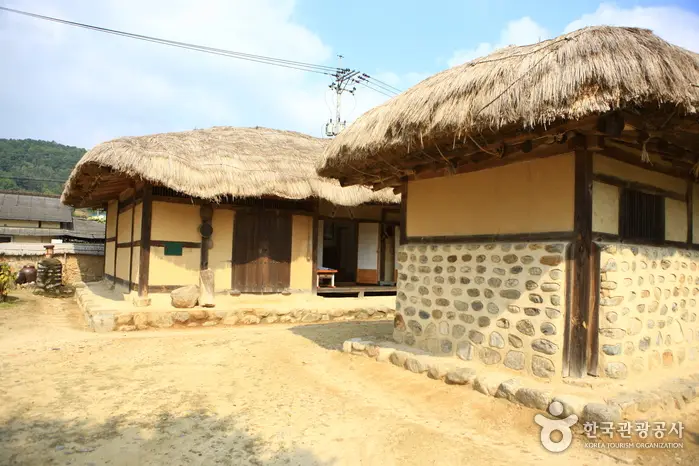
Restored to its original form in 1996 and carefully maintained, the birthplace of Jeong Jiyong can be reached by heading toward Subuk from the Gueup Intersection and crossing Cheongseokgyo Bridge, where visitors will find a monument engraved with the poem 'Nostalgia' (Hyangsu) and an information board. Underneath Cheongseokgyo Bridge in front of the house, the small stream featured in the opening lines of 'Nostalgia' still flows; though its surroundings have long changed, the flowing water remains as clear as ever. The birthplace keeps its room doors open at all times, with traditional furnishings indicating that his father ran an oriental medicine pharmacy. Poems by Jeong Jiyong are hung wherever the eye can see, allowing visitors to appreciate his verses. Along with poetic lines from 'Nostalgia' such as 'When ashes cool in the earthen brazier, the night wind Gallops over the empty fields' and 'The place where we gather around the dim light, murmuring softly,' props such as an earthen brazier and an oil lamp arranged in the room naturally invite visitors to savor 'Nostalgia' once more.MoreLess
- 2Jeong Jiyong Memorial Hall
정지용 문학관
Hagye-ri, Okcheon-eup, Okcheon-gun, Chungcheongbuk-do is the hometown where poet Jeong Jiyong, widely known for his poem 'Nostalgia', was born and raised. Next to his birthplace sits the Jeong Jiyong Memorial Hall, a space where visitors can understand his life and literature and appreciate and experience his major works in diverse ways. The literary exhibition hall features various sections that allow visitors to encounter Jeong Jiyong's literature by theme, including a chronological timeline of his life, his life and literary works, a literary map, and exhibitions of first-edition poetry and prose collections.MoreLess
- 3
Okcheon Hyangsu 100-ri Bicycle Path (Geumgang Course)
옥천 향수 100리 자전거길(금강코스)
The Okcheon Hyangsu Bicycle Path allows riders to enjoy both the beautiful riverside along Daecheongho Lake where the Geumgang River meanders and the poetic literature of Okcheon, the hometown of 'Nostalgia' and the birthplace of Jeong Jiyong, a pioneer of modern Korean poetry. It is a cycling trail where visitors can escape busy city life to experience the leisure, slow pace, and warmth of the rural landscape. Visitors can experience poetic literature with all their senses by visiting Jeong Jiyong's birthplace and memorial hall to look into the poet's life, and traveling along National Route 37, famous for its cherry blossoms, to visit Janggye Tourist Site, home to a 'Brave New World' themed after Jeong Jiyong's poetry.MoreLess
- 4
Geumgang Amusement Park
금강유원지
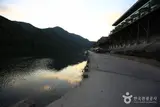
Located at 596 Geumgang-ro, Dongi-myeon, Okcheon-gun, Chungcheongbuk-do, Geumgang Amusement Park is well known as a Gyeongbu Expressway rest area. This is because the stretch of river unfolding below the rest area serves as a recreation resort. Even before the service area was built, the Geumgang River basin flowing through this area was called Geumgang Amusement Park. A rubber dam was installed to operate a small hydroelectric power plant that supplies electricity to the rest area and nearby villages, over which the blue river waters roll. A bridge crosses the river below. The middle section of this submersible bridge is always filled with water, so caution is required when crossing.MoreLess
- 5Okcheon Yongamsa Temple
용암사(옥천)
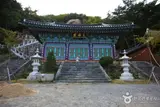
Yongamsa Temple is nestled halfway up Jangyongsan Mountain in Okcheon-gun, Chungcheongbuk-do, boasting lush forests and timeless beauty. Yongamsa is a branch temple of Beopjusa Temple, the head temple of the 5th District of the Jogye Order of Korean Buddhism, and was founded by Master Uisin in 552 (the 13th year of King Jinheung's reign during the Silla period). Unlike typical temple layouts, the stone pagodas at Yongamsa are situated on a low northern peak overlooking the surroundings in all directions. They appear to have been built in accordance with the Goryeo Dynasty's bibo geomancy (mountain and river complementation) philosophy, which held that erecting pagodas or structures could revitalize the declining energy of nature.MoreLess
Source: Korea Tourism Organization (TourAPI) · Machine-translated