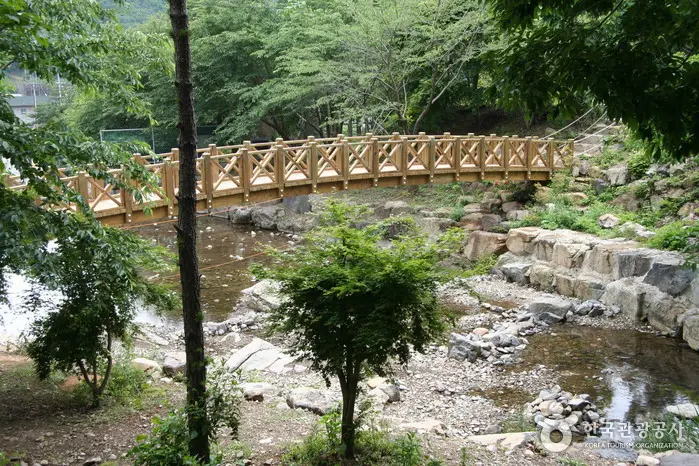
Refreshing Forest of Namdo
4 stops
A single day is not enough to fully enjoy Hadong. This travel itinerary introduces a fulfilling tour ranging from a recreational forest full of phytoncides to Deungnyangyeok Memory Street embracing modern and contemporary history, Boseong Inn, and the Taebaeksanmaek Literature Museum.
- Distance
- Approx. 83.36km
Along the way
- 1Jeamsan Natural Recreation Forest (Accommodation)
제암산자연휴양림(숙박)
The four seasons of Jeamsan Mountain are beautiful, with royal azaleas in spring, abundant water in summer, silver grass in autumn, and snow flowers in winter. Yet, as its name suggests, it is also the 'Emperor's Mountain' that overwhelms all other mountains. Nearby lies Yongchu Valley, making it a sacred mountain where around 100,000 visitors flock during vacation season. Moreover, just one mountain pass away by car from Jeamsan Mountain, the scenic view of the blue sea unfolds at Yulpo Beach, making it a popular choice to visit Yulpo Beach together after touring Jeamsan Natural Recreation Forest.MoreLess
- 2
Deungnyang Station Memory Street
득량역 추억의 거리
Deungnyang Station began operations in 1930 with the opening of the Gyeongjeon Line. The Gyeongjeon Line is a South Coast trans-Korean railway connecting Samnangjin Station in Miryang, Gyeongsangnam-do, to Gwangju Songjeong Station. When it opened, it transported freight and more, but its role gradually declined due to population decline and industrial development, and it currently handles passenger transport and reversing train shunting between Deungnyang and Boseong Stations. Shunting refers to operations such as separating, coupling, and switching tracks for train cars. \nDeungnyang Station Memory Street, which recreates the look of a town in the 1970s and 80s, began construction in 2011 as part of the Train Station Cultural Design Project promoted by the Ministry of Culture, Sports and Tourism. A barbershop that has been in business for over half a century, a station dabang (traditional tearoom) where you can taste a variety of teas, an old mill, Deungnyang Elementary School, a comic book shop, and an arcade create a rich 70s and 80s atmosphere.MoreLess

- 3
Taebaeksanmaek Literature Museum
태백산맥문학관
The Taebaeksanmaek Literature Museum was built facing north with a desire for national reunification. Architect Kim Won participated in the modern design, which features exhibition halls on the 1st and 2nd floors and an observatory on the 5th floor. Additionally, the mural 'Original Figure - Aspiration of the Baekdudaegan Mountain Range,' measuring 8 meters high and 81 meters wide facing visitors in the 1st-floor exhibition hall, was visualized by Professor Lee Jong-sang and has already attracted public attention as the world's largest and first outdoor dry Ongseok mural (stoneware mural). The museum displays materials related to the novel Taebaek Mountain Range by author Jo Jung-rae, which took six years to complete after beginning writing in 1983, suffered from controversies over pro-communist tendencies, and endured tangible and intangible hardships before reaching the pinnacle of division literature. It is organized into sections: 'Preparation and Writing for the Novel,' 'Completion of the Novel Taebaek Mountain Range,' 'After the Publication of the Novel Taebaek Mountain Range,' and 'The Author's Life and Literature: The Novel Taebaek Mountain Range.' It exhibits 623 donated works, including the 16,000-page handwritten manuscript of Taebaek Mountain Range. Subsidiary facilities include a 'Book Cafe' where anyone can read books and an 'Author's Room' where the author himself stays and writes, setting it apart from other literature museums.MoreLess
- 4
Former Boseong Inn
구 보성여관
The Former Boseong Inn is a two-story Japanese-style building built in 1935, possessing high preservation value as it well maintains the characteristics of Japanese-style wooden architecture. It served as the real-life model for the 'Namdo Inn' where rebel suppression commander Im Man-su and his unit members stayed in the epic novel Taebaek Mountain Range and the movie of the same name, and was registered as Registered Cultural Heritage No. 132 in 2004. In 2008, National Trust for Cultural Heritage acquired Boseong Inn and completed restoration work on the damaged building in 2011. In particular, the 'Former Boseong Inn' is a rare remaining Japanese-style inn blending Hanok and Japanese architectural styles, holding high value in modern architectural history and daily life history. Furthermore, the 'Former Boseong Inn' is considered highly valuable not only as a building, but also as an important base forming the modern and contemporary historical and cultural environment of Beolgyo, Boseong-gun.MoreLess
Source: Korea Tourism Organization (TourAPI) · Machine-translated