The World's Largest Dolmen Kingdom
7 stops · 6 hours
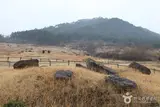
Although dolmens are found all around the world, the dolmens listed as UNESCO World Heritage Sites are found exclusively in Gochang, Hwasun, and Ganghwado Island in Korea. Among them, Gochang boasts the largest concentration, with over 1,500 dolmens. Six dolmen exploration courses are established here, with Courses 1 and 2 being the highlights. Thanks to numerous quarries in the area, visitors can encounter a wide variety of dolmens.
- Duration
- 6 hours
- Distance
- 23.77km
Along the way
- 1Gochangeupseong Walled Town
고창읍성
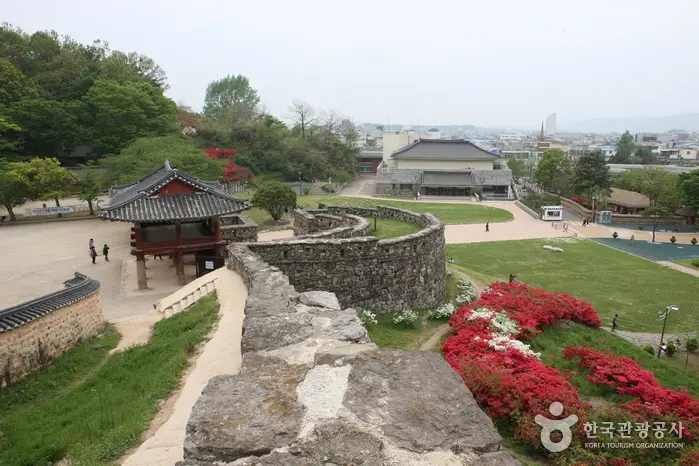
Gochangeupseong Walled Town is a natural stone fortress built in the first year of King Danjong's reign during the Joseon Dynasty (1453) by the people of Jeolla-do Province with the wisdom of preparedness to defend against Japanese invasions. Also known as Moyangseong Fortress, it was linked with Ibamsanseong Fortress of Naju Jingwan to serve as an outpost defending the inland Honam region and is preserved as a defense-related cultural heritage representing national protection during times of crisis. Designated as Historic Site No. 145 on April 1, 1965, the fortress has a circumference of 1,684 meters, a height of 4 to 6 meters, and an area of 50,172 pyeong. It is equipped with essential strategic facilities, including east, west, and north gates, 3 bastions (ongseong), 6 protruding battlements (chiseong), and a moat outside the fortress. Inside the fortress, there were once 22 government office buildings—such as the dongheon (magistrate's office) and gaeksa (guesthouse)—along with 2 ponds and 4 springs. However, most were lost to war fires, leaving only the fortress wall and Gongbuknu Pavilion. Restoration to its historic form has been underway since 1976.MoreLess
- 2
Gochang Pansori Museum
고창판소리박물관
Gochang Pansori Museum was established at the historic residence site of Shin Jae-hyo (pen name Dongri)—a pansori theorist, adapter, and patron—to commemorate him and many master singers such as Jin Chae-seon and Kim So-hee, as well as to inherit and develop the pansori tradition. Currently, only the sarangchae (men's quarters) of the historic residence has been restored, and Dongri Gugakdang Hall is located right next to it. The Pansori Museum was founded to collect, preserve, investigate, research, exhibit, and interpret tangible and intangible materials of pansori, providing the public with opportunities for advanced pansori art re-education and appreciation, and ultimately establishing Gochang as a sacred ground of pansori.MoreLess
- 3
Seonunsa Temple (Gochang)
선운사(고창)
Said to have been founded in the 24th year of King Wideok of Baekje (577) by Master Geomdan, Seonunsa Temple is one of the two head temples of the Jogye Order in Jeollabuk-do, along with Geumsansa Temple. According to the historical records preserved at Seonunsa Temple, at the time of its founding, it was once a grand temple where around 3,000 monks practiced across 89 hermitages. Currently, only the main temple and Dosolam, Chamdangam, Dongunam, and Seoksangam hermitages remain.MoreLess
- 4
Gochang Pansori Museum
고창판소리박물관
Gochang Pansori Museum was established at the historic residence site of Shin Jae-hyo (pen name Dongri)—a pansori theorist, adapter, and patron—to commemorate him and many master singers such as Jin Chae-seon,\n Kim So-hee, as well as to inherit and develop the pansori tradition. Currently, only the sarangchae (men's quarters) of the historic residence has been restored, and Dongri Gugakdang Hall is located right next to it. The Pansori Museum was founded to collect, preserve, investigate, research, exhibit, and interpret tangible and intangible materials of pansori, providing the public with opportunities for advanced pansori art\n re-education and appreciation, and ultimately establishing Gochang as a sacred ground of pansori.MoreLess
- 5Gosan (Gochang Dolmen Site)
고산(고창 고인돌유적지)
To the southwest lies Gosanseong Fortress, presumed to have been built during the Baekje period. Thanks to its geopolitical location surrounded by Mt. Wollangsan and Gungammwae, along with natural rock cliffs, Gosanseong Fortress is regarded as a strategic outpost for repelling foreign invaders. Utilizing the natural topography, it features a mix of earthen and stone fortress walls, with traces of east and south gates remaining, though no trace of a north gate exists. According to the Dongguk Yeoji Seungnam (Augmented Survey of the Geography of Korea), Gosanseong Fortress measured 8,100 cheok in length and 20 cheok in height. Gosan is home to numerous prehistoric dolmens, Korean black raspberry (bokbunja) cultivation fields, and wetlands.MoreLess
- 6
Seonunsa Temple (Gochang)
선운사(고창)
Said to have been founded in the 24th year of King Wideok of Baekje (577) by Master Geomdan, Seonunsa Temple is one of the two head temples of the Jogye Order in Jeollabuk-do, along with Geumsansa Temple. According to the historical records preserved at Seonunsa Temple, at the time of its founding, it was once a grand temple where around 3,000 monks practiced across 89 hermitages. Currently, only the main temple and Dosolam, Chamdangam, Dongunam, and Seoksangam hermitages remain.MoreLess
- 7Gosan (Gochang Dolmen Site)
고산(고창 고인돌유적지)
To the southwest lies Gosanseong Fortress, presumed to have been built during the Baekje period. Thanks to its geopolitical location surrounded by Mt. Wollangsan and Gungammwae, along with natural rock cliffs, Gosanseong Fortress is regarded as a strategic outpost for repelling foreign invaders. Utilizing the natural topography, it features a mix of earthen and stone fortress walls, with traces of east and south gates remaining, though no trace of a north gate exists. According to the Dongguk Yeoji Seungnam (Augmented Survey of the Geography of Korea), Gosanseong Fortress measured 8,100 cheok in length and 20 cheok in height. Gosan is home to numerous prehistoric dolmens, Korean black raspberry (bokbunja) cultivation fields, and wetlands.MoreLess
Source: Korea Tourism Organization (TourAPI) · Machine-translated