A Time Travel Tour of Busan by Subway
4 stops
This Busan Subway Line 1 travel course visits Geumgang Park with various amusement facilities, Geumjeongsanseong Fortress located at the end of the Baekdudaegan Mountain Range, museums embracing Busan's modern history, and the vibrant Jagalchi Market. It makes for an even more enjoyable experience when traveling with children.
- Distance
- 39.39km
Along the way
- 1
Jagalchi Market Live Fish Section
자갈치시장 활어부
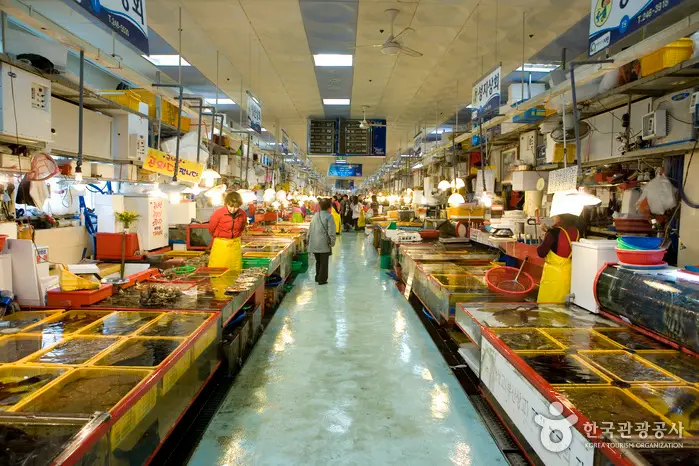
Jagalchi Market, the region's foremost specialty landmark, is the largest fish market in East Asia. It was formed around street vendors in the gravel yard (Jagalmadang) and South Port (Namhang) area along with repatriated Koreans after the 1945 Liberation and refugees from the outbreak of the Korean War. It is a comprehensive seafood market handling all types of seafood from the sea. Visitors can personally experience the vibrant daily lives of locals, and for tourists, it is an essential travel destination where fresh seafood can be tasted at reasonable prices. The live fish section is the most popular spot for sashimi lovers, where you can select live fish on the spot and enjoy it fresh.MoreLess

- 2Yongdusan Park
용두산공원
Yongdusan Mountain (49m) is a hill located in downtown Busan and is one of the three famous mountains of Busan. In ancient times, it was called Songhyeonsan Mountain because the sea could be seen through the dense pine trees. Later, it came to be called Yongdusan because the mountain's shape resembled a dragon's head, conveying the spirit of swallowing the Japanese invaders crossing over from Japan.MoreLess
- 3Geumgang Park
금강공원
Located at the foot of Geumjeongsan Mountain (Godangbong Peak, 801.5m above sea level) northwest behind the Dongnae Hot Springs area, Geumgang Park spans an area of 936,000 pyeong and features dense forests of naturally grown trees and spectacular rocky cliffs. Listening to the clear streams flowing through every valley makes visitors feel as if they have entered a realm of Daoist immortals, leaving all worries behind. As a neighborhood park that attracts visitors continuously from spring to winter, it is beloved as a relaxing retreat for people of all ages. Belonging to the historic Dongnae Dohobu in the past, this storied location features numerous cultural heritage sites throughout, serving as a living educational site for future generations.MoreLess
- 4
Geumjeongsanseong Fortress
금정산성
Designated as Historic Site No. 215, Geumjeongsan Mountain in Busan is home not only to Beomeosa Temple—an ancient temple said to have been founded by the eminent monk Uisang during the reign of King Munmu of Silla—but also to Geumjeongsanseong Fortress, constructed during the Three Kingdoms period. Located atop Geumjeongsan Mountain (801.5m) northwest of the Dongnae Hot Springs area, Geumjeongsanseong Fortress served as a fortress of evacuation and defense for Dongnae-bu, Yangsan, and Gijang, stretching 17,337 meters in total length, 1.5 to 3 meters in height, and spanning an area of approximately 8,213㎢. Damaged and devastated by the Japanese during the colonial period, it was designated as a national historic site in 1971, after which its East, West, and South Gates were restored over two years, and restoration projects continue steadily to this day. The fortress features four gate pavilions (East, West, South, and North) and four watchtowers (Watchtowers 1, 2, 3, and 4), as well as facilities such as a cable car connecting Geumgang Park to the summit of Geumjeongsan Mountain, training centers, and mountain cabins.MoreLess
Source: Korea Tourism Organization (TourAPI) · Machine-translated