Away with Fatigue! A Relaxing Hot Spring Trip
4 stops · 2 days, 1 night
Suanbo Hot Springs has a long history. Records show that King Taejo frequently visited to treat skin ailments. After exploring historic sites in Chungju, relax your body and mind in the mildly alkaline waters of Suanbo Hot Springs and return feeling refreshed. It will surely bring vitality back into your life.
- Duration
- 2 days, 1 night
- Distance
- 73.03km
Along the way
- 1
Chungju Mireukdaewon Temple Site
충주 미륵대원지
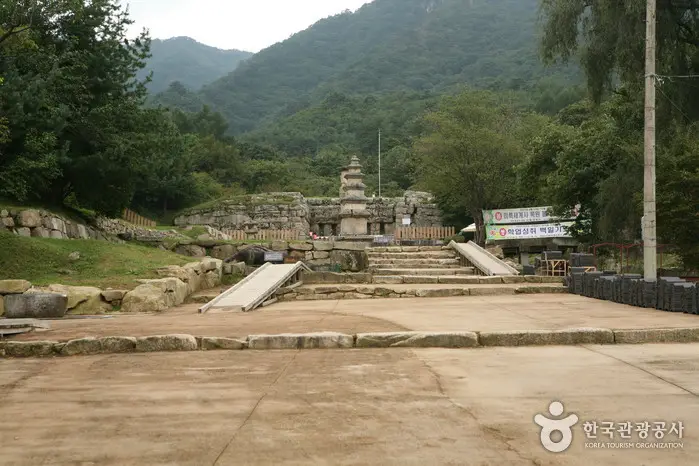
It has been revealed that Mireuksa Temple Site had a rectangular layout of about 46,280 square meters with one pagoda and one main hall. In addition, within the Mireuk-ri temple site, there are Treasure No. 95 (Five-story Stone Pagoda) and Treasure No. 96 (Standing Stone Buddha), along with Local Tangible Cultural Heritage No. 19 (Stone Lantern) and No. 33 (Three-story Stone Pagoda). Jungwon Mireuk-ri Temple Site is a cave temple site combining stone and wooden architecture, serving as the only relic featuring a unique north-facing structure where a stone cave served as the main hall. The stone Buddha at Mireuksa Temple Site is the only north-facing Buddha statue in Korea. The square main chamber housing the Buddha measures 9.8 meters wide by 10.75 meters long, with a 6-meter-high embankment built from large dressed stones, enshrining the statue at its center. A now-lost wooden building once stood atop the stone embankment, and the hall was a semi-constructed stone cave built of wood.MoreLess
- 2
Seven-story Stone Pagoda in Tappyeong-ri, Chungju
충주 탑평리 칠층석탑
Said to have been erected in the 12th year of King Wonseong of Silla, this pagoda is also known as Jungangtap (Central Pagoda). Standing at 14.5 meters tall, it is the largest surviving stone pagoda from the Unified Silla period. It is commonly called Jungangtap because it was built near the geographical center of the country. When the stone pagoda was dismantled, sarira reliquaries and Goryeo Dynasty mirrors were discovered in the foundation and the sixth-story body stone. Together with the surrounding lawn park, local folk museum, and Goguryeo Monument, it has become a popular tourist attraction.MoreLess
- 3Exhibition Hall of Chungju Goguryeo Monument
충주고구려비전시관
At the Exhibition Hall of Chungju Goguryeo Monument, you can encounter the Chungju Goguryeo Monument (National Treasure No. 205), the only surviving Goguryeo stone stele in Korea. Having stood in front of Ipseok Village in Yongjeon-ri, Gageum-myeon for a long time, its historical value was not widely recognized until 1979. Believed to be a monument erected by King Jangsu after conquering the Namhangang River basin, it was named the Goguryeo Monument. A protective pavilion was later built, and in 2012, the Exhibition Hall of Chungju Goguryeo Monument finally opened its doors. The exhibition hall introduces Goguryeo's heritage, folklore, lifestyle, and history, along with Anak Tomb No. 3, the Gwanggaeto Stele, and the discovery process of the Chungju Goguryeo Monument, allowing visitors to feel the monument's great historical value.MoreLess
- 4Suanbo Hot Springs Special Tourist Zone
수안보온천 관광특구
Suanbo Hot Springs Special Tourist Zone is a traditional hot spring resort. Said to have existed for 30,000 years as Korea's first naturally emerging hot spring water, its therapeutic benefits are well renowned. The hot spring water emerging from 250 meters underground is mildly alkaline at a temperature of 53°C. Directly managed by Chungju City, the spring water contains various minerals as well as far-infrared rays beneficial to the human body. Perhaps for this reason, many people have visited Suanbo Hot Springs since ancient times for healing and leisure. Multang Park is located at the center of Suanbo Hot Springs. The park features a gentle stream of flowing hot spring water. If taking a full bath is inconvenient, enjoy a foot bath here instead. It is especially popular from the chilly autumn months through spring.MoreLess

Source: Korea Tourism Organization (TourAPI) · Machine-translated