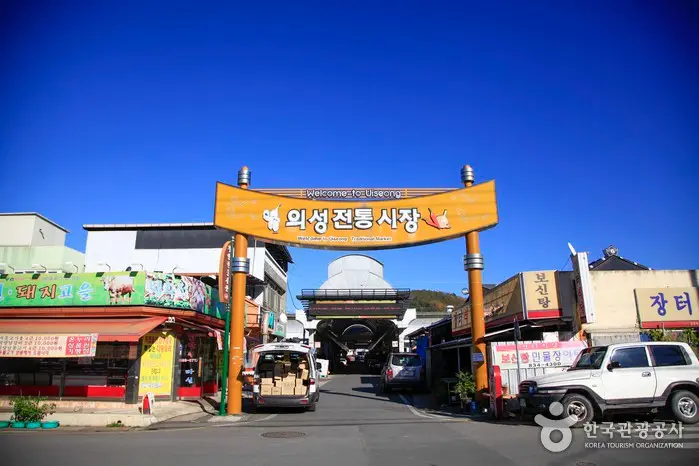
In Search of Delicious Eats at Uiseong Garlic Market
4 stops · 1 day
Uiseong Traditional Market in Gyeongbuk, famous for garlic, is a large marketplace where regular markets have been held since 1946. It is well-known for garlic and especially famous for its Chicken Feet Alley. The food is widely reputed to be so delicious that some say, 'You will regret it if you don't try it at least once,' and a bowl of noodles or mukchae (sliced acorn jelly soup) at a tented restaurant is also a special delicacy. Market days are on the 2nd, 7th, 12th, 17th, 22nd, and 27th of every month.
- Duration
- 1 day
- Distance
- 108km
Along the way
- 1
Uiseong Market (Days ending in 2, 7)
의성장 (2, 7일)
Uiseong Market is a traditional market located around 962 Dodong-ri, Uiseong-eup. The market opens on the 2nd, 7th, 12th, 17th, 22nd, and 27th of each month. Starting as a periodic market in 1946, shops and street vendors do business here. Major traded products include garlic, onions, safflower, chili peppers, and sesame seeds. Uiseong Market is famous for its 'Chicken Feet Alley,' where people line up amid thick smoke. Some say, 'You'll regret it if you don't try it at least once.' If you need a quick meal, you can easily enjoy a bowl of noodles or mukchae (sliced acorn jelly soup) at a tented restaurant reminiscent of 1970s–80s school sports days.MoreLess
- 2
Gounsa Temple (Uiseong)
고운사(의성)
Gounsa Temple is the head temple of the 16th District of the Jogye Order of Korean Buddhism. Founded in 681 (the 1st year of King Sinmun of Silla) by Great Master Uisang, the temple was originally named Gounsa (高雲寺). About 200 years later, when Goun (孤雲) Choe Chi-won practiced asceticism here and built Ga-unru Pavilion and Uhwaru Pavilion, the temple was renamed Gounsa (孤雲寺) after his pen name. During the reign of King Heongang, Monk Doseon erected the Bhaisajyaguru (Medicine Buddha) statue and a stone pagoda.MoreLess
- 3
Binggye Valley
빙계계곡
Binggye Valley, one of the Eight Scenic Views of Gyeongbuk, was designated as a county park on September 25, 1987. Because it features ice holes and wind holes, the mountain is called Bingsan (Ice Mountain); the stream winding around the mountain is called Binggye, and the village is called Binggye-ri. Binggye Valley is located in Seowon Village, Binggye 3-ri. It is a mysterious valley where cool breezes blow and ice freezes during the peak of summer, while warm steam rises in the dead of winter.MoreLess
- 4
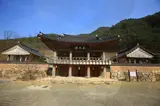
Binggye Seowon Confucian Academy
빙계서원
Binggye Seowon Confucian Academy
Source: Korea Tourism Organization (TourAPI) · Machine-translated