A Journey to 4 of the 8 Scenic Views of Seo-gu, Jeonnam Gwangju Integrated Special City
4 stops · 1 day
Seo-gu of Jeonnam Gwangju Integrated Special City, home to the Gwangju Universiade Main Stadium, boasts eight scenic views. Offering a rich variety of sights where natural scenery harmonizes with cultural heritage, let's explore 4 of Seo-gu's 8 Scenic Views: the 1st view Mangwijeong Pavilion, the 6th view Yangdong Market, the 7th view Rock-carved Seated Buddha of Uncheonsa Temple, and the 8th view May 18th National Cemetery!
- Duration
- 1 day
- Distance
- 14.14km
Along the way
- 1
Mangwijeong Pavilion
만귀정
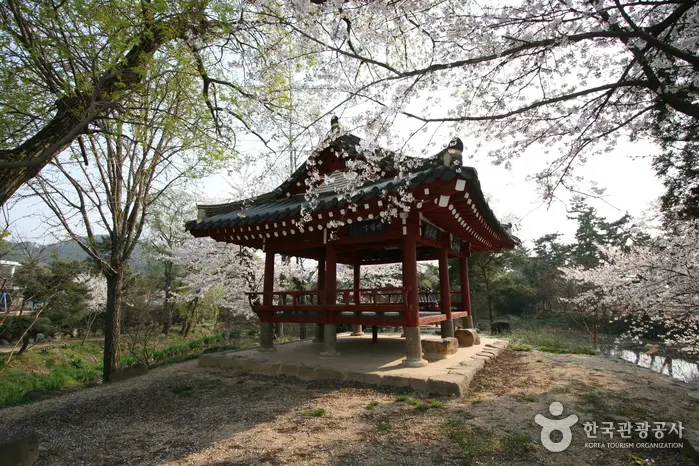
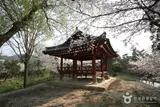
This pavilion is located in Dongha Village, Seha-dong, Seo-gu. It is said to have been built by Hyo-u-gong \nJang Chang-u to teach younger students and spend his later years. However, \nthe original building collapsed and was lost over time, and it reached its present form after being reconstructed in 1934 and \nrepaired in 1945 by his descendants. Jang Chang-u is the ancestor who settled in the south (Nangnam ancestor) of the Heungseong Jang clan, who lived here forming a clan village, but the exact time of its initial construction is unknown. \nThe building is sized two-by-two kan on all four sides, featuring a hipped-and-gabled roof (paljak roof) \ncovered with convex/concave tiles, a well-patterned wooden floor (umul-maru), and railings \ninstalled along three directions: east, west, and south. Mangwijeong is a water pavilion built in the middle of a large pond, and next to it, other pavilions named Seup-hyang-gak and \nMuk-am-jeong-sa stand side by side across a bridge. Both \npavilions were built after the reconstruction of Mangwijeong. [Mangwijeong Pavilion] Gwangju Metropolitan City Cultural Heritage Material No. 5 (Designated on 1984.02.29)MoreLess
- 2
Rock-carved Seated Buddha of Uncheonsa Temple
운천사마애여래좌상
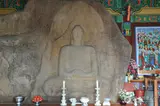
It is said that one day, while Great Monk Wonhyo was staying at Wonhyosa Temple on Mudeungsan Mountain, he saw the western sky filled with auspicious energy and sent his disciple Bokwang Hwasang to the site. Miraculously, light was emanating from a large rock, so he carved a Buddha image into it, and built a temple named Jeongtosa Temple at this location; however, there are no historical records or relics to substantiate this. This Buddha statue is carved in high relief on a large natural rock cliff, and a prayer hall was built attached to the rock wall to serve as a Buddha hall. Standing at a seated height of about 2m, this large Buddha statue is reminiscent of the Great Buddha at Yungang Grottoes in China.MoreLess
- 3May 18th National Cemetery
5·18 기념공원
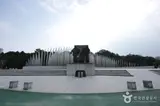
May 18th National Cemetery is a civic rest area established to properly inherit and develop the lessons of May 18. It was created by receiving a portion of the relocated Sangmudae base site as a free transfer for a civic park. Spanning an area of 204,985㎡, it features a traditional pond and various trees, making it widely used as a nature learning site for children.MoreLess
- 4
Yangdong Market
양동시장
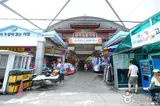
The origin of Yangdong Market dates back to the 1910s when a market was held on the 2nd and 7th of every month on the sandy beach beneath Gwangjugyo Bridge. In 1940, during the Japanese colonial period, the market was moved to its current location as part of the project to organize the area around the shrine, continuing to this day. Before December 1969, it operated as a municipal market, after which it was converted into a privately run market. In 1972, a covered arcade shopping center was established next to the market, and today it is neatly maintained with modern facilities. The building consists of 4 blocks and houses about 340 shops handling agricultural products, \nmarine products, industrial goods, and other items. Yangdong Market is particularly famous for ceremonial goods for ancestral rites and wedding items. From April to September, it is regularly closed on the 1st and 3rd Sundays of each month, and from October to March, there are no regular closing days.MoreLess
Source: Korea Tourism Organization (TourAPI) · Machine-translated