A Trip to Suncheon Where Beautiful Nature and Folk Traditions Coexist
5 stops · 2 Days, 1 Night
Suncheon is widely known for hosting the International Garden Exposition. From the Yongsan Observatory where you can witness the sunset over the S-shaped waterway of Suncheonman Bay, to the Suncheonman Bay Natural Ecology Park and Suncheon Bay Garden where you can experience the bay's natural beauty, the National Nagan Folk Recreational Forest, and Naganeupseong Walled Town which preserves authentic folk lifestyles, set off on a journey to Suncheon to enjoy nature and tradition!
- Duration
- 2 Days, 1 Night
- Distance
- 33.39km
Along the way
- 1
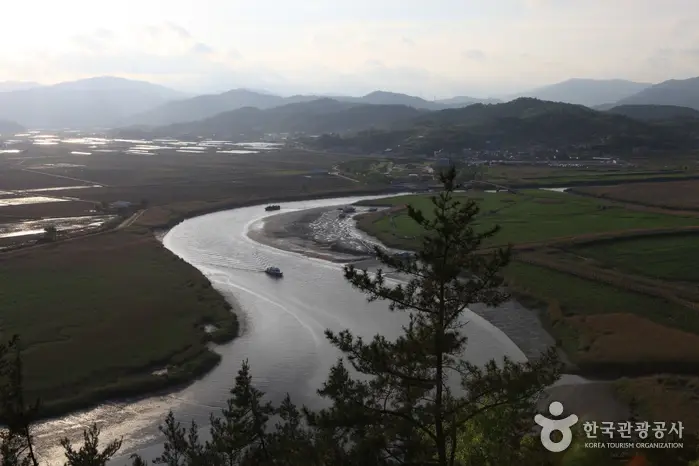
Yongsan Observatory at Suncheonman Bay (S-shaped Waterway)
순천만 용산전망대(S자 물길)
If you were to choose the most beautiful scene in Suncheonman Bay, the sunset over the S-shaped curve of the waterway would undoubtedly come first. The sight of the waterway flowing in an S-curve and glowing golden at sunset is so breathtaking that many photographers visit Suncheonman Bay to capture this scenery. The place where you can admire the reeds, mudflats, the proud S-shaped curved waterway of Suncheonman Bay, and the enchanting sunset is a low hill called Yongsan in Nongju-ri, Haeryong-myeon, Suncheon-si. Crossing Mujingyo Bridge and the reed deck leads to a trail with stairs. After hiking up those stairs for about 20 minutes, you will reach the open and refreshing Yongsan Observatory, which offers a panoramic view of Suncheonman Bay. In addition, you can access the S-shaped course of Suncheonman Bay by driving along the coastal road in Haeryong-myeon and entering at the entrance of the Nongju-ri King Prawn Farm (Nongju Village Bus Stop).MoreLess
- 2Suncheonman Bay Natural Ecology Park
순천만자연생태공원
The total area of the Suncheonman Bay reed field, spanning Gyoryang-dong and Daedae-dong in Suncheon-si as well as Jungheung-ri, Haechang-ri, and Seonhak-ri in Haeryong-myeon, reaches about 150,000 pyeong. The area surrounding Suncheonman Bay—composed of 27 ㎢ of estuarine salt marshes and mudflats, including 21.6 ㎢ of mudflats and 5.4 ㎢ of reed beds enclosed by a 39.8 km coastline—is home to much more than just thick reed beds. While it looks like an endless field of reeds from afar, looking closer reveals small and large clusters of Silvergrass and Tatarian Aster growing throughout the area. Beyond the estuarine reed fields lies a community of reddish Suaeda japonica. This is also a habitat visited by 11 internationally rare or natural monument bird species, including hooded cranes, white-naped cranes, oriental storks, black-faced spoonbills, and Eurasian oystercatchers, making it known as one of the world's wetlands with the highest diversity of rare birds.MoreLess
- 3Suncheon Bay Garden
순천만 정원
Created to protect Suncheonman Bay, Suncheon Bay Garden covers a 1.12 million ㎡ (340,000 pyeong) site in Dosa-dong, Suncheon, planted with 790,000 trees across 505 species and 3.15 million flowers across 113 species. Tulips, royal azaleas, and other flowers bloom in stunning displays. A 30,000 ㎡ area around the Nanum Forest has been cultivated as a canola flower field, creating a 'yellow wave' in full bloom around mid-May. The city has planted 50,000 trees such as hackberries and zelkovas along the main walking routes to provide natural shade. Along with the opening, a small Personal Rapid Transit (PRT) system operating on a 4.64 km section between Suncheon Bay Garden and the Suncheon Literature Museum began service. Visitors who have explored the garden can ride the PRT to the Literature Museum, get off, and transfer to the Reed Train for a 1.2 km ride to Mujingyo Bridge at the entrance of Suncheonman Bay.MoreLess
- 4
National Nagan Folk Recreational Forest
국립 낙안민속자연휴양림
Located at a key transportation hub where the Jeolla and Gyeongjeon railway lines intersect and the Namhae and Honam Expressways pass through, this site offers excellent accessibility and is situated about 2 km from Naganeupseong Folk Village. With beautiful surrounding scenery alongside Naganeupseong Walled Town, it is not only an optimal place for relaxation, but it is also usable throughout all four seasons thanks to nearby traditional temples like Songgwangsa and Seonamsa, Juamho Lake and Sangsaho Lake where you can enjoy the evening sunset over Seosan, as well as numerous attractions including the reeds and coast of Suncheonman Bay and various cultural festivals at Naganeupseong Folk Village.MoreLess
- 5Naganeupseong Walled Town
순천 낙안읍성
Originally Mahan territory during the Samhan period, Pajiseong Fortress during the Baekje period, and the town site of Nagan-gun during the Goryeo period, this site preserves Joseon Dynasty fortress walls, government offices (Dongheon), guest houses (Gaeksa), the monument for General Im Gyeong-eop, the marketplace, and thatched-roof houses in their original forms. As a result, the fortress and village were collectively designated Historic Site No. 302 for the first time in Korea. In the 6th year of King Taejo of Joseon (1397), when Japanese pirates invaded, General Kim Bin-gil (Yanghyegong), a native of this region, raised a righteous army and built an earthen fortress for defense. Three hundred years later, in the 4th year of King Injo (1626), General Im Gyeong-eop (Chungmingong) was appointed magistrate of Nagan and rebuilt the fortress into the current stone wall. Unlike fortresses in other regions, it was solidly constructed in a rectangular shape across a wide plain using 1 to 2-meter square natural stones, standing 4 meters high, 3 to 4 meters wide, and measuring 1,410 meters in total perimeter to embrace the living grounds of three villages: Dongnae, Namnae, and Seonae. Even now, nearly 400 years later, the wall remains unbroken and remarkably magnificent. As an authentic traditional folk village where many households still live today, it is recognized for its academic folk value as well as an invaluable living educational site for history.MoreLess

Source: Korea Tourism Organization (TourAPI) · Machine-translated