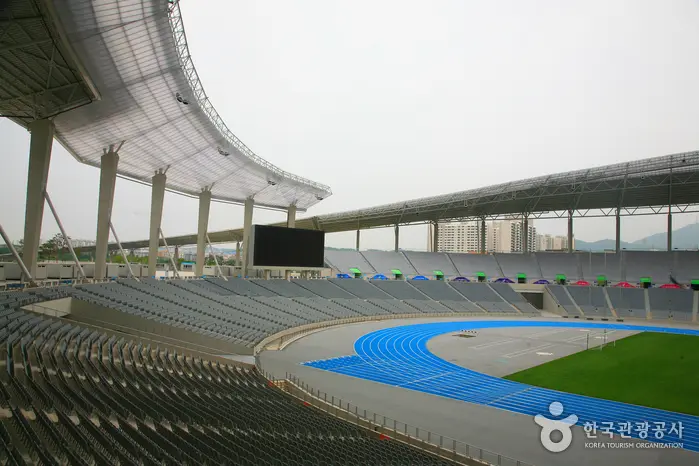
Family Experiential Tour Centered on the Asian Games Stadium
5 stops · 5 hours
This tour course explores Incheon Metropolitan City. Centered around the Asian Games Stadium, where the 17th Asian Games were held, visitors can experience unique museums nearby, such as the Nokcheongja Museum and Geomdan Prehistoric Museum. The museum, which opened as the Nokcheongja Kiln Site Exhibition Hall, also offers hands-on pottery experiences. In addition, Gimpo Jangneung offers the pleasure of strolling outdoors across a wide open field away from indoor museums.
- Duration
- 5 hours
- Distance
- 20.43km
Along the way
- 1Incheon Asiad Main Stadium
인천아시아드주경기장
Incheon Asiad Main Stadium, which will serve as the main stadium during the 17th Incheon Asian Games held in September 2014, began construction in June 2011 and opened on June 1, 2014. The total site area is 631,975㎡, the main stadium's gross floor area is 113,620㎡, and it has a 5-story scale from 1 basement level to 4 floors above ground, with over 60,000 spectator seats. Inside the main stadium, there are tracks for hosting various track and field events and an international standard grass football field, while an auxiliary stadium and Yeonhui Cricket Ground with a gross floor area of 1,415㎡ are located around the main stadium. The seating capacity is 61,818 seats, of which 32,514 seats are installed as non-fixed temporary seats to be dismantled after the games end. MoreLess
- 2Nokcheongja Museum
녹청자박물관
The Nokcheongja Kiln Site Exhibition Hall opened on October 25, 2002, by remodeling the Gyeongseo-dong Office. Nokcheongja Kiln Site, which provides academic materials on the Gyeongseo-dong Nokcheongja Kiln Site (Historic Site No. 211) and operates pottery hands-on classes, was excavated four times in 1965 and 1966. The pottery from this kiln site is nokcheongja (greenish-brown celadon), baked by applying a coarse greenish-brown glaze over relatively refined thin celadon body clay. It was designated as Historic Site No. 211 in May 1970, becoming the region's first designated cultural heritage. While there are various theories regarding the chronology (era) of nokcheongja's origin, it is presumed that while high-quality haemuri-gup (sunburst-foot) celadon developed from the late Silla to early Goryeo periods (around the 9th to 10th centuries) and spread to wealthy classes such as local gentry, nokcheongja was produced for commoners from the early Goryeo Dynasty to the late Joseon Dynasty. MoreLess
- 3
Lunch (Geumgangsan Chueotang)
점심식사(금강산추어탕)
At Geumgangsan, you can taste chueotang (loach soup) cooked to suit modern palates while reviving the taste and nostalgia of the soup once cooked and eaten in the countryside in the past. Containing abundant nutrients, chueotang is good for patients and is a dish that protects the five internal organs. MoreLess
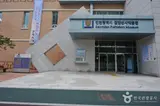
- 4Incheon Geomdan Prehistoric Museum
인천 검단선사박물관
In the Geomdan area, cultural heritage excavation surveys were conducted starting in 1999 as part of a land readjustment project. As a result of the survey, ruins and artifacts from various periods ranging from the Paleolithic to the Joseon Dynasty—centered around the Bronze Age—were confirmed. Based on these excavation achievements, Geomdan Prehistoric Museum opened on November 27, 2008. Geomdan Prehistoric Museum exhibits the prehistoric way of life by period and region, and also operates a hands-on learning room where visitors can experience prehistoric culture firsthand. MoreLess
- 5
Gimpo Jangneung [UNESCO World Heritage]
김포 장릉 [유네스코 세계문화유산]
Jangneung is Historic Site No. 202 and is the royal tomb of Wonjong, the biological father of King Injo (r. 1623–1649), the 16th monarch of Joseon, and his wife, Queen Inheon of the Gu clan. The scale and standard of the tomb reflect the typical style of the mid-Joseon period. Below the tomb mound is a jaesil (ritual preparation hall), which is also a building where King Yeongjo (21st monarch of Joseon) and King Jeongjo (22nd monarch) visited annually to hold ancestral memorial rites. MoreLess
Source: Korea Tourism Organization (TourAPI) · Machine-translated