Great Date Spots Among Gaya Historic Sites
4 stops · 7 hours
Representative cultural and historic sites of Gaya include the Tomb of King Suro, Bonghwang-dong Historic Site, Museum of the ancient tombs in Daseong-dong, Yean-ri Ancient Tombs, Tomb of Queen Heo, Gujibong Peak, and Gimhae National Museum. In addition, there are cultural attractions such as Sanhaejeong Pavilion, Gimhae Astronomical Observatory, Eunhasa Temple, and Hyanggyo (local Confucian school). Furthermore, it is a great place for a date as there is plenty to see, including the Hallim Folk Museum and Clayarch Gimhae Museum.
- Duration
- 7 hours
- Distance
- 18.46km
Along the way
- 1
Gaya Street
가야의 거리
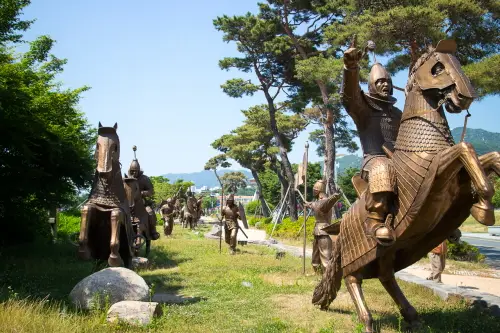
As the birthplace of Geumgwan Gaya, the city of Gimhae created Gaya Street as a street park connecting major Gaya cultural heritage sites in order to comprehensively organize the historical and cultural resources scattered throughout the downtown area. Along the total 2.1 km stretch, centering on the Haebancheon Stream which preserves the glory of Gaya's splendid maritime trade, it serves as a structural landscape axis encompassing surrounding sites such as the Bonghwang-dong Historic Site, the Tomb of King Suro, the Daeseong-dong Tombs, and Gimhae National Museum, creating a space where the city's past and present coexist and nature can be enjoyed in daily life. The prosperity of Gaya culture is symbolized through a fountain representing iron culture and night landscape lighting, and an oval ground fountain, themed gardens reflecting the living environment of the Gaya people, small plazas, and resting areas have been created. MoreLess
- 2Museum of the ancient tombs in Daseong-dong
대성동고분박물관
This is a venue that presents and exhibits materials excavated from four rounds of archaeological investigations at the Daeseong-dong Tombs, revealing the true nature of Geumgwan Gaya that had been obscured in history and highlighting this area as the center of Geumgwan Gaya. The museum features an exhibition hall on the first floor and auxiliary facilities in the basement. The three exhibition rooms on the first floor are divided into five exhibition sections: Introduction, Overview, Tombs, Exchange, and Culture. MoreLess

- 3Gimhae Astronomical Observatory
김해천문대
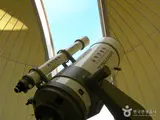
Gimhae Astronomical Observatory was promoted in December 1998 as part of the Millennium Commemoration Project to satisfy the public's curiosity about celestial bodies and the universe, inspire dreams and hopes in growing youth, and offer romance and memories to citizens; it opened on February 1, 2002. The exhibition building consists of a planetarium and exhibition rooms. The planetarium houses a celestial projector that projects night sky stars onto a hemispherical screen with an 8-meter diameter. Educational videos that help in understanding the universe, such as seasonal constellations and solar system exploration, are screened here. MoreLess
- 4Bunsanseong Fortress
김해 분산성
Bunsanseong Fortress was built in 1377 (the 3rd year of King U of Goryeo) by Magistrate Park Wi to fend off Japanese pirates, destroyed during the Imjin War, and rebuilt in 1871 (the 8th year of King Gojong) by Magistrate Jeong Hyeon-seok. It features fortress walls forming an oval elongated north to south, surrounding the flat terrain at the mountain summit. The near-vertical stone walls are about 3 to 4 meters high, with quite a few collapsed sections. According to the 'Jeonggukgun Bakgongwi Chukseong Sajeokbi' monument erected here, this mountain fortress was rebuilt based on an ancient fortress by Park Wi in the early Joseon period, destroyed during the Imjin War, and repaired to its current fortress walls in 1871 (8th year of King Gojong). Judging from the fact that the method of selecting the fortress foundation followed the 'teomwe-sik' (hilltop-encircling type) prevalent in the mountain fortresses of the Three Kingdoms period, it can be inferred that its initial construction dates back to the Three Kingdoms period. MoreLess

Source: Korea Tourism Organization (TourAPI) · Machine-translated