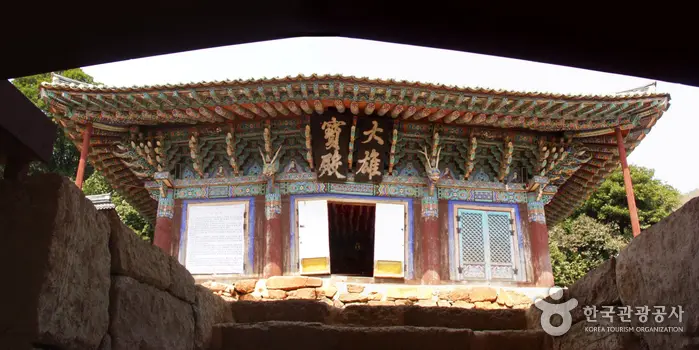
Unchanging Scenery Overlooked from Wolchulsan Mountain and Baengnyeonsa Temple
4 stops · 1 day
The verdant evergreen pine and cypress trees of Baengnyeonsa Temple on Wolchulsan Mountain possess an unchanging strength and grace whenever seen. The scenery of Baengnyeonsa Temple itself is incomparably beautiful. Touring the historically profound Wolnamsaji Temple Site, along with Muwisa Temple and Wolchulsan National Park, allows you to truly appreciate the mountainous landscape of Gangjin.
- Duration
- 1 day
- Distance
- 41.91km
Along the way
- 1
Baengnyeonsa Temple (Gangjin)
백련사(강진)
The Baengnyeon Gyeolsa (White Lotus Society) movement, which emphasized repentance and the Pure Land by announcing the Baengnyeon Gyeolsamun in the 19th year of King Gojong of Goryeo, forms the two major pillars of late Goryeo Buddhism along with the Jeonghye Gyeolsa movement of Songgwangsa Temple. In , this temple is described as \"facing the southern sea, with valleys densely filled with pine and cypress trees, and camellias mixed in, making it a superb scenic view whose deep green remains unchanging throughout all four seasons,\" reflecting how beautiful the surrounding scenery is. Inside Baengnyeonsa Temple, a wooden Buddha triad is enshrined, which is presumed to have been created in the late Joseon period. This Buddha triad is unique in that while the central principal Buddha is Sakyamuni Tathagata and should naturally be flanked by Bodhisattvas on the left and right, Tathagata statues are enshrined instead. \nMoreLess
- 2
Wolnamsaji Temple Site
월남사지
Wolnamsaji Temple Site is a rectangular temple site measuring 175 m in front and 185 m on the sides, situated on flat ground with the summit of Wolchulsan Mountain and Yangjaam Rock in the background. Covering a total area of about 10,000 pyeong, it is presumed to have been larger in both scale and topography than the nearby Muwisa Temple in ancient times. Today, two cultural heritages remain: the Three-story Stone Pagoda (Treasure No. 298), which is noted as a Baekje-style stone pagoda, and the Stele for State Preceptor Jingak (Treasure No. 313). Traces of an outer wall remain around the stone pagoda. In addition, relics presumed to be the foundation stone of a stupa or the base of a pagoda remain in nearby private houses. Relics such as roof tiles, celadon, and white porcelain pieces were discovered at Wolnamsaji Temple Site, most of which date from the Goryeo to Joseon periods. In particular, celadon tile pieces presumed to have been used on the walls of Wolnamsaji Temple buildings were discovered, drawing much interest. \nMoreLess
- 3Muwisa Temple
무위사
Muwisa Temple is located about 16 km northwest of Gangjin-eup. According to the temple's records, Great Monk Wonhyo founded it at the southern foot of Wolchulsan Mountain in the 39th year of King Jinpyeong of Silla (617) and named it Gwaneumsa Temple, and in 1 555, Zen Master Taegam is said to have called it by its current name, \"Muwisa.\" Except for Geungnakbojeon Hall, most of the buildings constructed at that time were burned down during the Japanese invasions of Korea (Imjin War). Geungnakbojeon Hall was built in the early Joseon period and is designated as National Treasure No. 13. After liberation, in 1 956, Geungnakjeon Hall was repaired and restored, and a new preservation pavilion was erected to enshrine the murals inside. \nMoreLess
- 4
Wolchulsan National Park
월출산국립공원
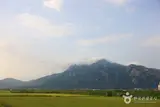
Wolchulsan Mountain is the southernmost mountainous national park on the Korean Peninsula, where beautiful natural landscapes, distinguished cultural resources, and the local sentiment of the Namdo region are harmoniously blended, befitting its name meaning \"mountain where the moon rises.\" Formed as a monadnock protruding on a plain as the Sobaeksanmaek Mountain Range flows toward the sea off Mokpo, Wolchulsan Mountain is composed of bizarre rocks and strange stones centered around Cheonhwangbong Peak (809 m), so much so that the entire mountain can be considered an exhibition of viewing stones. \nMoreLess
Source: Korea Tourism Organization (TourAPI) · Machine-translated