A Hiking Tour Accompanied by Daegaya Culture: Hiking Courses in Goryeong
5 stops · 1 day
Goryeong holds ample cultural and historical value as it preserves clear prehistoric petroglyphs and served as the capital of the Daegaya Kingdom for 520 glorious years. It is also a historic town dotted with cultural heritage sites, known as the birthplace of Master Ureuk, a revered musical sage who created the gayageum.
- Duration
- 1 day
- Distance
- 95.26km
Along the way
- 1
Anhwa-ri Petroglyphs in Goryeong
고령안화리암각화
The Anhwa-ri Petroglyphs refer to rock carvings created on cliff faces by prehistoric people. Three motifs were pecked onto a rock surface measuring 115 cm wide and 90 cm high. The central design is based on a U-shaped semicircle with symmetrical bow-shaped lines carved on the left and right, and small cup marks were carved on the right drawing. There are two to three more carvings of the same kind on the rock face of the cliff above; similarities to the Chilpo-ri Petroglyphs in Yeongil suggest that coastal and inland inhabitants shared the same ritualistic beliefs. MoreLess
- 2
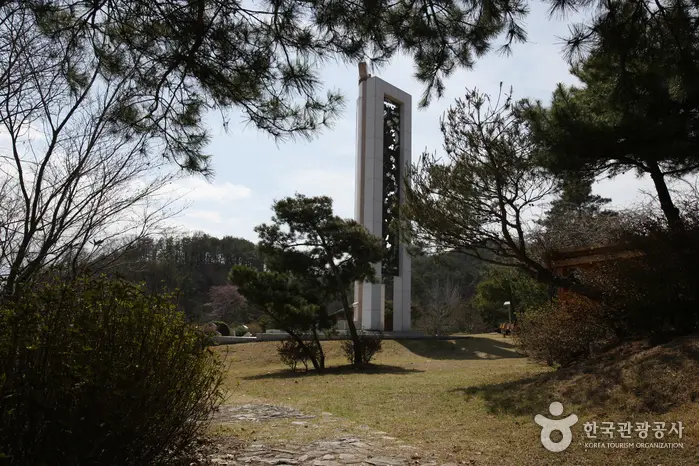
Ureuk Memorial Tower
우륵기념탑
As one of Korea's three musical sages (Ureuk, Park Yeon, and Wang San-ak), Ureuk received orders from King Gasil toward the end of Gaya to create the 12-stringed gayageum in Jeongjeonggol, Kwaebin-ri, Goryeong-eup, modeled after the 12 months of a year. Its round top is said to represent heaven, while the flat bottom symbolizes the earth. Records show that Ureuk composed 185 pieces during his lifetime, but none have survived, leaving only the record of the 12 songs composed in Jeongjeonggol of the Daegaya Kingdom. MoreLess
- 3
Lunch (Hwanggeumteo Sutbulchon)
점심식사(황금터숯불촌)
Located in downtown Goryeong, the capital of Daegaya, "Hwanggeumteo Sutbul Galbi" is close to the road and offers relatively convenient parking, making it an ideal place to rest and enjoy a meal while touring Daegaya's relics. The exterior of the restaurant exudes the warmth and cleanliness of a wooden building, and the interior feels spacious and refreshing thanks to its high ceilings and ample sunlight streaming through large glass windows. MoreLess

- 4Daegaya Museum
대가야박물관
The Daegaya Museum features a Permanent Exhibition Hall that showcases the history and culture of Daegaya and the Goryeong region from the Paleolithic Period to modern times, as well as a Special Exhibition Hall for temporary exhibitions. In addition, there is a Children's Experience Zone where young visitors can learn about Daegaya culture through hands-on activities, an outdoor exhibition area, Jisang-ri Tomb No. 30, and a recreation garden, all designed to help visitors easily understand the daily lives of people during the Daegaya era. MoreLess

- 5
Ballyongsa Temple
반룡사
Ballyongsa Temple is said to have been built by descendants of Daegaya at a site imbued with the sacred energy of a dragon, giving it the name Ballyongsa (盤龍寺). According to tradition, it was established in 802 (the 3rd year of King Aejang of Silla) at the same time as Haeinsa Temple. It was later rebuilt by National Preceptor Bojo in the mid-Goryeo period and rebuilt once again by Monk Naong near the end of Goryeo. MoreLess
Source: Korea Tourism Organization (TourAPI) · Machine-translated