A Journey to Hadong's Highlights: From Hwagaejangteo Market and Choi Champandaek to Samseonggung
6 stops · 1 day
Hadong is a wonderful travel destination famous for the House of Choi Champan and Hwagaejangteo Market, offering a rare and beautiful tour course where visitors can explore the dignified culture of the yangban (traditional ruling class). Don't miss out on visiting the House of Choi Champan, Hwagaejangteo Market, Cheonghakdong Village, and the unique ancient site of Samseonggung.
- Duration
- 1 day
- Distance
- 58.70km
Along the way
- 1
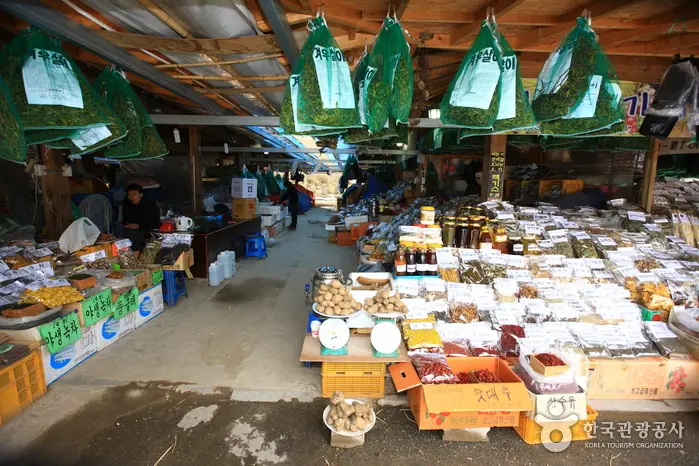
Hadong Hwagaejangteo Market
하동 화개장터
Hwagaejangteo is a traditional market originally held at the confluence of Hwagaecheon Stream, which originates from Jirisan Mountain, and the Seomjingang River. It was once a vibrant five-day market. Recently, it has been established as a permanent daily market, so the five-day market is no longer held separately. To meet the expectations of the many visitors drawn by singer Cho Young-nam's hit song "Hwagaejangteo Market" and to restore the traditional atmosphere where one can feel old-world charm, a project costing 1.6 billion KRW on a site of approximately 8,400㎡ was undertaken to build traditional market stalls, specialty green tea shops, and other convenient amenities, now operating as a permanent market. MoreLess
- 2Choi Champandaek (House of Choi Champan)
최참판댁
Pyeongsa-ri in Agyang, famous as the setting for author Park Kyung-ni's epic novel Toji (The Land), is a land blessed by the Seomjingang River. The area name Agyang was given because it resembles Yueyang (Agyang in Korean) in China. Borrowing Chinese place names, the sandy riverbank of Pyeongsa-ri was named Geumdang, and the lake within the sandbank was named Dongjeongho Lake. Among the songs praising the beauty of Agyang is the Sosangpalgyeong (Eight Views of the Xiao and Xiang Rivers). Dongjeongho Lake and the Sosangpalgyeong of Agyang are the pride of the local residents, creating a landscape brimming with traditional Korean beauty. MoreLess
- 3
Lunch (Dongheung Sikdang)
점심식사(동흥식당)
The restaurant serves delicious food prepared directly by the owner, who has 11 years of culinary experience using only natural marsh clams caught from the Seomjingang River. The jaecheop-guk (marsh clam soup), seasoned with wild chives from the foot of Jirisan Mountain, has a fragrant and deep flavor, while the jaecheop-hoe (marsh clam salad), made by tossing shelled clams with sweet and sour red chili paste and assorted vegetables, offers a delightfully sweet, sour, and chewy texture. A large framed photograph showing marsh clam harvesting against the backdrop of the Seomjingang River is hung on the wall, adding an interesting visual touch. MoreLess

- 4
Hadong Songnim Pine Forest
하동송림
The forest covers an area of 26,000㎡ and is densely populated with around 750 old pine trees. Within the forest lies Hasangjeong, an archery ground, which harmonizes with the vast white sand beach like a picturesque painting. This park is also used as a venue for various folk games and major county events. Equipped with sports facilities and recreation spaces for teenagers, children, and families to enjoy together, the Songnim Pine Forest Park is widely visited by both local residents and numerous tourists. MoreLess
- 5
Cheonghakdong Myeongnyun Hakdang
청학동 명륜학당
Continuing the unbroken lineage of traditional seodang (village schools) into modern times, the 30-year-old Cheonghakdong Myeongnyun Hakdang is not an entertainment- or play-oriented experiential seodang, but an educational academy that awakens the fundamental principles of life and practical etiquette—guiding individuals, as masters of their own lives, on how to build success, happiness, love, and respect. MoreLess
- 6Samseonggung
삼성궁
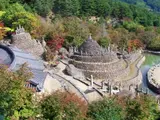
This is a sacred shrine and ascetic training ground for the Baedal nation, dedicated to Hwanin, Hwanung, and Dangun. Fifteen years ago, Master Hanpul, inheriting the ancient Taoist tradition of Seondo, practiced spiritual training with his disciples and built over 1,500 stone towers one by one into curious shapes. Harmonizing with the surrounding forest, these towers create an exotic and mystical atmosphere. Here, these stone towers are called Wonryeok Sotdae. MoreLess
Source: Korea Tourism Organization (TourAPI) · Machine-translated