Exploring Muju's Historic Sites Imbued with Ancient Tranquility
6 stops · 5 hours
This course offers a chance to experience the traditions of Hyanggyo local Confucian school, Hanpungnu Pavilion, and the tranquil ancient temple Hyangsansa quietly nestled in the pristine land of Muju. Take a stroll and savor the charm of these hidden gems rarely known to anyone outside of Muju. The deep tranquility here will soothe away even the most complicated troubles of worldly life.
- Duration
- 5 hours
- Distance
- 20.51km
Along the way
- 1
Rajetongmun Gate
라제통문
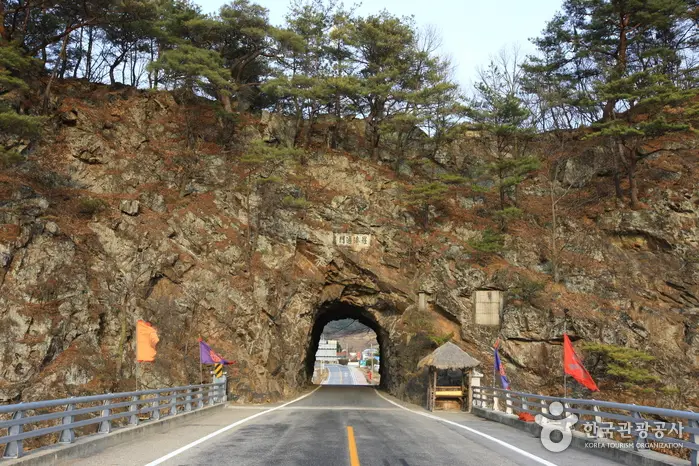
Rajetongmun Gate in Seolcheon-myeon, Muju, is a rock tunnel located in Seokgyeonsan Mountain, which borders Sindu Village in Dugil-ri and Inam Village in Socheon-ri, Seolcheon-myeon, where the Silla and Baekje kingdoms shared a border during the Three Kingdoms period. It measures 3 meters in height and 10 meters in length. During the Three Kingdoms period, with the rocky ridge of Seokgyeonsan Mountain as the boundary, Mupung to the east was Silla territory, while Seolcheon-myeon, Jeoksang-myeon, and Muju-eup to the west belonged to Baekje. As the customs and culture differed vastly from the Three Kingdoms period through the Goryeo Dynasty, unique characteristics in language and customs remain today. If you visit on Seolcheon Market Day, you can distinguish people from Muju and Mupung simply by their dialects. MoreLess
- 2
Hyangsansa Temple
향산사
Hyangsansa, an immaculate temple in the heart of town, is much like a lotus flower. Just as a lotus blooms from muddy water while radiating a pure appearance and clear fragrance, Hyangsansa is a peaceful, pristine prayer sanctuary for Buddhist nuns where urban noise seems to bypass, despite its location in the middle of a bustling downtown. Upon entering the grounds, your eyes are first drawn to the spotless courtyard, and soon, captivated by the deep fragrance of incense, you find yourself clasping your hands in prayer, naturally straightening your collar at the soft sound of the wooden fish gong (moktak). This is Hyangsansa Temple.MoreLess
- 3
Muju Hanpungnu Pavilion
무주한풍루
Regarded as the finest pavilion in the Honam region, Hanpungnu Pavilion is one of the 'Three Hans' (Samhan) along with Hanbyeokdang in Jeonju and Gwanghallu in Namwon. While its exact year of construction is unknown, it was burned down by Japanese forces during the Imjin War (1592). In 1599 (the 32nd year of King Seonjo's reign), the local magistrate Lim Hwan rebuilt it after his older brother Lim Je, who deeply loved Hanpungnu, appeared in a dream requesting its restoration. It was later repaired in 1783 by Magistrate Lim Jung-won. Alongside Jeonju's Hanbyeokdang and Namwon's Gwanghallu, it stands as one of Honam's Three Hans and the region's foremost pavilion. MoreLess
- 4
Lunch (Modeun Iui House)
점심식사(모든 이의 하우스)
Formerly known as 'Sujeong Sikdang', this restaurant is located next to the Muju County Office in Muju-eup. The signature menu is the gamasot baekban (cauldron-cooked set meal with rice), served with a variety of side dishes. In addition, guests can enjoy pollack soup (saengtae-tang), spicy braised monkfish (agwijjim), and back rib dishes stewed with aged kimchi (mukeunji). MoreLess
- 5
Rajetongmun Gate
라제통문
Rajetongmun Gate in Seolcheon-myeon, Muju, is a rock tunnel located in Seokgyeonsan Mountain, which borders Sindu Village in Dugil-ri and Inam Village in Socheon-ri, Seolcheon-myeon, where the Silla and Baekje kingdoms shared a border during the Three Kingdoms period. It measures 3 meters in height and 10 meters in length. During the Three Kingdoms period, with the rocky ridge of Seokgyeonsan Mountain as the boundary, Mupung to the east was Silla territory, while Seolcheon-myeon, Jeoksang-myeon, and Muju-eup to the west belonged to Baekje. As the customs and culture differed vastly from the Three Kingdoms period through the Goryeo Dynasty, unique characteristics in language and customs remain today. If you visit on Seolcheon Market Day, you can distinguish people from Muju and Mupung simply by their dialects.MoreLess
- 6
Hyangsansa Temple
향산사
Hyangsansa, an immaculate temple in the heart of town, is much like a lotus flower. Just as a lotus blooms from muddy water while radiating a pure appearance and clear fragrance, Hyangsansa is a peaceful, pristine prayer sanctuary for Buddhist nuns where urban noise seems to bypass, despite its location in the middle of a bustling downtown. Upon entering the grounds, your eyes are first drawn to the spotless courtyard, and soon, captivated by the deep fragrance of incense, you find yourself clasping your hands in prayer, naturally straightening your collar at the soft sound of the wooden fish gong (moktak). This is Hyangsansa Temple. MoreLess
Source: Korea Tourism Organization (TourAPI) · Machine-translated