Yeongdeok Cultural Heritage Course 1
5 stops · 7 hours
Thanks to its geographical location at the foot of the Taebaek and Nakdong mountain ranges, this area is shielded from environmental pollution (the mountain ranges act as natural filters to purify the air of metallic particles and dioxins carried by the westerlies responsible for yellow dust blowing from China in spring), allowing visitors to breathe in fresh oxygen. In addition, its crystal-clear sea, scenic coastal drives, and parks naturally inspire admiration.
- Duration
- 7 hours
- Distance
- 51.59km
Along the way
- 1
Yugeumsa Temple (Yeongdeok)
유금사(영덕)
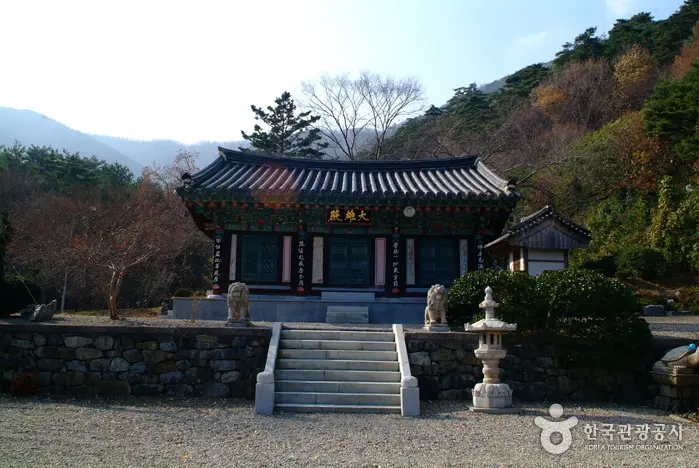
Nestled at the foot of Chilbosan Mountain (810 m above sea level), Yugeumsa is a temple founded by Master Jajang under royal order during the reign of Queen Seondeok of Silla. Until before the mid-Joseon period, it featured Daeungjeon Hall, a bell pavilion, and the Shrine for Lady Janghwa, accommodating dozens of monks. However, it is said that one day, the head monk was returning from a Buddhist service at Bulguksa Temple when he saw two dragons mating at the dragon pond in front of the temple and found it ominous. Before he could reach the temple, torrential rain poured down and a landslide destroyed the temple. It was subsequently rebuilt several times to reach its present state. As the oldest ancient temple in the region, its grounds house a three-story stone pagoda, Daeungjeon Hall, Hyangnojeon Hall, and Sansingak Shrine. MoreLess
- 2
Jangyuksa Temple
장육사
Jangyuksa is an ancient temple founded in 1355 by Master Naong during the reign of King Gongmin of the late Goryeo Dynasty, situated at the foot of Unseosan Mountain. Daeungjeon Hall is believed to be a building from the mid-Joseon period, featuring a gable-roof structure measuring 3 kan in the front and 3 kan on the side, with many interesting murals painted on its walls. The temple grounds also include Hongyeonam Hermitage, Sansingak Shrine, Heungwonnu Pavilion, and monks' living quarters (Yosachae). Jangyuksa also enshrines the Dry-lacquered Seated Bodhisattva (Early Joseon), designated as Treasure No. 1933. This dry-lacquered statue is a Buddha figure made by applying multiple layers of paper over a basic frame to shape the form and then coating it with gold paint. MoreLess
- 3
Hwasuru Pavilion
화수루
This is the place where Gwon Ja-sin, the maternal uncle of King Danjong of Joseon, suffered misfortune at the hands of King Sejo, and his son Gwon Chaek was exiled to spend the rest of his life. The exact year of its construction is not known. When King Danjong was reinstated during the reign of King Sukjong, Daebongseowon Confucian Academy was built; however, following the decree to abolish Confucian academies by Heungseon Daewongun during the reign of King Gojong, only Hwasuru Pavilion and Cheongganjeong Pavilion remained. Hwasuru Pavilion is an elevated wooden-floored building measuring 5 kan in the front and 2 kan on the side, with 1 kan on each side arranged as rooms and only the 3 central kan serving as an open wooden hall. It features a gable roof shaped like the Chinese character "人" on the sides. With its simple ornamentation, the building reveals the dignity of ancient architecture. Today, it is surrounded by private houses and cultivated fields, and there is an old grave on a low hill behind it, which is believed to be associated with this pavilion. MoreLess
- 4
Gwoesiri Traditional Village
괴시리 전통마을
Lined with around 30 historic houses that are over 200 years old, Gwoesiri Traditional Village is a single-clan village of the Yeongyang Nam clan, who have lived here for about 400 years. The village layout is said to resemble the Chinese character "八" (eight). In front of the village, the Yeonghae Plain stretches out broadly. In the past, it was called Hojigol because there was a lake called Hoji, and it is also known as Hoji Village. The current village name, Gwoesiri, originated in the 8th year of King Gongmin of Goryeo when a Chinese envoy named Rae Wang-si, who was close friends with Mogeun Yi Saek, visited the village and named it Gwoesiri because its landscape resembled Hojichon in Sugu Pungmyeon, Gwoesiri. Featuring historic houses rarely found even within the province, the Head House of the Gwoesi Branch of the Nam Clan and six other historic residences are designated and managed as cultural heritages. MoreLess
- 5
Yeonghae March 1st Movement Monument
영해 3.1의거탑
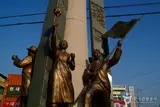
This monument was erected in 1983 to commemorate the noble spirit and souls of the patriotic ancestors who died while staging the independence movement on the Yeonghae market day of March 18, 1918, and to serve as an educational site for fostering the spirit of national salvation among future generations. To honor the spirit of the patriots and martyrs from Chuksan, Byeonggok, and Changsu-myeon centered around Yeonghae who risked their lives to resist Japanese colonial rule and shout for independence on the market day of March 18, 1919, a groundbreaking ceremony was held in March 1983, followed by an unveiling ceremony in November 1983. Every year on March 1, a March 1st Independence Movement Day event is held to honor the patriotic spirit of the various ancestors of Yeonghae-myeon, during which the independence movement situation of that time is reenacted throughout the streets of Yeonghae. MoreLess
Source: Korea Tourism Organization (TourAPI) · Machine-translated