Exploring the Mineral Spring Destinations of Bonghwa
4 stops · 1 day
Located in the northern part of Gyeongsangbuk-do, it borders Uljin-gun to the east, Yeongju-si to the west, Andong-si and Yeongyang-gun to the south, and Yeongwol-gun, Samcheok-si, and Taebaek-si in Gangwon-do to the north. We introduce a clear mineral spring course in Bonghwa, an auspicious land cradled like a nesting crane.
- Duration
- 1 day
- Distance
- 58.12km
Along the way
- 1
Historic Site Related to Gwon Chungjae in Yugok-ri, Naeseong
내성유곡권충재관계유적
This is the historic site of Chungjae Gwon Beol (1478–1548), a civil official during the reign of King Jungjong of the Joseon Dynasty. Originally from Andong, Gwon passed the lower civil service examination (jinsa) in the 2nd year of Prince Yeonsan's reign (1496) and passed the higher civil service examination (mungwa) in the 2nd year of King Jungjong's reign (1507), subsequently serving in various key governmental posts such as the Office of the Inspector General, the Royal Secretariat, and Ministers of various ministries. In the 1st year of King Injong's reign (1545), he served as the Right State Councilor (Uchansung) and Chief Magistrate of the State Tribunal (Paneuigeumbusa). During the Eulsa Purge (1545), he was exiled to Sakju by the Lesser Yun faction and died there. His false charges were cleared during the reign of King Seonjo, whereupon he was posthumously honored with the rank of Chief State Councilor (Yeonguijeong) and enshrined at Samgye Seowon Confucian Academy in Andong. MoreLess
- 2
Rock-carved Seated Buddha in Bukji-ri, Bonghwa
봉화 북지리 마애여래좌상
This stone Buddha is a rare, colossal rock-carved seated Buddha from the Silla period, originally created as the principal Buddha inside a niche (gamsil). Although there are cracks in several places on the stone surface today, the majesty of the Buddha is still well preserved. Because it was carved in very high relief, almost resembling a fully rounded freestanding statue, its dignity stands out even more. Its characteristics, along with the transformed Buddhas carved around the statue, vividly showcase the dignified and merciful Buddhist aesthetics of the mid-7th century. It was discovered in 1947 during site clearing work. Currently, to preserve and manage the Buddha statue, a newly built single-story wooden hanok protective pavilion with a gabled roof has been constructed and painted with dancheong patterns. MoreLess
- 3
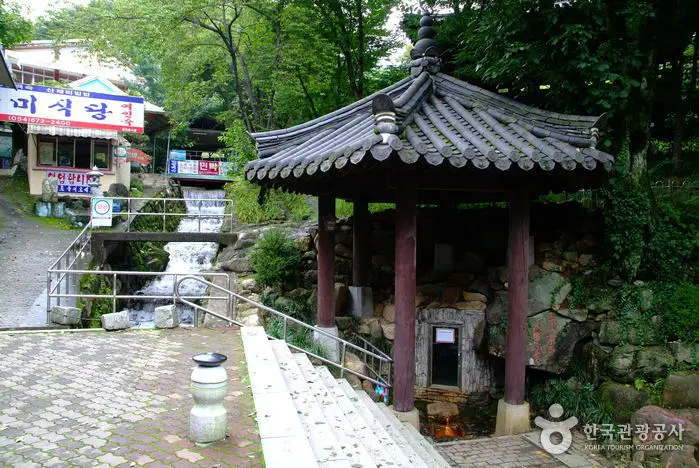
Ojeon Mineral Spring
오전약수탕
The village where Ojeon Mineral Spring is located was formerly called Aejeon (艾田), meaning 'mugwort field.' There are two theories regarding the origin of this name. One theory suggests that because this area is a confluence of waters where streams often overflowed to form a constant swamp, it was referred to as Sujeon (水田, water field); this was colloquially called Ssubaengi and later evolved into Ssukbat (mugwort field). Another theory holds that the spring water here was known to be efficacious for skin ailments, so leprosy patients drank the mineral water, washed their bodies, applied moxibustion using local mugwort, and drank boiled mugwort decoctions to cure their illness, which led to the area being called Ssukbat. MoreLess
- 4
Bonghwa Dalsil Village
봉화 달실마을
Dalsil Village is a clan village of the Andong Gwon clan. While Chungjae Gwon Beol is widely known as the village's founding ancestor, the person who actually settled in this village first was Gwon Beol's fifth-generation ancestor. Because the village prospered after Chungjae Gwon Beol, many came to recognize him as the founding patriarch. Even when viewed from the national highway in the distance, the prominent old houses readily suggest that it is a noble yangban clan village. Dalsil Village is home to the Head House of Chungjae, where five sets of ancient books and documents are designated as National Treasures/Treasures. These include Treasure No. 262 Geunsarok (Reflections on Things at Hand), Treasure No. 261 Chungjae Diary (7 volumes), Treasure No. 896 Books Bestowed by King Jungjong, Treasure No. 901 Household Register Documents, and Treasure No. 902 Calligraphy Albums and Writings, which are fitting treasures for the head house of a scholar who loved books. MoreLess
Source: Korea Tourism Organization (TourAPI) · Machine-translated