Jinju Festival Course
5 stops · 5 hours
This trip to Jinju offers a chance to savor Jinju's specialty, Yukhoe Bibimbap (beef tartare bibimbap), enjoy Jinju's signature festivals including the Bullfighting Festival and the Jinju Yudeung (Lantern) Festival, and experience crafting a silk phone charm in a traditional boudoir craft room. Timing your visit well will make for an enjoyable, hands-on tour of Jinju.
- Duration
- 5 hours
- Distance
- 30.44km
Along the way
- 1
Bullfighting Stadium
소싸움 경기장
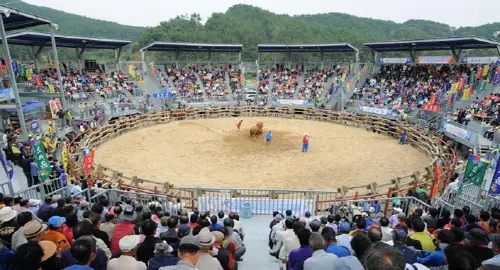
Jinju bullfighting has deep historical roots, with theories suggesting it originated from victory celebrations after Silla defeated Baekje during the Three Kingdoms period, and the original form of bullfighting has been well preserved and passed down. To establish its status as the birthplace of traditional bullfighting with a thousand-year history and to inherit and develop bullfighting as a traditional folk culture, Jinju City built the nation's first traditional bullfighting arena at Jinyangho Lake. It hosts annual national competitions (such as the Nongae Festival and Gaecheon Art Festival) as well as regular Saturday bullfighting matches from March to November, providing visitors to Jinju with a unique spectacle. MoreLess
- 2Jinyangho Lake Park
진양호공원
Formed where the Gyeonghogang and Deokcheongang rivers flowing down from Jirisan Mountain meet, this is the only artificial lake in western Gyeongsangnam-do and serves as a resting spot for tourists equipped with various recreational facilities. It houses the only zoo in Gyeongsangnam-do, making it the most popular spot for children as they can see wild animals such as tigers, lions, bears, eagles, and giraffes in person. MoreLess
- 3
Lunch (Jinju Tongdak)
점심식사(진주통닭)
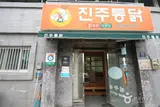
Located in a tourist rest area within Jinyangho Lake. The lush pine forest behind it serves as a refreshing retreat to ease body and mind tired from city life. It is uniquely notable for being run by the mother of Cho Kwang-rae, a prominent former South Korean soccer star. MoreLess
- 4Gangju Pond
강주연못
Gangju Pond is said to have originally been the site of the Gangju Military Camp (Gangjuyeonggi). According to the Jinyangji (Records of Jinyang), Ha Ryun (1347–1416) wrote in his Record of the Castle Gate of Chokseokseong Fortress: "In the autumn of the Gimi year (1379), Lord Bae (Bae Geuk-ryeom, 1355–1392), Jimiljiksa (Chief State Councilor), came as the Commander of Gangju and sent an official notice to the local magistrate to rebuild the earthen Chokseokseong into stone, but before the work was half finished, it was captured by Japanese invaders." This makes it clear that this place was the campsite where Bae Geuk-ryeom was stationed in the 5th year of King U of Goryeo (1379), and it is the original site that gave rise to today's stone-built Jinjuseong Fortress. MoreLess
- 5
Jinju Yudeung Festival
진주유등축제
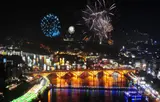
The floating lantern custom on the Namgang River in Jinju originates from the Battle of Jinjuseong Fortress during the Imjin War, one of the greatest national crises in Korean history. In October 1592, when General Kim Si-min (posthumously titled Chungmugong) achieved the great victory of the "Great Battle of Jinju" with a small force of only about 3,800 soldiers, defeating 20,000 invading Japanese troops and raising national pride, lanterns were sent into the sky as military signals to righteous armies outside the fortress, and floating lanterns along with torches were cast onto the Namgang River as a military tactic to deter the Japanese army from crossing. It also originated from soldiers and citizens inside the fortress using them as a means of communication to send greetings to families left far away. MoreLess
Source: Korea Tourism Organization (TourAPI) · Machine-translated