Stories of Life Discovered While Walking Through Chungju's Markets
6 stops · 1 day
Along the Chungjucheon Stream, which flows into the Namhangang River running through downtown Chungju, three traditional markets stand warmly shoulder-to-shoulder. Muhak Market, Jayu Market, and the Public Market are interconnected, making exploring the markets a true delight. In a corner of the market where people and life thrive, a blacksmith shop catches the eye—one of only a few remaining in the entire country. Watching Samhwa Blacksmith Shop, run by a blacksmith whose lifetime of heating and hammering iron has become his life story, is uniquely fascinating. [Source] From Top 30 Chungju Travel Highlights
- Duration
- 1 day
- Distance
- 67km
Along the way
- 1
Chungju Folk 5-Day Market (5th, 10th)
충주 민속5일장(5, 10일)
This is a regular traditional market held every 5 days in the area of Chungui-dong, Chungju-si, Chungcheongbuk-do. Recognized as one of the top five folk markets in the nation, it features a permanent market of about 600 shops on regular days, expanding to roughly 1,200 shops on folk 5-day market days, offering an abundance of diverse food and sights where nothing is missing. MoreLess
- 2
UN Secretary-General Ban Ki-moon Birthplace Village
반기문 유엔사무총장 생가마을
Haengchi Village, the birthplace of UN Secretary-General Ban Ki-moon, is embraced on both sides by Bodeoksan Mountain, offering a warm and inviting atmosphere. The village features his birthplace, a memorial hall, Peace Land, ancestral graves, an ancestral shrine, a stone world map (genealogy), a commemorative poem monument, and a pond. Originally a small three-room thatched-roof mud house, it was converted to a slate roof during the Saemaul Movement in the 1970s and demolished around March 2002. The birthplace was restored in 2010 based on historical photographic records. MoreLess
- 3
Lunch (Unjeong Sikdang)
점심식사(운정식당)
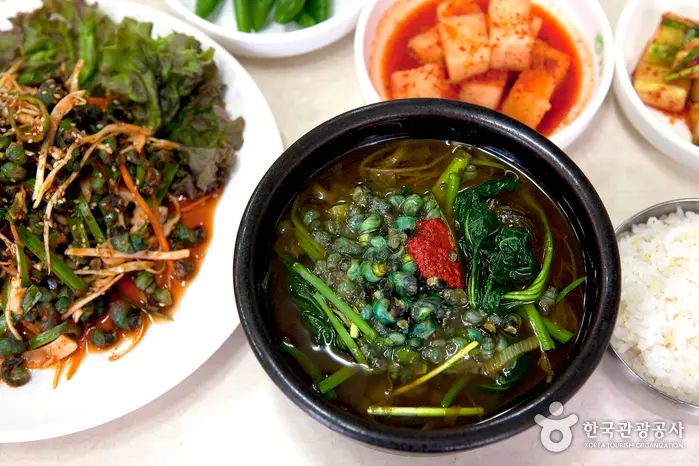
Olbaengi (marsh snails) have long been considered good for digestion and were enjoyed by ancestors of the past. Unjeong Sikdang serves a variety of dishes made with marsh snails, including olbaengi haejangguk (hangover soup) and spicy seasoned olbaengi, alongside yukgaejang (spicy beef soup) and doenjang-jjigae (soybean paste stew). MoreLess
- 4
Chungju Jayu Market
충주 자유시장
Chungju Jayu Market begins at the former Jungang Police Box, an area where the North Gate of Chungju Eupseong Walled Town once stood and was formerly called 'Bukmun-geori' (North Gate Street). Given that markets in the past were typically centered outside fortress gates, this area appears to have flourished as a market hub since the days of Chungju Eupseong. In March 1997, the Chungju Jayu Market Prosperity Association was formed. Along the main thoroughfare from the 1st Rotary across to the Jungwon Building, shops leverage roadside access to sell mainly clothing and jewelry, while the alleyway shops stretching from the former Jungang Police Box toward Chungil Pharmacy primarily deal in clothing, silk, and textiles. MoreLess
- 5
Jegeumdang Hall, Chungju
충주 제금당
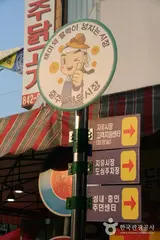
This is an early Joseon Dynasty government office building located within Gwanna Park in downtown Chungju. It was also used as a guest hall to welcome distinguished visitors. After burning down along with Cheongnyeongheon in the 7th year of King Gojong (1870), it was rebuilt by Jo Byeong-ro, then magistrate of Chungjumok. It was subsequently used as the office of the Jungwon-gun magistrate before being restored to its original form in 1983. The building measures 7 kan across the front and 3 kan along the sides, featuring a paljak (hipped-and-gabled) roof and an ikgong (bird-wing-shaped bracket) style. The central 2 kan comprise a wooden-floored hall (daecheong), while the right 2 kan and left 3 kan consist of ondol (underfloor heated) rooms and floored rooms. Nearby are the Chungju Fortress Construction Monument, Chungju Museum, and Chungju Cultural Center. MoreLess
- 6
Danhosa Temple (Chungju)
단호사(충주)
No matter the location or size of a temple, each possesses its own distinct charm. Chungju is home to a Seated Iron Buddha. While the total number of iron Buddhas across the Goryeo and Joseon periods is small enough to count on one's fingers, Chungju is remarkably rich in them. Serving as a major iron production center since the Three Kingdoms period, a central transportation hub of the inland midland region, and a home base for influential local clans, Chungju saw the creation of many captivating iron Buddhas with distinct, regionally expressive appearances. MoreLess
Source: Korea Tourism Organization (TourAPI) · Machine-translated