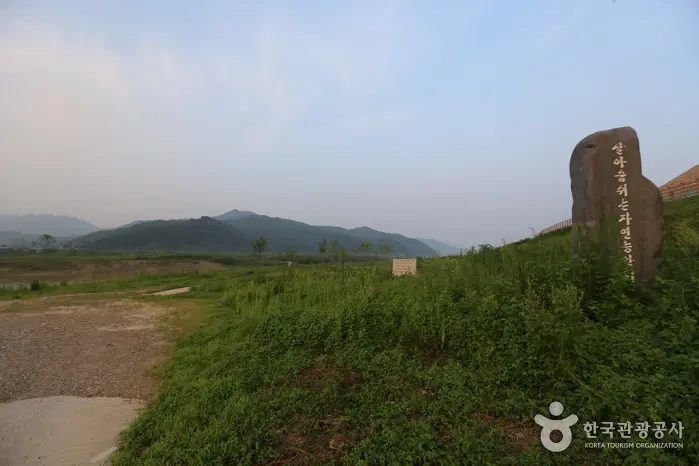
Time Flows with the River, Leaving Only Stories: Traces of Mokgyenaru Ferry
5 stops · 6 hours
A bustling ferry where dozens of boats came and went, and the lively voices of people gathered from across the country echoed over the river waters. Explore the traces of Mokgyenaru Ferry and spend an enjoyable time at the Folk Crafts Street. It will also be a meaningful journey to discover the historic Sinheungsa Temple and the Cheongnyongsaji Temple Site, nestled serenely at the foot of Jangbyeongsan Mountain. [Source: From 30 Selected Tours in Chungju]
- Duration
- 6 hours
- Distance
- 40.84km
Along the way
- 1
Bonghwanggyeong (Neungam-ri Island)
봉황경(능암리섬)
Abundant aquatic flora and fauna attract migratory birds, making Neungam-ri Island an ideal place for nature study and leisurely walks. Visitors can observe wild birds along the waterside trail, and enjoy panoramic views of reed beds, pine groves, and birds in flight from the observation deck. Centered around the riverside lawn plaza, the area features bicycle paths, embankment trails, and a youth campsite, as well as a Mokgyenaru Ferry recreation and experience zone, a waterside plaza, observation decks, and a wild flower garden. MoreLess
- 2
Chungju Folk Crafts Street
충주 민속공예거리
This street is situated along the old National Route 38 between Mokgye and Gamgok in Bonghwang-ri, Gageum-myeon, Chungju-si, Chungcheongbuk-do. Beginning in the late 1990s, antique dealers and artisans started gathering here one by one, eventually forming a folk crafts street stretching about 1 kilometer. Chungju Folk Crafts Street naturally developed into a hub for crafting and selling folk crafts and interior decoration items, where visitors can browse and purchase a wide variety of artworks across approximately 50 showrooms and shops. MoreLess
- 3
Lunch (Songpungjae)
점심식사(송풍재)
Songpungjae is a tofu specialty restaurant housed in a Hanok (traditional Korean house) building that exudes the beauty of Korean tradition right from the entrance. Lamps and window panes made of Hanji (traditional Korean paper) provide a cozy ambiance, enhancing the traditional charm. A spacious private parking lot outside makes it convenient to visit. As a soybean specialty restaurant, it serves tofu made in its own processing facility using locally farmed soybeans, allowing guests to dine with confidence. The duck dishes, offered as a special delicacy, also use only domestic duck. Takeout is available for all menu items. MoreLess
- 4
Sinheungsa Temple
신흥사
Sinheungsa Temple is located at the foot of Jangbyeongsan Mountain at San 3, Sinman-ri, Eomjeong-myeon, Chungju-si, Chungcheongbuk-do. It was founded in 1890 (the 27th year of King Gojong's reign during the Joseon Dynasty) by Oh Yeong-geun. In 1905, Lee Yeong-wol had a dream and excavated a golden bell and a cloud-shaped gong (unpan) from the temple grounds; he reported the golden bell to the government office and used the reward to rebuild the main hall in 1924, renaming the temple Sinheungsa. It was rebuilt again in 1952, and the Samseonggak Shrine and the bell pavilion were renovated in 1976, leading to its present form. It belonged to the Cheontae Order of Korean Buddhism until 1980 and the Beophwa Order from 1981, before changing its affiliation to the Haedong Order in 1998. MoreLess
- 5
Cheongnyongsaji Temple Site
청룡사지
It is said that King Taejo of Joseon had a large temple built here after National Preceptor Bogak, the royal teacher of King Taejo, went into seclusion at a small hermitage that stood halfway up Cheonggyesan Mountain in the late Goryeo Dynasty. Today, the temple lies in ruins, but the Stupa of National Preceptor Bogak (Jeonghye Wonyung Pagoda), a stone lantern, and the Stele of Jeonghye Wonyung Pagoda remain nearby. The Jeonghye Wonyung Pagoda enshrines the sarira of National Preceptor Bogak; upon his passing, King Taejo ordered the pagoda to be built, Gwon Geun composed the epitaph, and the pagoda was named Jeonghye Wonyung. It collapsed over time but was restored in 1968. The stone lantern was created to pray for the repose of National Preceptor Bogak's soul and features a square plan, typical of Joseon Dynasty stone lanterns. Because a lion is dynamically sculpted at the base, it is also referred to as the Lion Stone Lantern. MoreLess
Source: Korea Tourism Organization (TourAPI) · Machine-translated