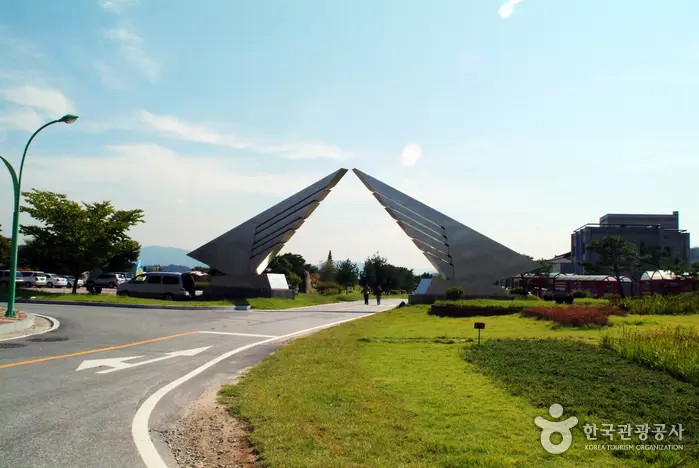
From a Battlefield of Jungwon to a Peaceful Jungwon: Jungangtap Historic Park and Chungju Museum
5 stops · 6 hours
This park is home to the Seven-story Stone Pagoda in Tappyeong-ri, Chungju, which was once a symbol of the Jungwon region. Transformed into a historic park in 1992, it embraces the Namhangang River and offers wonderful scenery. The fierce battlefields of Jungwon are now a distant memory, replaced by cozy relaxation at its center. [Source: 30 Best Travel Spots in Chungju]
- Duration
- 6 hours
- Distance
- 24.31km
Along the way
- 1
Jungangtap Park (Chungju)
중앙탑공원(충주)
The Seven-story Stone Pagoda in Tappyeong-ri, Jungwon (National Treasure No. 6), is commonly called Jungangtap (Central Pagoda) because it is located at the center of the country. Believed to have been built during the Unified Silla period (mid-9th century), it is the only 14.5-meter-high seven-story stone pagoda. Around Jungangtap is a sculpture park with an expansive lawn, making it the first outdoor sculpture park in North Chungcheong Province, showcasing 26 works by Korean sculptors under the theme 'The Meeting of Cultural Heritage and Lakeside Art.' MoreLess
- 2Chungju Museum
충주박물관
Located in the heart of the Jungwon cultural area, Chungju Museum opened in 1986 as a relic exhibition hall displaying relics donated by citizens and has since relocated near Jungangtap (National Treasure No. 6) in Gageum-myeon, Chungju-si, developing into a comprehensive museum. On November 25, 1986, the relic exhibition hall opened in Seongnae-dong. On June 29, 1991, council approval was obtained for the organization of Chungju Museum. On November 23, 1992, it was registered with the Ministry of Culture. When Gageum-myeon of Jungwon-gun was merged into Chungju-si on January 1, 1995, the Jungwon Local Folk Relics Exhibition Hall located in Gageum-myeon was renamed Chungju Museum. In August 1996, it was designated as a Cultural School by the Ministry of Culture and Sports. MoreLess
- 3
Lunch (Chungjudam Garden)
점심식사(충주댐가든)
Chungjudam Garden is a restaurant specializing in Korean beef and Korean cuisine, where you can taste a variety of dishes, including Korean table d'hôte and spicy fish stew (maeun-tang). MoreLess

- 4Chungju Ecology Experience Museum
충주자연생태체험관
Located near Chungju Dam, this natural ecology experience hall is a place where you can experience the preciousness of nature. It raises awareness of ecological conservation and serves as a connected educational and ecological experience space for children and youth in Chungju. There is a Natural Ecology Exhibition Hall where visitors can learn about the importance of nature and Chungju's local ecology, as well as an Aquatic Plants Exhibition Hall decorated with aquatic flora. Many people visit for various hands-on educational programs, and visitors also come to relax while enjoying the beautiful scenery of nearby Chungju Dam. MoreLess
- 5Chungju Tangeumdae and Tangeumdae Park
충주 탄금대와 탄금대공원
Tangeumdae is a hill originally called Daemunsan Mountain, offering scenic beauty with dense pine forests and the Namhangang River flowing gently around rugged cliffs. The name Tangeumdae originates from the fact that Ureuk, one of the three great music masters in Korean history during the reign of King Jinheung of Silla, played the gayageum (traditional zither) here. About 1,400 years ago during King Jinheung's reign, the musician Ureuk from the Gaya Kingdom was one of many Gaya people forcibly relocated here after their kingdom's fall. Ureuk resided on the cliff rocks of Tangeumdae, spending his days playing the gayageum while admiring the scenery. Captivated by the exquisite melodies, people gathered one by one to form a village, and they named the place Tangeumdae. MoreLess
Source: Korea Tourism Organization (TourAPI) · Machine-translated