Sujupalbong Mountain Course: Eight Peaks Reflected on the Dalcheon Stream
5 stops · 5 hours
One day, the king had a dream where he dipped his feet in the water reflecting eight peaks and strolled like an immortal being. That very place is the scenic wonder unfolding along the Dalcheon Stream, the lifeline of Chungju. Let's embark on a journey accompanied by the picturesque eight peaks of Chungju. [Source] Selected from Top 30 Chungju Travel Destinations
- Duration
- 5 hours
- Distance
- 27.69km
Along the way
- 1
Danhosa Temple (Chungju)
단호사(충주)
No matter the location or size, every temple has its own unique charm. The seated iron Buddha statue in Chungju is one such treasure. Iron Buddha statues from the Goryeo and Joseon dynasties are rare enough to be counted on one's fingers, but Chungju happens to be the region with an unusually high concentration of these iron Buddhas. MoreLess
- 2
Royal Stele at Chungryeolsa Shrine in Dalcheon
어제 달천 충렬사비
This stele was erected to commemorate the achievements of General Im Gyeong-eop, a renowned military commander of the Joseon dynasty. In 1633 (the 11th year of King Injo's reign), Im Gyeong-eop suppressed rebels in Ming China and defended Baengmasanseong Fortress from the Qing invasion during the Byeongja Horan (Manchu Invasion of 1636). The stele is currently located within the grounds of Im Chungmingong Chungryeolsa Shrine. The front of the stele is engraved with the title 'Royal Stele at Chungryeolsa Shrine in Dalcheon (御製達川忠烈祠碑).' The main text was calligraphed by Yi Byeong-mo, Minister of Rites and Jikjehak (Senior Grade 2), while the seal script was written by Yun Dong-seom, Minister of Personnel (Senior Grade 1), upon royal command. The epitaph was composed by King Jeongjo. During the reign of King Sukjong, Im Gyeong-eop was granted the posthumous title 'Chungmin,' and King Yeongjo named his shrine 'Chungryeol.' Later, during the reign of King Jeongjo, a commemorative gate and stele honoring General Im were erected. Nearby attractions include Danwol River Bathing Area, Daelimsanseong Fortress, and Sujupalbong Mountain. MoreLess
- 3
Lunch (Unjeong Sikdang)
점심식사(운정식당)
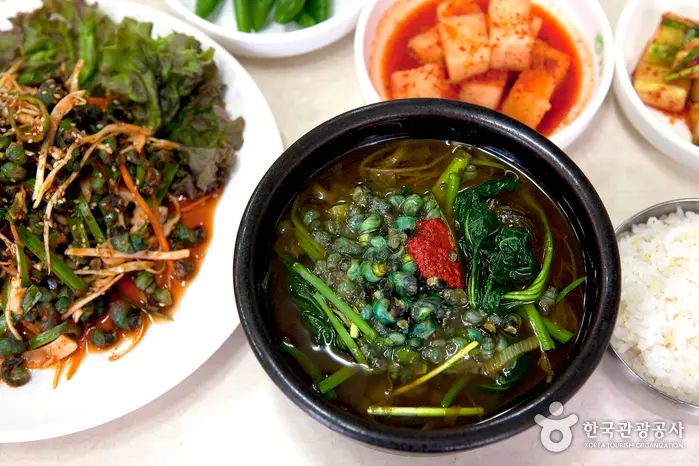
Olbaengi (marsh snails) have long been considered beneficial for the stomach and were enjoyed by ancient ancestors. Unjeong Sikdang serves a variety of dishes made with marsh snails, such as olbaengi haejangguk (hangover soup) and spicy olbaengi muchim (seasoned snail salad), as well as yukgaejang (spicy beef soup) and doenjang jjigae (soybean paste stew). MoreLess
- 4
Sujupalbong Mountain
수주팔봉
With an altitude of 493 meters, Sujupalbong Mountain is located in Hyangsan-ri, Salmi-myeon, Chungju-si, Chungcheongbuk-do. Although not very high, its sharp, craggy rocks give it a majestic and commanding presence. The name Sujupalbong Mountain was given because, when looking east across the Dalcheon Stream from Palbong Village in Munju-ri, eight peaks seem to float above the waters of the Dalcheon Stream from the summit down to the riverbank. MoreLess
- 5
Mungang Sulfur Hot Springs
문강유황온천
Located in the center of Woraksan Mountain, Joryeongsan Mountain, and Sujupalbong Mountain, Mungang Sulfur Hot Springs boasts the nation's finest sulfur spring water, renowned for its exceptional quality. Sulfur hot springs are known to possess various healing properties, often said to benefit all kinds of ailments. Currently, facilities such as the Mungang Sulfur Hot Spring Hotel and Item Pool Mungang Training Institute are established within the Mungang Hot Springs Zone. In addition, Suanbo Hot Springs is located nearby, offering visitors the opportunity to enjoy two hot springs with distinctly different water qualities.MoreLess
Source: Korea Tourism Organization (TourAPI) · Machine-translated