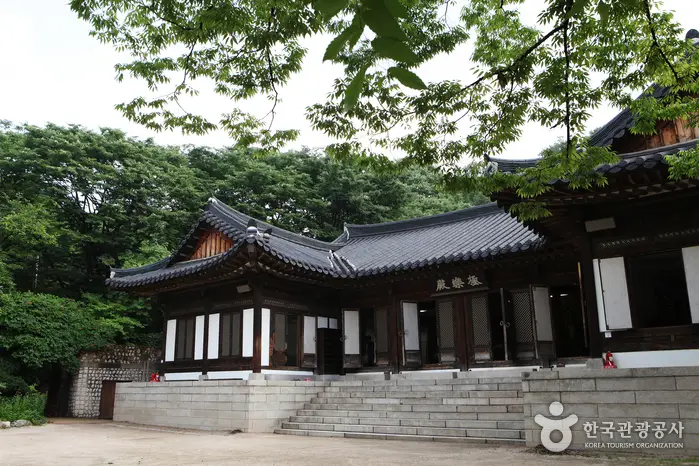
The Story of Seongbuk-dong Village and Cultural Heritage
4 stops · 5 hours
The Seongbuk-dong Heritage Course leads from Gilsangsa Temple to Jeongneung Royal Tomb amidst pure, fragrant, and tranquil scenery. Walk along this path to discover lesser-known historical sites and traces within the capital of Seoul, immersing yourself in the rich cultural and historical legacy of the era. Source: Walking along Hanyangdoseong with Stories.
- Duration
- 5 hours
- Distance
- 6.45km
Along the way
- 1
Gilsangsa Temple (Seoul)
길상사(서울)
Located halfway up Seongbuk-dong in Seoul, Gilsangsa Temple was established on the former site of Daewongak, a prominent restaurant. It opened in 1997 after the owner of Daewongak donated the land and buildings. Although its history is relatively short, its convenient location in central Seoul makes it easily accessible for both domestic and international visitors. It also serves as an urban cultural space offering various programs such as temple stays, Buddhist practice programs, and retreats. Within the grounds are the Gilsang Seonwon and the House of Silence, spaces dedicated to meditation and spiritual practice. Gilsang Seonwon is a permanent Zen meditation hall for the public accessible to registered practitioners, while the House of Silence is open to anyone for personal meditation, quiet reflection, or music meditation. MoreLess
- 2
Seongnakwon Garden
성락원
Designated as Historic Site No. 378 and located around 1 Seongbuk-dong, Seongnakwon was originally the villa of Shim Sam-eung, Minister of Personnel during the reign of King Cheoljong of Joseon. It was later used as a secondary palace by Prince Imperial Ui (Yi Kang) and was subsequently inhabited by his eldest son, Yi Geon. The property later passed to a person named Park Yong-ha, but in April 1950, Shim Sang-jun, a descendant of the Shim clan, repurchased it. He did so to honor his mother's wish to "carry on the spirit of our ancestors," given the villa's historical connection to their ancestor Shim Sam-eung. MoreLess
- 3Choi Sunu House
최순우 옛집
The Choi Sunu House is where master Hyegok Choi Sunu (1916–1984) lived from 1976 until his passing. It is registered as Registered Cultural Heritage No. 268. His birth name was Hui-sun, and he was born in Gaeseong. As an art historian and museum specialist, he made numerous achievements by dedicating himself to rediscovering the beauty of Korea in the fields of Korean ceramics, traditional woodworking, and painting history. Inspired by his meeting with master Woohyeon Ko Yu-seop, he joined the Gaeseong Municipal Museum in 1943. He served as the 4th Director of the National Museum of Korea from 1974 to 1984, greatly contributing to the development of Korean museums. He also made significant contributions to promoting Korean culture and art abroad by organizing special international traveling exhibitions. MoreLess
- 4
Jeongneung Royal Tomb, Seoul [UNESCO World Heritage]
서울 정릉 [유네스코 세계문화유산]
Jeongneung is the tomb of Queen Sindeok of the Kang clan, the second wife of King Taejo Yi Seong-gye, the founder of Joseon. In accordance with Goryeo customs, King Taejo had one wife in his hometown and another in the capital; Queen Sindeok was his wife in the capital. His first wife, Lady Han, passed away before Taejo's accession to the throne, and it was Queen Sindeok who was crowned queen upon his enthronement, bearing him two sons, Bang-beon and Bang-seok. After both of her sons were killed by Yi Bang-won during the First Strife of Princes, King Taejo lost interest in state affairs and, while staying in the Taesangdang, frequently visited Jeongneung to devote himself to Buddhist prayers. MoreLess
Source: Korea Tourism Organization (TourAPI) · Machine-translated