Stories of Artists, Historic Houses, and the Seongbuk-dong Village
4 stops · 5 hours
Here are the villages, the houses, and the artists who once lived in them. Bukjeong Village preserves the look and feel of Seoul in the 1970s and 1980s. This tour offers a chance to explore historic residences in Seongbuk-dong, including Simujang, the house of Manhae Han Yong-un—one of the 33 national representatives of the March 1st Movement—as well as Suyeonsanbang of Sangheo Lee Tae-jun and the villa of Lee Jong-seok. Take a leisurely stroll through Seongbuk-dong, where the artistic spirit of writers and painters lingers. Source: Walking along the Hanyang City Wall following stories.
- Duration
- 5 hours
- Distance
- 5.3km
Along the way
- 1
Simujang House of Manhae Han Yong-un
만해한용운심우장
This house is where poet Manhae Han Yong-un, one of the 33 national representatives of the March 1st Movement and poet of , lived from 1933 to 1944. Entering through the east-facing main gate, you will find Simujang, a north-facing tile-roofed house, along with a Western-style caretaker's house and a juniper tree said to have been planted by Han Yong-un himself. Simujang is a small house consisting of only five kan, with an ondol (underfloor heating) room on the left and a kitchen on the right centered around the middle symmetry. Behind the kitchen lies the cheonmarubang, a space used for preparing meals. MoreLess
- 2
Sukjeongmun Gate on Bugaksan Mountain, Seoul City Wall
서울성곽 북악산 숙정문
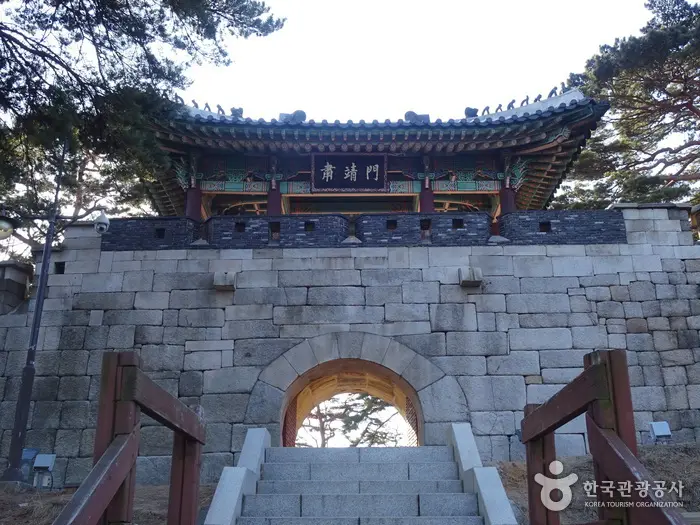
Sukjeongmun Gate is located at the eastern foot of Bukhansan Mountain. As the North Great Gate of the Seoul City Wall, its name carries the meaning of "governing solemnly." Completed in the 5th year of King Taejo's reign (1396), it was originally located slightly west of its current position, but was reportedly moved when the fortress wall was repaired in the 10th year of King Yeonsangun's reign (1504). Sukjeongmun was not originally built for pedestrian passage, but rather to complete the formality of having four main gates facing the cardinal directions around the Seoul City Wall, and it was kept closed for emergency use during normal times; thus, no major road passes through it. In 1976, during the restoration of the fortress wall in the Bugaksan Mountain area, the gate pavilion was constructed and the signboard reading 'Sukjeongmun' was hung. MoreLess
- 3
Gilsangsa Temple (Seoul)
길상사(서울)
Located on the slopes of Seongbuk-dong, Seoul, Gilsangsa Temple was established on the former site of Daewongak, opening in 1997 after the land and buildings were donated by Daewongak's owner. Although its history is relatively short, its downtown Seoul location makes it easily accessible to both domestic and foreign visitors. It also serves as an urban cultural space by offering programs such as temple stays, Buddhist practice programs, and retreats. Gilsangsa Temple features the 'Gilsang Seonwon' and the 'House of Silence' as practice spaces for the public. Gilsang Seonwon is a permanent Zen meditation hall for the general public accessible only to those with approved registration, while the House of Silence is open to anyone for personal practice, including meditation and music-guided contemplation. MoreLess
- 4Historic House of Sangheo Lee Tae-jun (Suyeonsanbang)
상허 이태준 가옥(수연산방)
This house is where author Sangheo Lee Tae-jun lived from 1933 to 1946 and penned many literary works. Lee named the house 'Suyeonsanbang' and devoted himself to writing literary works such as , , , , and . His essays describe the process of building this house and the history of the site. Centered on the daecheong (central wooden hall) at the center of the building, the house features an across-the-hall room on the left and an inner master bedroom on the right, forming a T-shape that is both cozy and refined. MoreLess
Source: Korea Tourism Organization (TourAPI) · Machine-translated