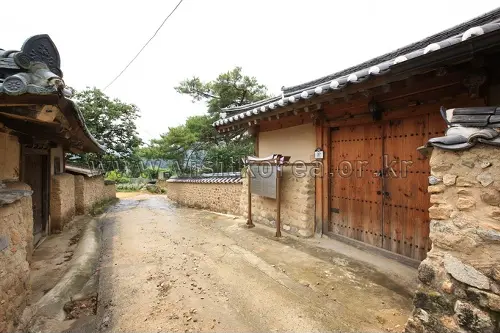
A Historical Journey Harmonized with Seongju's Nature
4 stops · 1 day
Centered around Gayasan Mountain, this quiet and tranquil town of Seongju forms a basin surrounded by gentle hills. Much like Goryeong, this region once flourished with Gaya culture and is home to numerous ancient Gaya burial mounds. Above all, stepping into the well-preserved hanok clan community of Hangae Village makes visitors feel as though they have traveled back in time. Do not miss the chance to admire the wildflowers of Gayasan Mountain as well.
- Duration
- 1 day
- Distance
- 66.29km
Along the way
- 1
Seongju Hangae Village
성주 한개마을
Seongju Hangae Village is a typical single-clan village where the Seongsan Yi clan has lived for generations. Yi U, who served as the Magistrate of Jinju during the reign of King Sejong of the Joseon Dynasty, first settled here and founded the village. Today, descendants of Wolbong Yi Jeong-hyeon continue to live in this clan community, and the village is preserved as a traditional hanok village. MoreLess
- 2
Ancient Tombs in Seongsan-dong, Seongju
성주 성산동 고분군
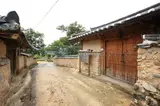
The Ancient Tombs in Seongsan-dong are Gaya-period burial mounds located on Seongsan Mountain to the southeast of Seongju-eup, recognized as the cemetery of the ruling class of Seongsan Gaya based in the Seongju area. The tombs are densely clustered along the ridge of Seongsan Mountain, comprising both large and small mounds. Most of them are circular, and to date, 129 tombs have been identified and are undergoing preservation and restoration. MoreLess
- 3
Placenta Chambers of King Sejong's Sons, Seongju
성주 세종대왕자 태실
Placenta Chambers of King Sejong's Sons of the Joseon Dynasty *These are the placenta chambers (taesil) of the sons of King Sejong of the Joseon Dynasty, consisting of 11 chambers in the front row and 8 in the back row. A placenta chamber stele stands before each prince's chamber, most of which are presumed to have been erected between the 20th year (1438) and the 24th year of King Sejong's reign. Many of these steles are weathered and difficult to read, but notable legible examples include those of Grand Prince Pyeongwon, Grand Prince Yeongeung, and Prince Uichang. In December 1977, during renovation and maintenance work, artifacts including earthenware, placenta jars, Buncheong stamped-pattern bowls, a set of Buncheong inlaid lotus-pattern lids, and two inscribed epitaph tablets were excavated from the presumed sites of the chambers of Grand Prince Geumseong, Prince Hwa-ui, and King Danjong. These are currently preserved at Daegu National Museum, Gyeongju National Museum, and Kyungpook National University Museum. Nearby is Seonseoksa Temple, which served as the guardian temple for these placenta chambers. MoreLess
- 4Gayasan Wildflower Botanical Garden
가야산 야생화식물원
Opened on June 16, 2006, this is Korea's first botanical garden specializing in wildflowers. Planted with around 400 species of trees and wildflowers, it is a cultural wildflower venue established to conserve wildflower resources and contribute to natural learning and academic research. The botanical garden features a comprehensive exhibition hall and a glass greenhouse with one ground floor and one basement level. It houses 92 species of trees including pine trees, 54 species of shrubs including royal azaleas, and 257 species of wildflowers including Korean pasqueflowers. In addition, it features diverse attractions such as 'The Twelve Months of Seongju' and 'Twelve-Month Plant Stories,' offering rich information and a space to relax. MoreLess
Source: Korea Tourism Organization (TourAPI) · Machine-translated